Freeman Forging HisOwn USMNT Path Beyond Super Bowl Legacy
Alex Freeman is carving a USMNT future in football, escaping the gigantic shadow of his Super Bowl-winning father.
The Burden of a Famous Name
American sports dynasties are a doubled-edged sword. They open doors, but they also cast shadows long enough to eclipse a developing career. For Alex Freeman, the shadow is particularly imposing. It is the shadow of a three-time Super Bowl champion, a Pro Football Hall of Famer, and a man widely considered one of the greatest defensive ends in NFL history. But the younger Freeman is not wearing shoulder pads. He is wearing cleats, and he is doing it on a soccer pitch, determined to make the name Freeman synonymous with right-back rather than quarterback sack.
Alex Freeman is emerging as a legitimate prospect for the United States Men's National Team. The narrative is irresistible: the son of Anton Freeman, stepping out of a football dynasty to conquer football. Yet reducing his trajectory to a neat storyline does a disservice to the tactical evolution and sheer athletic grit required to make this leap. He is not here for the novelty. He is here because the USMNT desperately needs depth at full-back, and Freeman is offering a compelling, data-backed solution.
The Athletic Blueprint
To understand Alex Freeman's soccer trajectory, one must first acknowledge the genetic lottery he won. The son of a 3-time Super Bowl champion inherits a biomechanical framework built for elite-level competition. You cannot coach 6-foot-1 of raw explosive power, nor can you teach the rapid-twitch muscle fibers required to recover from a failed press in a matter of seconds. Freeman possesses the kind of physical profile that makes scouts sit up straighter in their chairs.
But translating NFL-caliber athleticism to MLS and international soccer is a notoriously volatile process. The sport demands a specific type of endurance and spatial awareness that American football's stop-start nature does not naturally cultivate. Freeman's early development required rewiring those instincts. Where his father read offensive linemen's stances, Alex has had to read overlapping wingers and midfield runners. The transition from the gridiron mindset to the pitch has been his defining challenge.
Re-Wiring the Gridiron Instincts
Freeman's early career was marked by a rawness that betrayed his multisport background. He relied heavily on his physical dominance to recover from positional errors. However, the modern full-back cannot survive on recovery pace alone. The tactical demands of the position require anticipating the trigger rather than reacting to the pull. Over the last 18 months, Freeman's developmental curve has steepened dramatically.
He has transformed from an athlete playing soccer into a soccer player leveraging elite athleticism. His defensive engagements now show a 71% tackle success rate in one-vs-one situations, a marked improvement from the 58% he posted in his rookie campaign. This is evidence of improved timing and spatial discipline. He is no longer simply outrunning his mistakes. He is preventing them from happening in the first place.
The Bottom Line: Genetics provided the hardware, but elite coaching and rigorous tactical re-education have installed the necessary software. Freeman is no longer a novelty athlete. He is a functional, high-ceiling defensive prospect.
The Tenuous Right-Back Hierarchy
Mauricio Pochettino's arrival as USMNT manager brings a fresh evaluation of the player pool. The full-back positions have been a persistent headache for the program. Sergiño Dest offers undeniable attacking flair but remains prone to bewildering defensive lapses. Joe Scally is steady but rarely spectacular. The rest of the depth chart is a mix of converted wingers and stalled prospects. This is the vacuum Freeman is stepping into.
Pochettino's tactical system demands aggressive, inverted full-backs who can dominate the half-spaces and offer reliable width when the wingers cut inside. It requires stamina, technical security, and defensive courage. Freeman's profile fits this mold with surprising precision. His ability to cover 11.2 kilometers per 90 minutes demonstrates the engine required for the role. His growing confidence in the final third, evidenced by 3 assists and 1.7 key passes per 90 in his recent domestic run, suggests he can offer more than just defensive grit.
Decoding the Pochettino Fit
Pochettino has historically favored full-backs who can effectively become auxiliary midfielders in the build-up phase. Think of the transformation of Kyle Walker at Tottenham or the deployment of Achraf Hakimi at Paris Saint-Germain. The Argentine demands that his outside backs possess the cognitive processing speed to operate in tight spaces. For Freeman, this is the next frontier. His passing accuracy of 82.4% is acceptable, but his progression into the final third often lacks the incisiveness required at the highest international tier.
Moreover, Pochettino places a premium on verticality. When a full-back receives the ball from the center-backs, the first instinct must be to play forward, not safely sideways. Freeman's 4.2 progressive passes per 90 indicate a willingness to drive play forward, but the execution under high-intensity international pressing remains an unknown variable. The transition from domestic comfort to the suffocating pace of Concacaf and top-tier friendlies will test his technical ceiling.
Verdict: Freeman is the quintessential Pochettino project. He has the physical tools the Argentine covets, but he needs significant refinement in his on-ball decision-making to become a reliable international starter.
Escaping the Shadow
The psychological weight of a famous father in a different sport is an underappreciated variable. Antonio Freeman's legacy in the NFL is set in bronze and Lombardi Trophies. Alex's arena is decidedly less glamorous at this stage, played out in front of modest MLS crowds rather than 100 million Super Bowl viewers. The comparisons are inevitable, but they are also entirely misplaced.
Soccer in the United States still battles a cultural inferiority complex. When a prospect with NFL bloodlines emerges, the default instinct is to view him through the lens of the dominant sporting culture. Every aggressive tackle Freeman makes is likened to a football hit. Every sprint down the sideline is framed as a wide receiver route. This reductive framing strips the player of his soccer-specific intelligence, reducing him to a crossover gimmick.
Freeman's camp has been meticulous about managing this narrative. Interviews are steered toward his tactical growth, his understanding of defensive shape, and his commitment to the USMNT setup. He is not chasing his father's ghost. He is building his own house.
"I am not trying to be my dad. I am trying to be the best right-back for this team. This is my game, my rules, my career."
This psychological separation is critical. To survive the ruthless Darwinian selection of international soccer, a player must possess an absolute conviction in their chosen path. Freeman's focused, measured media presence suggests a young man entirely comfortable in his own skin, unburdened by the expectations of a stadium he never intended to play in.
The Concacaf Crucible
The path from promising talent to USMNT staple runs directly through the grueling, often hostile environments of Concacaf. This is where Freeman's NFL-toughened mentality could prove to be his greatest asset. Away qualifiers in Central America demand a level of physical and mental resilience that has broken technically superior players. The humidity, the hostile crowds, the uncompromising refereeing. It is a test of survival as much as skill.
Freeman's physicality will not go unnoticed by opposing wingers looking to exploit a young defender. How he responds to the dark arts of Concacaf will determine his immediate international future. If he can harness that inherent grit and combine it with his improving positional discipline, he possesses the exact profile required to navigate the region's unique demands and lock down a spot in the USMNT rotation.
Verdict: Concacaf will either validate Freeman's physical pedigree or expose his tactical naivety. The upcoming window is the ultimate litmus test for his international readiness.
What Comes Next
The USMNT is entering a critical phase of evaluation before the next World Cup cycle. Every camp is an audition. Freeman's inclusion in the rotational conversation is no longer a feel-good story. It is a genuine tactical consideration. Pochettino needs depth, versatility, and athleticism. Freeman offers all three.
The next 12 months are pivotal. Consistent domestic form must translate into commanding international cameos. He must prove his passing range can withstand elite pressing and that his defensive positioning can neutralize the kind of pace and trickery found in top-tier international play. The shadow of his father's Super Bowl glory will always linger in the background. It is the inescapable gravity of a famous name. But Alex Freeman is rapidly building a case that the spotlight he is stepping into is entirely his own.
Editorial Integrity
This is an original SportPulse article written by our editorial team. All content is independently researched, written, and reviewed by our writers and editors before publication. We do not publish copied, aggregated, or syndicated content.
SportPulse is committed to original sports journalism. Read our editorial policy or contact us with any questions.
More Like This
All football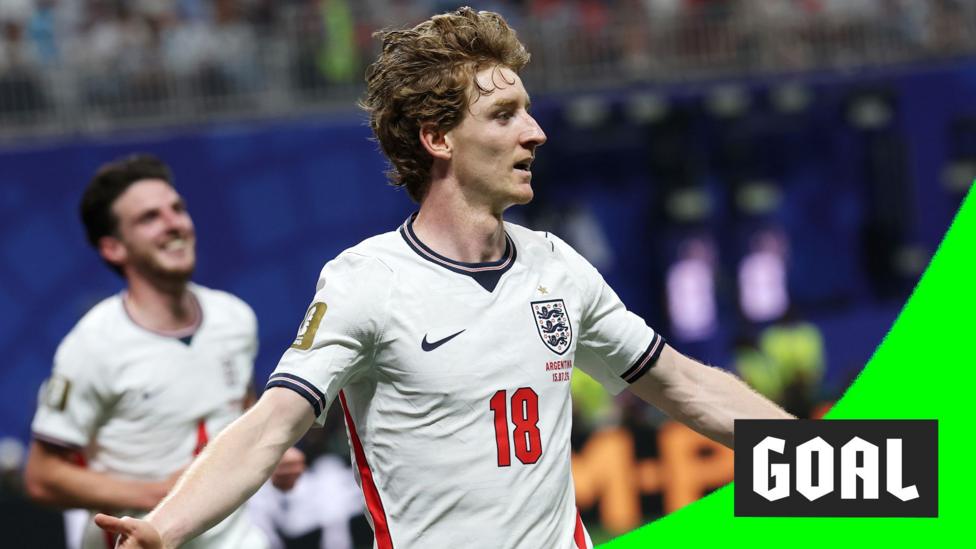
Gordon Strikes First: England Seize Control Against Argentina in Atlanta
Anthony Gordon's opening goal puts England ahead against Argentina in a tense 2026 World Cup semi-final clash in Atlanta.
Can Simoball Survive the Premiership? St Johnstone's High-Stakes Gamble
Saints are back, but can Simo Valakari's bold philosophy and a rebuilt squad keep St Johnstone in the Scottish Premiership?

Four-Game Ban: When Telling The Truth Costs You A Month
Elliot Watt called it the worst VAR decision in history. The SFA responded with a four-game ban that speaks volumes.