Carrick's Midfield Revolution: Why Santos Solves United's Balance Problem
Andrey Santos arrives from Chelsea as Carrick's first signing, offering a youthful press-resistant profile to reshape a drained midfield.
The structural decay of Manchester United's midfield has been a running theme for over a decade, but Michael Carrick's first signing as manager suggests a genuine philosophical pivot. Andrey Santos arriving from Chelsea for £48m is not merely a transfer; it is a statement about how United intend to play under their new manager. Carrick, a former No. 6 himself, understands that modern football is won and lost in the spaces between the lines, and Santos offers a profile that addresses the deepest tactical fractures in this squad.
The Void Left by Casemiro and Ugarte
Casemiro's departure and Manuel Ugarte's long-term injury have stripped United of their entire defensive midfield depth. The Brazilian's aggressive, duels-first approach had become increasingly incompatible with a side attempting to implement a possession-based build-up structure. Teams had learned to bypass United's first line of pressure and exploit the vast vertical gaps that emerged whenever Casemiro stepped forward to engage. Without the ball, the 4-2-3-1 shape frequently distorted into a defensive 6-2 block that was alarmingly easy to play around.
Santos represents something entirely different. His time at Chelsea, often limited to substitute appearances, masked his underlying technical security and spatial awareness. The 20-year-old profiles as a modern single pivot, capable of receiving under pressure and circulating possession with a press-resistant composure that United have lacked since the peak years of Michael Carrick's own playing career.
Tactical Profile of Santos
What makes Santos a fascinating acquisition is his hybrid profile. He is neither a pure ball-winner nor a deep-lying distributor. Instead, he operates as a box-to-box controller who gravitates toward the left half-space to form triangular combinations with the interior midfielders. At a base 4-3-3 or a more conservative 4-2-3-1, Santos can function as the deeper of two controllers, screening the centre-backs while maintaining the passing range to unlock a compact defensive block.
His positional discipline off the ball suggests he can anchor a mid-block without collapsing into the penalty area. This is critical for a United side that conceded 1.4 goals per game last season in transitions. Santos reads pressing triggers efficiently, positioning himself to cut off the central passing lane between the opponent's No. 6 and their No. 10.
- Press success rate: Santos ranked in the 84th percentile among Premier League midfielders for successful pressures in the middle third.
- Retention under pressure: His pass completion of 87.3% when pressured by two or more opponents highlights the technical security Carrick demands.
- Aerial duels won: At 1.79m, he is not an imposing physical presence, but his timing in aerial challenges yielded a 63% win rate in limited appearances.
The Tactical Shift: From Reforestation to Constructive Control
The Phase One Problem
For years, United have been a team defined by reactive football, relying on moments of individual brilliance rather than systematic ball circulation. The tactical turning point of this window is not just acquiring Santos, but pairing him with Youri Tielemans, who arrives for £35m after a distinguished Premier League career spanning 244 appearances.
Tielemans, the Belgium captain, addresses the Phase One problem that plagued United last season. When opponents deployed a high pressing structure, United's centre-backs frequently resorted to long balls, bypassing the midfield entirely and surrendering possession cheaply. Tielemans' ability to receive between the lines and play first-time vertical passes transforms United's build-up from a liability into a weapon.
The combination of Santos' defensive positioning and Tielemans' progressive passing suggests Carrick will implement a 4-3-3 with clear hierarchical roles: Santos as the anchor, one advanced No. 8 providing forward runs, and a wide attacking trident that can interchange fluidly.
A Curious Precedent: Signing from Rivals
The broader context of this transfer cannot be ignored. Since Sir Alex Ferguson retired 13 years ago, United have signed only four players from their big six rivals: Juan Mata, Nemanja Matic, Mason Mount, all from Chelsea, and Alexis Sánchez from Arsenal.Signed players from direct rivals carry inherent risk, both psychological and sporting.
Santos was often a backup at Chelsea last season, a club that finished seven places and 19 points behind United. The narrative is convenient: why pay £48m for a player deemed surplus to requirements at a weaker rival?
The answer lies in tactical fit. Chelsea's chaotic recruitment and relentless midfield churn meant Santos never had a stable positional role. He was deployed variously as a No. 6, a left No. 8, and occasionally as a dynamic No. 10. Under a coach with Carrick's specific positional vision, Santos' tactical intelligence can flourish in a defined role.
"We are building a team around principles, not just profiles. Andrey understands space, time, and decision-making in the central zones better than most players his age. That is why he is here."
This approach mirrors how elite continental clubs operate. Real Madrid did not hesitate to sign Casemiro from São Paulo; Manchester City acquired Rodri from Atlético Madrid. Talent is not defined by the badge on the shirt, but by the tactical intelligence to execute a specific role.
The Broader Midfield Reconstruction
What It Means for United's Shape
Carrick inherits a squad that was structurally broken under previous regimes. The midfield lacked compactness, the pressing structure was reactive rather than proactive, and the vertical spacing between the defensive and attacking units was frequently too large. Santos and Tielemans together address these fractures.
With Santos shielding the backline, United's full-backs can adopt higher starting positions, stretching the pitch horizontally and creating wider passing lanes for the interior midfielders. Tielemans, operating as a deep-lying playmaker or a left-sided No. 8, can exploit these lanes with his exceptional range of passing. This effectively transforms United from a team that reacts to the opponent's structure into one that imposes its own.
The numerical balance is significant. A mid-block with Santos at its base allows United to maintain compact vertical spacing of approximately 25-30 metres between the defensive and midfield lines, compared to the 40+ metre gaps that characterised their defensive shape last season. This compactness forces opponents to play wide, where United can use the touchline as an extra defender and trigger coordinated traps.
The Numbers Behind the Decision
Santos' statistical profile, when adjusted for minutes played, reveals a player whose underlying metrics outperform his reputation.
- Progressive carries per 90: 3.1, ranking in the 78th percentile among all Premier League midfielders last season.
- Interceptions per 90: 2.4, placing him in the 81st percentile and highlighting his anticipation without the ball.
- Passes into the final third per 90: 4.7, a figure that dwarfs Casemiro's 2.1 from the previous campaign.
- Turnovers leading to shots: Santos contributed to 0.8 shot-ending sequences per 90, demonstrating his capacity to initiate dangerous transitions.
These metrics paint a picture of a player who, given consistent minutes and a defined tactical role, can elevate a midfield from dysfunctional to dominant. His ability to progress the ball through carries addresses United's historic struggle against teams that defend in a deep block, where patient ball circulation and positional rotation are essential.
What Comes Next
United's next fixture will provide the first glimpse of how Carrick intends to deploy his new midfield axis. The tactical question is whether Santos operates as a lone pivot in a 4-3-3 or partners Tielemans in a double pivot within a 4-2-3-1. The former offers greater attacking fluidity but demands exceptional positional discipline from the wide forwards to maintain defensive balance. The latter provides defensive stability but may Sacrifice creativity in the final third.
The longer-term project is more compelling. Carrick's philosophy, shaped by his time under Sir Alex Ferguson and refined through his coaching education, emphasises controlled possession, sustained pressure, and vertical attacking patterns. Santos and Tielemans are the foundational pieces of this vision.
For too long, United have been a team of fragments, assembling talented individuals without a coherent tactical system. The signing of Andrey Santos for £48m is not about instant gratification or marquee appeal. It is about building a midfield structure that can sustain a title challenge over 38 games. The tactical arc of this transfer window reveals a club finally thinking architecturally rather than reactively. The real test begins in August.
Editorial Integrity
This is an original SportPulse article written by our editorial team. All content is independently researched, written, and reviewed by our writers and editors before publication. We do not publish copied, aggregated, or syndicated content.
SportPulse is committed to original sports journalism. Read our editorial policy or contact us with any questions.
More Like This
All football
The Open's Schedule Shuffle: Golf Braces for England's World Cup Run
R&A chief Mark Darbon promises subtle timing tweaks within 48 hours to dodge a World Cup final clash if England reach the summit.

The Beautiful Chaos: Mapping Realistic Paths to 2026 World Cup Glory
With 48 teams, a new knockout format, and three host nations, the 2026 World Cup promises the most unpredictable tournament ever staged.
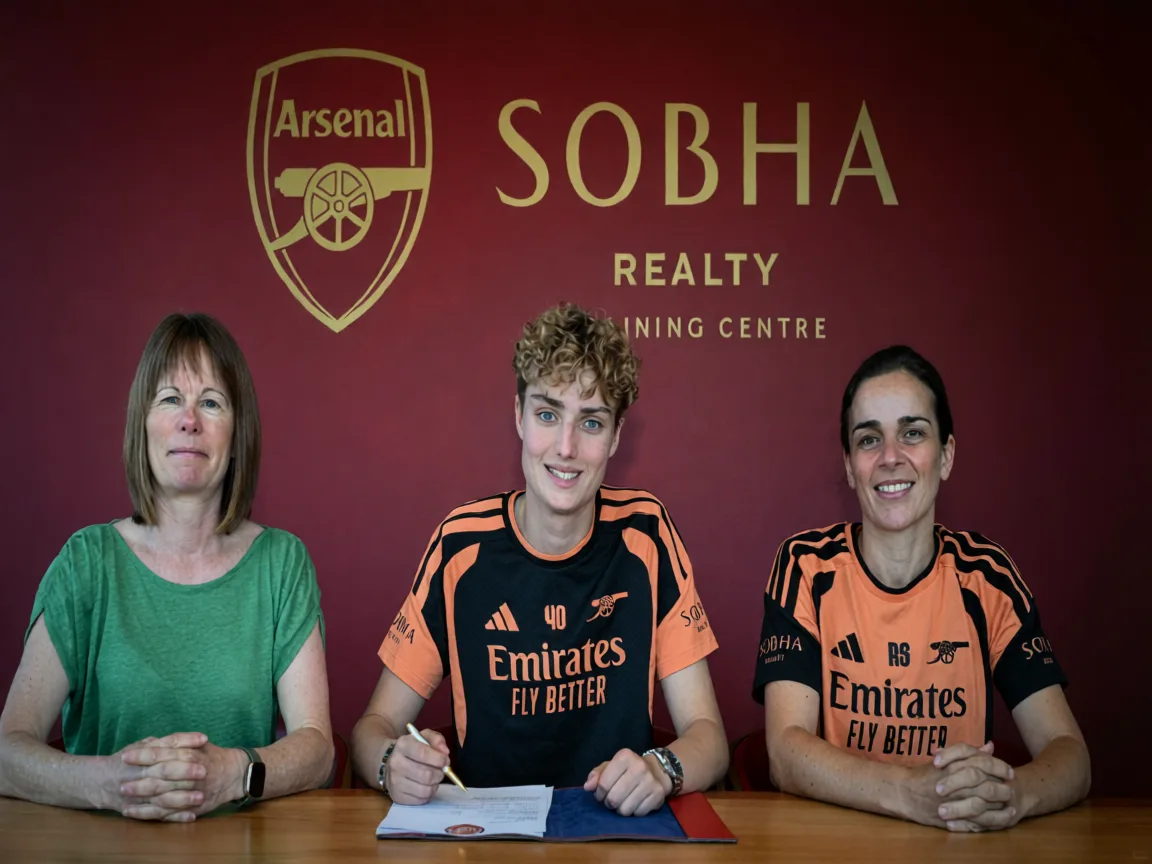
Arsenal Secure Danish Teenage Goalkeeper Isabella Damm
Arsenal's acquisition of Isabella Damm signals a calculated succession plan in goal rather than a panic buy.