Arthur Fery: The Wildcard Who Refused to Let Wimbledon's British Dream Die
Born in France, raised minutes from Centre Court, Arthur Fery carries an unlikely British torch into Wimbledon's last eight.
The Boy Who Grew Up in the Shadow of Centre Court
The queue for Wimbledon grounds passes snakes past the private homes of Church Road, past the meticulously maintained hedges and the discreet security cameras, past the kind of quiet English wealth that makes this corner of SW19 feel like a village pretending to be a world capital. Arthur Fery used to walk through this world every day. He grew up five minutes from the All England Club gates, a boy born in France but raised on the peculiar mythology of British tennis, where the grass is sacred and the expectations are a strange mixture of desperate hope and habitual resignation.
Now 23 years old, Fery stands inside the gates rather than outside them. He holds a wildcard into the main draw and, against every reasonable projection, he carries the last credible British singles hope into the second week of Wimbledon 2026.
This is not the script anyone wrote.
Near-Wipeout to Miracle Run
When the 19-strong British contingent entered the singles first round, the home nation braced for the usual: a few spirited performances, a handful of brave five-setters, and then a slow, collective eviction. The reality was worse. The British ranks suffered a near-total wipeout, players falling across the first two days like dominoes in a wind tunnel. By the time the dust settled, the notion that any home player would reach the quarter-finals seemed less a possibility and more a fantasy engineered for broadcast melodrama.
Fery was one of the few who survived. And then he kept surviving.
Consider the scale of what he has done. Before this fortnight, Fery had won exactly one match at Wimbledon in his entire career. He had won only two Grand Slam matches in total. These are not the statistics of a quarter-finalist. These are the statistics of a player grinding on the Challenger tour, scrapping for ranking points, hoping to qualify for the main draw of a 250-level event.
And yet here he is, standing in the last eight, staring across the net at Flavio Cobolli, with a legitimate chance to go further still.
The Making of a Reluctant Hero
Fery's story is unusual in the modern game because it is deeply local. Tennis has become a passport sport, a nomadic existence of academies in Florida and training bases in Barcelona. Fery's grounding is different. He moved to Britain as a child, settled in the Wimbledon village, and absorbed the tournament as a feature of his neighbourhood rather than a distant television spectacle.
There is a particular psychology to growing up beside the venue. The All England Club is not abstract for Fery. It is a physical place he has walked past thousands of times, a collection of courts he may have glimpsed through gaps in the gates. That proximity can cut two ways. It can either demystify the occasion or magnify the pressure, turning every match into a performance judged by neighbours and friends.
Fery has handled it with the calm of someone who long ago stopped being impressed by postcode. His tennis through this tournament has been characterised not by brilliance but by resilience. He has not played with the swagger of a man who expects to be here. He has played with the grit of a man who refuses to leave.
Cobolli Awaits in the Quarter-Final
Wednesday's quarter-final slate tells you everything about the unpredictable geometry of Grand Slam tennis. On the women's side, Linda Noskova faces Elise Mertens and Marta Kostyuk takes on Jasmine Paolini. On the men's side, Taylor Fritz plays Alexander Zverev in a marquee clash of established names, and then there is Cobolli against Fery.
The contrast in the men's quarter-finals is stark. Fritz and Zverev are fixtures of the top tier, players with titles and deep runs and ranking points banked in the millions. Cobolli, meanwhile, is a dangerous floater, a player who has proven himself on the biggest stages but does not carry the institutional weight of the established elite.
Fery is the outlier in every sense. He is the wildcard who should not be here, the local boy playing the role of stunning upset, the last British singles player standing after a first round that gutted the home challenge before it had properly begun.
The wildcard who grew up five minutes from the gates is now the one standing inside them, carrying the weight of a nation's tennis hopes.
Career by Numbers
- One Wimbledon match win before this tournament, and two Grand Slam match wins in his entire career
- 23 years old, wildcard entry into the main draw
- 19 British singles players entered, with Fery the last singles survivor into the quarter-finals
- 0 previous Grand Slam quarter-finals before this run
The Weight of the Wildcard
There is a particular burden to being the last British player at Wimbledon. The tournament has spent two decades trading on the Andy Murray era, a period when the home nation could reasonably expect not just participation but contention. Murray's absence has left a vacuum that the British tennis establishment has struggled to fill, and the public, conditioned by years of deep runs and thrilling finales, has searched for a successor with increasing desperation.
Fery is not that successor. Not yet. His ranking does not suggest it, his career record does not support it, and his game, while improving, has not shown the consistency required to be a permanent fixture in the second week of Slams. But for two weeks in the summer of 2026, he has become something equally valuable: a reminder that tennis still produces stories the scriptwriters would reject.
The wildcard system exists precisely for this purpose. It is not designed to hand gifts to deserving locals but to give opportunities to players who, for whatever reason, have not yet converted their potential into ranking. Fery has taken that opportunity and squeezed every drop of meaning from it, winning matches he was not supposed to win and extending a run that should have ended days ago.
What Comes Next
The Cobolli match presents a specific tactical challenge. Cobolli is a baseliner with excellent movement and a willingness to extend rallies. Fery's best path to victory likely lies in aggressive court position, taking the ball early, and using the grass to his advantage with sharp angles and frequent net approaches.
But tactics, at this stage of a Grand Slam, are only part of the equation. The larger question is mental. Fery has already exceeded every reasonable expectation. The pressure that weighed on him in the first round, the pressure of representing the home nation, has been replaced by something different and potentially more dangerous: the pressure of expectation born from overachievement.
He is no longer the plucky wildcard. He is the British player in the quarter-finals.
Whether he wins or loses against Cobolli, Fery's run has already delivered something the tournament needed. After the carnage of the first round, after 18 of 19 British singles players had departed, the All England Club faced the prospect of a second week with no home singles representative at all. Fery has singularly prevented that, giving the raucous Centre Court crowds and the wider British public a reason to keep watching.
A Legacy Beyond the Scoreline
Grand Slam wildcards are often forgotten by the time the next tournament rolls around. They are footnotes, curiosities, answers to trivia questions that nobody asks. Fery's run has a chance to be different, not because it will redefine his career but because it illuminates something true about the sport.
Tennis is a game of structure. Rankings determine entries. Seedings determine draws. The calendar is set years in advance. And yet, within that rigidity, there is still room for a player who grew up walking past the gates to walk through them as a competitor, to win matches he has never won at a tournament he has barely played, and to become, for a few improbable days, the most important British tennis player in the country.
The local boy is still standing. And at Wimbledon, that is worth more than any ranking.
Wednesday's quarter-final action continues with Noskola v Mertens, Kostyuk v Paolini, Fritz v Zverev, and Cobolli v Fery as the fortnight enters its decisive phase.
Editorial Integrity
This is an original SportPulse article written by our editorial team. All content is independently researched, written, and reviewed by our writers and editors before publication. We do not publish copied, aggregated, or syndicated content.
SportPulse is committed to original sports journalism. Read our editorial policy or contact us with any questions.
More Like This
All tennis
Draper Channels Murray's Grit in Messy But Vital Comeback Win
Jack Draper credits new coach Andy Murray for teaching him to win ugly on his long-awaited return to competition.
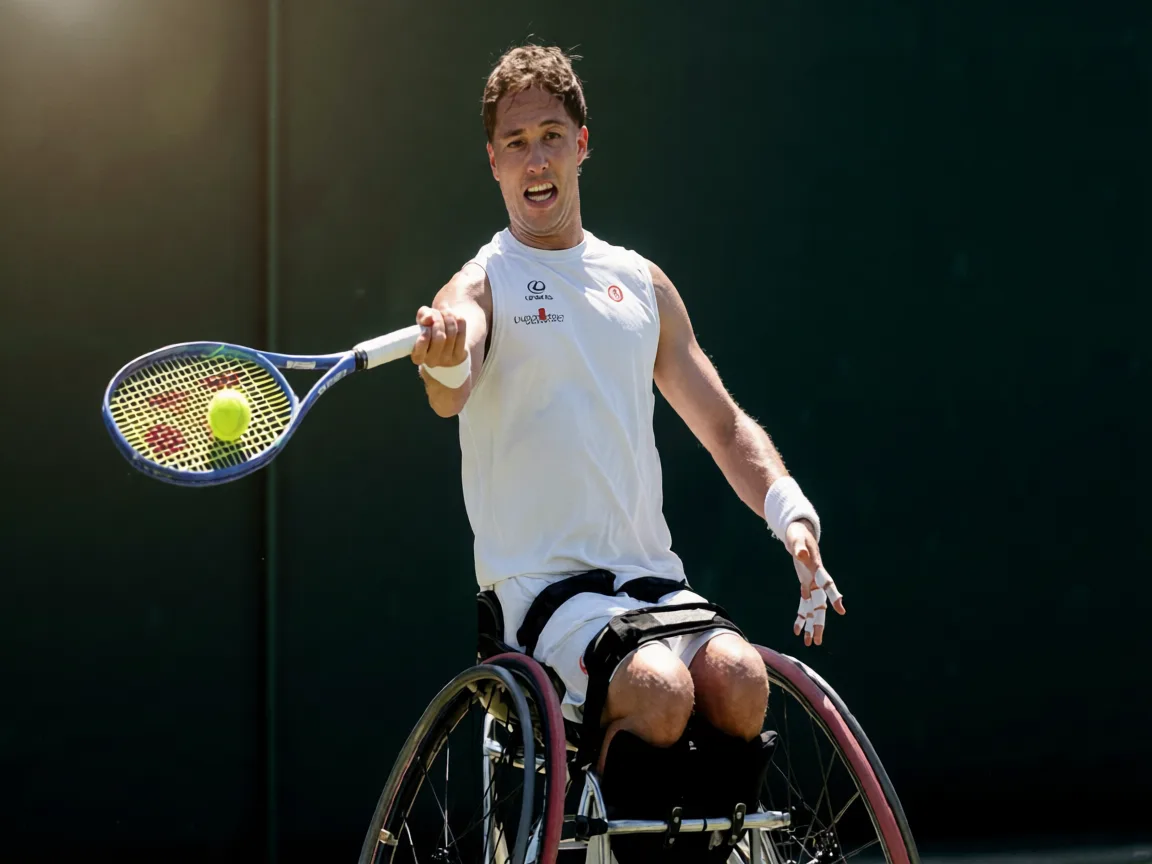
Hewett Marches On as Reid Falls: The Divergent Paths of British Wheelchair Tennis
Alfie Hewett reaches a tenth Wimbledon wheelchair singles quarter-final while Gordon Reid bows out early, encapsulating two very different chapters in British para-sport.

Boulter Dismantles Rybakina to Crown Queen's Return
Katie Boulter toppled top seed Elena Rybakina in a kinetic masterclass, booking a historic Queen's Club semi-final berth.