Bielsa Meets His Disciple as Fractious Uruguay Face Spain
Uruguay's mutinous dressing room meets Spain's clinical excellence in a pivotal showdown between master and former pupil.
Kick-off: 6pm local / 8pm EDT / 1am BST / 10am AEST.
Marcelo Bielsa does not do reunions. He does not trade in nostalgia. Yet when Uruguay step onto the pitch to face Spain, the tactical subplot will be inescapable. For the first time in his managerial career, Bielsa will face a direct disciple who has evolved his philosophy into something arguably more lethal than the original. Luis de la Fuente, the man who quietly studied at the altar of Bielsa's Athletic Bilbao revolution, now stands as the gatekeeper to Uruguay's tournament survival.
This is not merely a tactical battle. It is a collision of ideological inheritance meets modern application, played out against a backdrop of outright dressing-room rebellion.
The Master and the Apprentice
The summer of 2011 was a time of profound divergence at Athletic Bilbao. Bielsa arrived as the great disruptor, the Argentine who would drag a proud, insular club into the modern tactical era. De la Fuente was heading in the opposite direction. A former left-back who had bled red and white for eight years in the first team, he had cut his coaching teeth managing the club's under-19s and B team. But the path to the top was not linear. De la Fuente departed for Deportivo Alavés, a club languishing 50 miles south and stuck in the third tier of Spanish football.
It lasted 11 games. Sacked from his first and, to date, only senior club job, De la Fuente entered the wilderness. The phone did not ring. As the months bled into a year and a half of professional purgatory, he returned to Athletic's Lezama training ground. Not to coach, but to learn. He watched Bielsa's sessions, absorbing the structural geometry, the relentless verticality, and the non-negotiable intensity that would soon make Athletic the most thrilling demolition machine in Europe.
That period of silent observation shaped the coach De la Fuente would become. When the Spanish federation finally called, offering the under-19s job, he was ready. The discipline, the aggressive defensive transitions, the willingness to trust youth over reputation. These are Bielsa's fingerprints all over De la Fuente's European Championship-winning Spain side.
Verdict
De la Fuente absorbed the Bielsa gospel during his exile, weaponizing those lessons into a philosophy that now dominates Europe. Spain are what happens when Bielsismo gets a Spanish coat of paint and an endless supply of technically elite midfielders.
The Fractious State of Uruguay
While Spain arrive as continental champions operating with serene efficiency, Uruguay arrive at this crossroads in a state of organized chaos. La Celeste need a win to progress, but that necessity is dwarfed by the existential crisis consuming the squad. The Uruguayan dressing room is, by multiple accounts, in open revolt against Bielsa's methods.
This is the Bielsa paradox writ large. His methods demand total physical and mental submission. The training loads are punishing. The tactical instructions are microscopic. At Athletic, at Leeds, at Marseille, this intensity eventually fractures the body or the will. Uruguay are hitting that breaking point at the most inconvenient time.
Under Bielsa, Uruguay's defensive structure has remained reasonably robust, but the offensive output has collapsed into sterility. The underlying numbers paint a grim picture:
- 1.12 goals scored per match under Bielsa in competitive fixtures
- 0.84 xG generated per match across the current tournament, a marker of systemic creativity failure
- 62% possession average but just 8.4 penalty area entries per 90 minutes
The players are exhausted. The senior core, accustomed to a more pragmatic, physical South American rhythm, have reportedly chafed at the relentless man-marking and high-line demands. When the results dry up, the Bielsa command structure leaves no room for democratic compromise.
The Bottom Line
A manager who demands absolute control is confronting a squad that no longer believes in the system. Winning cures everything in football, but right now, Uruguay are losing both matches and the ideological war inside their own camp.
The Tactical Collision
So what happens when the master's original blueprint meets the disciple's refined iteration? Spain under De la Fuente play a version of Bielsismo that is uniquely Spanish. They retain the aggressive defensive triggers and the high press, but they marry it to a possession base that protects the players from the physical burnout that defines Bielsa's end cycles.
Where Bielsa forces verticality at all costs, De la Fuente permits horizontal circulation to manipulate the opposition before striking. Spain's tournament numbers underline this brutal efficiency:
- 2.4 goals per match averaged across competitive fixtures under De la Fuente
- 2.8 xG generated per 90 minutes in the current tournament
- 91.4% pass completion rate in the opposing half
Uruguay cannot match this technical precision. Bielsa's response will almost certainly be to lean harder into physicality. He will instruct his team to disrupt Spain's rhythm through sheer intensity, pressing the goalkeeper and centre-backs to force turnovers in dangerous areas. It is the classic Bielsa gambit: if you cannot outplay them, out-run them.
The problem is that Spain under De la Fuente are structurally immune to this approach. They do not panic under pressure. Rodri, if fit, acts as the ultimate release valve, and the wide inverting fullbacks offer passing angles that Bielsa's rigid man-marking schemes struggle to cover.
Verdict
Spain are built to weather the Bielsa storm. De la Fuente designed his team to dismantle exactly the kind of aggressive verticality his mentor preaches. Uruguay must find an alternative route or be dragged into a technical fight they simply cannot win.
The Stakes of Succession
Performance in this fixture will define the immediate trajectory of both camps, but the burden of consequence falls heaviest on Uruguay. A defeat does not just end their tournament. It likely accelerates the end of the Bielsa era in international football. The Uruguayan Football Association has backed their man publicly, but the political capital required to overrule a mutinous senior squad is immense.
Even if they do get thrashed by Spain tonight and end up going out, Uruguay are guaranteed a place in the 2030 World Cup due to the fact that they are co-hosts. And by co-hosts, I mean they’re hosting exactly one match.
For De la Fuente, the stakes are different. A victory over Bielsa offers a symbolic coronation. It is the apprentice definitively surpassing the master, proving that the modernized, possession-adjacent version of this tactical philosophy is the ultimate evolution.
Bielsa changed how De la Fuente saw the game in 2011. He showed him that structure could create chaos, that intensity could be a tactical weapon rather than just a physical attribute. But De la Fuente also learned what Bielsa never mastered: the art of sustainable intensity. The lesson of Lezama was not just in how to build a team, but in how to prevent one from consuming itself.
Uruguay need a miracle. Spain only need to be themselves. Football rarely rewards the desperate, and even more rarely rewards a team actively questioning its own instructions. The master taught the apprentice everything he knew. The apprentice added one vital lesson of his own: when to breathe.
The Bottom Line
Spain will control the tempo, Uruguay will chase shadows, and a fractious dressing room will finally have its mutiny vindicated or silenced. The disciples have surpassed the master, and Uruguay are about to learn that the hard way.
Updated: 2026-06-26 — Added kick-off time, France's 4-1 win over Norway as context, and Uruguay's 2030 co-host guarantee.
Editorial Integrity
This is an original SportPulse article written by our editorial team. All content is independently researched, written, and reviewed by our writers and editors before publication. We do not publish copied, aggregated, or syndicated content.
SportPulse is committed to original sports journalism. Read our editorial policy or contact us with any questions.
More Like This
All football
Three Titans, One Stage: Mbappé, Haaland, and Messi Light Up the World Cup
Mbappé, Haaland, and Messi simultaneously hitting top form has the 2026 World Cup crackling with generational electricity.
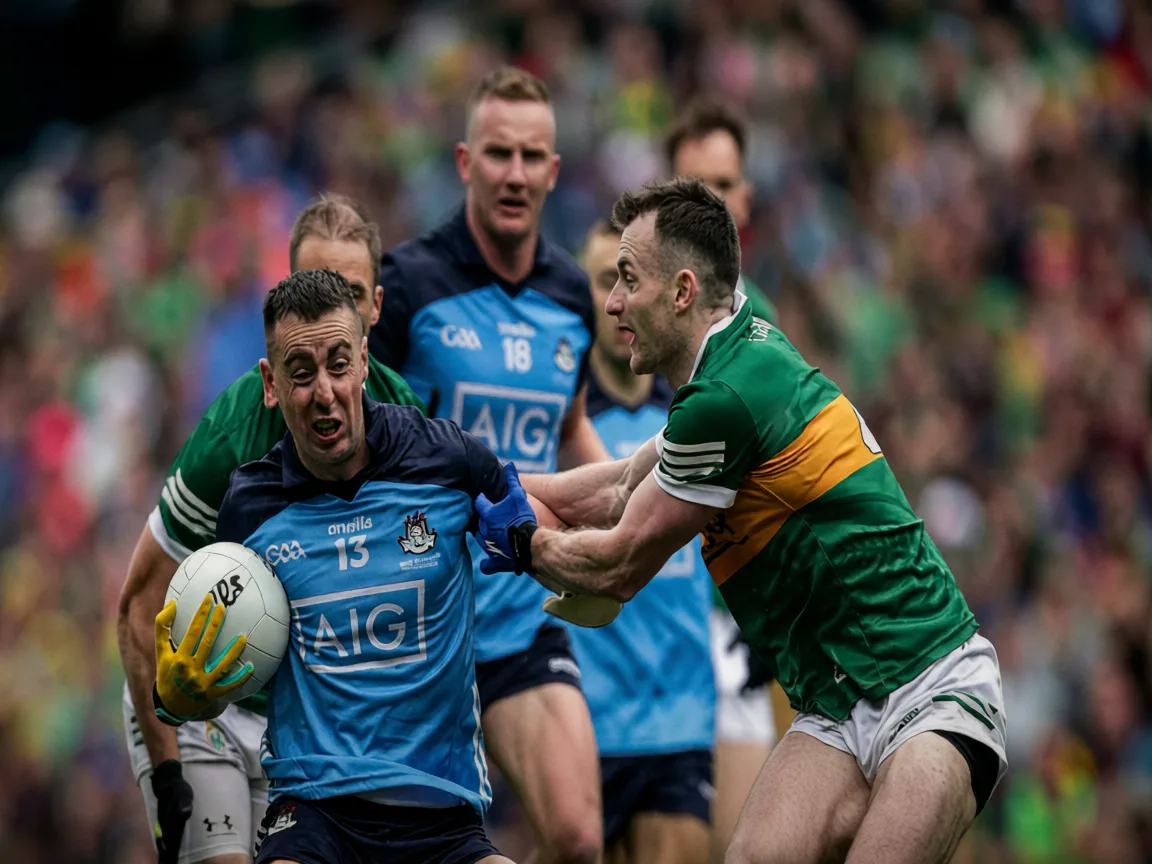
Dublin v Kerry: Gaelic Football's Defining Rivalry Enters New Chapter
The most iconic rivalry in Gaelic football returns as Dublin and Kerry prepare to write another chapter in a century-old saga.

Aspinall Returns to Full Training Ahead of Gane Rematch
Tom Aspinall resumes full training after dual eye surgery, resetting the tactical puzzle for his Ciryl Gane rematch.