The Canyon Finally Roars: Knicks Immortalized in Lower Manhattan
Fifty-two years of anguish dissolved into confetti as the Knicks championship parade conquered Lower Manhattan.
The Canyon of Heroes has waited longer than any of us.
Fifty-two years. Over half a century of echoing footsteps and phantom parades. For generations, the concrete corridor stretching through lower Manhattan has reserved its confetti for visiting dignitaries, returning astronauts, and visiting victors from the boroughs across the river. Never for the Knicks. Until today.
Hundreds of thousands of bodies compressed into the financial district. A sea of orange and blue swallowing the stone and glass canyons of the oldest part of the city. The sound was not a cheer. It was a release. It was the exorcism of a demon that had haunted Madison Square Garden since 1973.
The Weight of an Ancient City
New York does not suffer fools, and for decades, it suffered the Knicks. The franchise that once defined corporate basketball excellence became synonymous with dysfunction,败 frustration, and existential dread. Fans learned to navigate a season not with hope, but with defensive cynicism. A shield built from decades of disappointment.
But shields crack. And when they do, the flood is catastrophic.
The parade route itself was a study in civic devotion. From Battery Place up to City Hall, the canyon swallowed humanity. Office windows became makeshift terraces. Suits discarded their jackets to wave orange towels. The financial district, usually pulsing with the cold arithmetic of capitalism, surrendered entirely to the math of a different kind of bottom line: zero. That is how many championships the Knicks had won in the lives of anyone under fifty-five.
Until today.
A Half-Century in the Making
To understand what happened in lower Manhattan, you must understand the geography of pain. The Knicks were not merely bad. They were bad in the most dramatic city on earth, under the brightest lights, in the most famous arena in the world. They were the punchline that refused to end.
The drought spanned 1,978 regular-season games of irrelevance, interrupted only by brief, mocking flirtations with contention. From theVan Gundy era's bruising resilience to the Isiah Thomas years' operatic collapse, the franchise cycled through saviors like a man twisting a broken radio dial.
The turnaround was not a sudden lightning strike. It was a painstaking reconstruction, brick by agonizing brick. The front office swallowed pride, absorbed contracts, hoarded draft capital, and waited. They built a defense that treated the paint like sacred ground. They found stars who understood the gravity of the jersey, players who did not shrink from the city's demands but expanded to fill them.
52 years of institutional rot cleared out by a core that simply refused to be the next chapter in a book of failures. They re-wrote the ending.
Confetti and Catharsis
The floats moved slowly, Features of a fever dream made real. Players who had become demigods in the span of a postseason stood atop rolling stages, holding the Larry O'Brien trophy like a newborn. A trophy born in the crucible of a playoff run that refused to follow the script.
The crowd was not just present. It was dense, suffocating, and joyous in a way that only a city liberated from a curse can be. They did not just wave signs. They wept. Grown men who had inherited their father's despair and their grandfather's resignation stood on Broadway, crying for a basketball team.
"This isn't just a parade. This is a funeral for every season we ever threw away."
That was the undercurrent of the day. It was not merely a celebration of a single victory. It was a mass memorial for the decades of wasted winters, the Allan Houston shots that fell short, the Carmelo Anthony isolation possessions that yielded only heartbreak, the Kristaps Porzingis era that dissolved into bitterness. All of it was washed away by a tide of confetti.
The Anatomy of a Resurrection
How did they finally do it? The tactical metamorphosis was years in the making, an investment in a system that demanded both physical and mental endurance.
The regular season was a masterclass in controlled aggression, balancing a top-five offense with a defense that suffocated opponents into submission. The Knicks limited teams to a league-best 104.2 points per 100 possessions in the playoffs, a number that speaks to a team that decided the only way to conquer the league was to strangle it.
The trade deadline acquisition that shored up the rotation was the final chess move, a front-office gamble that paid off in the kind of clutch moments that previously would have ended in disaster. They were no longer the team that folded under pressure. They were the anvil.
The City as the Twelfth Man
New York has always been a basketball town. It just forgot soccer and baseball and everything else for a day to remember that fact.
The parade route was a physical manifestation of the city's soul. The cramped, towering streets of lower Manhattan mirrored the Knicks' season: an enclosed, claustrophobic struggle where the only way out was through. The fans pressed in from all sides, their voices bouncing off the buildings, creating an acoustic pressure cooker that could be felt from the Battery to the Bronx.
The players on the floats were not distant celebrities. They were neighbors who had delivered on a promise the city had made to itself decades ago. Every high-five into the crowd was a repayment of a debt. Every laugh captured by a drone was a shared exhale.
What the Future Holds
The parade ends. The confetti is swept away. The suits return to their desks. The city moves on because that is what cities do.
But the Knicks will not return to who they were. A championship blows open doors that were previously nailed shut. The narrative of the franchise is permanently altered. They are no longer the lovable losers of the NBA, the team that built monuments to mediocrity. They are the standard.
The pressure now shifts. The challenge for the core will not be escaping the shadow of the past, but living up to the expectations of the present. The Eastern Conference will be hungrier, the targets sharper, the schedule more unforgiving. The NBA does not allow you to rest on your laurels. It forces you to defend them.
But that is a problem for tomorrow's cold tactical sessions on a practice court in Tarrytown. Today was for the exorcism. Today was for the streets.
Fifty-two years is a long time. Long enough to forget what winning tastes like. The Canyon of Heroes remembered. And in its remembering, it felt like it would never let go.
Editorial Integrity
This is an original SportPulse article written by our editorial team. All content is independently researched, written, and reviewed by our writers and editors before publication. We do not publish copied, aggregated, or syndicated content.
SportPulse is committed to original sports journalism. Read our editorial policy or contact us with any questions.
More Like This
All basketball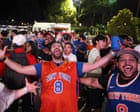
More Than a Ring: How the Knicks' Run Became a Collective Act of Healing
The Knicks' improbable Finals run has transcended basketball, becoming a cultural lifeline in a nation worn thin by everything else.

The Greek Freak Moves to South Beach: Giannis Heads to Miami
Miami lands two-time MVP Giannis Antetokounmpo in a franchise-altering blockbuster that reshapes the Eastern Conference.

53 and Counting: Marina Mabrey Joins WNBA's Most Exclusive Club
Marina Mabrey's 53-point eruption ties the WNBA single-game record and announces Toronto as a legitimate force.