From Varsity Cups to Test Arena: Coleman's England Call
Mary Coleman's journey from university pitches to England's Test squad is everything rugby's pathways dream could be.
The Bolt Nobody Saw Coming
Mary Coleman was not supposed to be here.
Not on a Tuesday morning when England's squad notifications pinged across phones and inboxes. Not on the radar of most rugby followers who spend their time tracking the established stars of the women's domestic game. And certainly not on the list of names most pundits would have circled as a potential international debutant for a summer Test against France.
Yet there her name sat. Plain. Unadorned. Definitive.
Coleman, M. Wigan Warriors. Prop. First call-up.
For a woman who built her rugby identity on university pitches, playing in not one, not two, but three Varsity Cups, this was the kind of plot twist that sport still writes better than Hollywood ever could.
When you've pulled on a university shirt in front of a few hundred students, the jump to an England camp feels like switching galaxies. Coleman has done it in the space of a few extraordinary seasons.
The story is not just about one player's elevation. It is about a shifting landscape in women's rugby where the route to the top no longer runs exclusively through traditional academy pathways.
Mary Coleman rewrote that itinerary entirely.
From Blue to Warrior to Red Rose
The architecture of Coleman's career reads like a manifesto against the idea that international rugby requires a linear trajectory.
She earned her rugby spurs at Cambridge. Three Varsity Cup campaigns. Three occasions where the weight of institutional rivalry, alumni expectation, and personal ambition collided at Twickenham's doorstep. Those experiences forged something that no elite academy can manufacture: a player who understands pressure not from a coaching manual but from living it.
The Varsity Cup is not your standard university fixture. It carries decades of heritage and an intensity that surprises players who arrive expecting a relaxed afternoon. Surviving three of them tells you everything about a player's mental scaffolding.
Wigan Warriors saw that scaffolding and bet on it. The move to the Warriors was where university promise collided with professional demands.
The transition from the intellectual rigor of Cambridge blue to the physical brutality of the women's domestic game required adaptation. Coleman did not merely adapt. She imposed herself.
A prop's world is unglamorous by design. The scrum. The collision. The repeated willingness to put your body in places most humans instinctively avoid. Coleman's work in the tight phases at Wigan established her as a forward who could be trusted when the game's geometry collapsed into chaos.
What the Numbers Whisper
- Three Varsity Cup appearances for Cambridge University
- Zero previous senior England call-ups before this summer
- One summer Test against France on 25 July to prove she belongs
- Front-row conversion from university standout to professional squad member
The statistics are sparse because Coleman's story is not one of accumulation. It is one of timing.
Why Now, Why Her
England's coaching setup has never been afraid to make a statement through selection. Bringing Coleman into the summer squad ahead of the France Test on 25 July is a selection that carries layers.
First, it acknowledges that the domestic game in England is producing front-row talent of genuine international quality outside the usual power corridors. Wigan Warriors are not historically the first name associated with women's international rugby production. That Coleman has emerged from their system validates the depth of investment in the women's game at clubs that exist beyond the traditional spotlight.
Second, it sends a message to every player currently running out in university fixtures or lower-tier club matches that the door is not closed. It is not sealed by age, by pathway, by institutional pedigree. Coleman's presence in the squad is proof of concept.
We have always said we will pick players who are performing, regardless of where they are performing. Mary has earned this through consistency and an ability to do the hard things well. When you watch her set a scrum, you see someone who understands the role.
The France Test on 25 July represents more than a summer fixture. It is a litmus test for England's evolving depth chart. France will arrive with physicality and tactical sophistication. For a debutant prop, there is no gentle entry.
This is precisely the point. Coleman was not selected for development. She was selected because the coaching staff believes she can perform at Test level against one of the most punishing forward packs in the women's game.
The Tactical Fit
England's scrum has long been a weapon. Maintaining that reputation requires constant infusion of players who can anchor the set-piece without the system buckling.
Coleman's game at Wigan has been built on scrummaging fundamentals. She is not a flashy ball-carrying prop who makes highlight reels. She is the player who holds the framework together so that others can flourish.
A prop who wins her scrum without drama is worth more than one who makes a break but collapses three set-pieces. International rugby is built on the quiet professionals. Coleman is exactly that.
In the modern women's game, where the collision area has become increasingly decisive, having a front-row recruit who relishes the dark arts of the tight five is gold dust. Coleman's university background brings an additional layer: a footballing intelligence that allows her to read the breakdown and position herself where the next collision will arrive.
France on 25 July will demand exactly that.
Beyond the Pitch: What the Call-Up Means
The wider resonance of Coleman's selection extends far beyond the squad announcement.
For Wigan Warriors, it is validation. For Cambridge University RFC, it is a recruiting poster made reality. For every young woman who has laced up boots at a university ground and wondered whether the dream had a ceiling, it is a crack in that ceiling.
The commercial and structural implications should not be ignored either.
Behind the Deal: The Commercial Layer
- Pathway visibility: Clubs like Wigan can now point to a graduate of their system reaching international level, strengthening their case for sponsorship investment
- University rugby's value: Cambridge can leverage a three-varsity international as evidence that their program remains a viable launchpad
- England's scouting reach: The coaching team demonstrably monitors talent outside the traditional corridors, expanding the effective recruitment pool
- Summer Test commercial value: A fresh face in the squad generates narrative interest that drives ticket and broadcast engagement for the 25 July fixture against France
The economics of women's rugby are still in a growth phase. Every story like Coleman's creates commercial tailwinds. Sponsors want narratives and authenticity. A prop who played in Varsity Cups and now faces France is an authentic thread that connects the grassroots to the summit.
The Weight of the Shirt
There is a moment, still to come, when Mary Coleman will pull on an England training top for the first time. Not as a hopeful trialist. Not as a guest. As a squad member.
The gravity of that moment will not be lost on her.
She has worn the Blue of Cambridge. She has worn the cherry and white of Wigan Warriors. Each shirt carried its own meaning, its own weight, its own expectations.
The red rose is something else entirely.
At every level, the criticism has been the same: she is too late to the pathway, she lacks the years in the system. And at every level, she has proved that the people saying that were measuring the wrong things.
What France Will Bring
France on 25 July will not be a welcoming committee. They will arrive with a pack that prides itself on confrontation. Their back row will target the fringes. Their scrum will test every technical compromise Coleman has made and refined.
For a debutant, the first scrum is a trial by fire. The referee's interpretation, the opposition's angle of engagement, the sheer violence of the collision at Test pace. All of it arrives at once.
England's coaches know this. They would not have selected Coleman if they doubted her ability to absorb it.
The expectation is not that she will be flawless. No debutant is. The expectation is that she will hold her own in the contest that defines a prop's existence: the scrum.
The Road Ahead
The France Test on 25 July is a beginning, not a destination.
England's international calendar stretches beyond the summer. Coleman's performance in camp and, if selected, during the Test will determine whether this call-up becomes a singular chapter or the opening page of a long international tenure.
For Wigan Warriors, losing a player to England duty is a badge of honor that validates their development program. For Cambridge, it cement a legacy that bridges academic and athletic excellence. For Coleman herself, it remains the opportunity she has spent her entire rugby life earning without ever believing she was earning it.
The pathway from Varsity Cups to Test arenas is not supposed to be straightforward. Mary Coleman never asked it to be. She simply took it.
On 25 July, she will discover where it leads.
Editorial Integrity
This is an original SportPulse article written by our editorial team. All content is independently researched, written, and reviewed by our writers and editors before publication. We do not publish copied, aggregated, or syndicated content.
SportPulse is committed to original sports journalism. Read our editorial policy or contact us with any questions.
More Like This
All football
Messi Shatters World Cup Scoring Record With Brace Against Austria
Lionel Messi rewrites World Cup history with a two-goal salvo that sends holders Argentina into the last 32.

World Cup 2026 Is Drawing Hundreds of Millions to Screens Worldwide
Early viewing figures show the 2026 World Cup is already a global television phenomenon before the knockout rounds even begin.
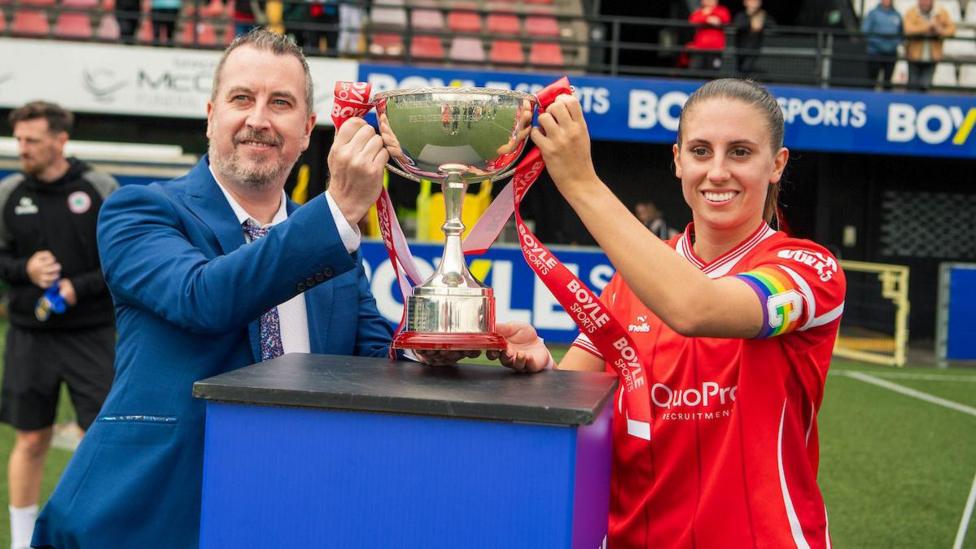
Cliftonville's Women Eye Historic Treble After League Cup Triumph
Kelsie Burrows leads Cliftonville's bold charge toward an unprecedented domestic treble after their emphatic League Cup final victory.