Deniz Undav: From Factory Floor to Germany's World Cup Saviour
Julian Nagelsmann once called him out publicly, but Deniz Undav is now rewriting Germany's World Cup script from the bench.
Julian Nagelsmann did not mince his words. It was barely a year ago when the Germany head coach delivered a very public dressing-down that echoed through German football. The target? A striker who had just come off a stunning season in the Bundesliga, yet whose commitment to the national team cause was being questioned by the very man entrusted with leading the nation back to glory.
"I expect more. Actions on the pitch, but also off it. You need to give everything for the badge."
Those words stung. They were designed to. For Deniz Undav, labeled as lacking the requisite hunger, the criticism could have been a career-killer. A subtle nod toward the exit door of the national team setup. Instead, it became the spark that ignited the most unlikely of World Cup revivals.
Fast forward to the global showpiece, and the narrative has flipped entirely. The man who was supposedly not invested enough is now the heartbeat of Germany's tournament. He is the super-sub rewriting the script, proving that sometimes the loudest statements come from the biggest skeptics.
The Unlikely Hero
To truly understand the magnitude of Undav's World Cup emergence, you have to go back to where this story actually starts. Not in the pristine academies of German football's elite, but on the factory floor.
Undav's path to the pinnacle of the sport is anything but conventional. Before the professional contracts and the international caps, there was honest, grueling manual labor. The striker worked on a factory production line, a reality that grounded him in a way that no elite youth academy ever could.
"When you've worked 8-hour shifts on a factory floor, football becomes the escape, not the job. That never leaves you."
That blue-collar grit is exactly what he brings to the pitch. He runs until his lungs burn. He chases lost causes that other forwards would gladly let go. It is a relentless, annoying style of play that has slowly worn down World Cup defenses and firmly won over a previously skeptical German fanbase.
Cracking the Code
Undav's rise wasn't linear. After a blistering spell in Belgium, a move to the Premier League with Brighton & Hove Albion offered the big break every player craves. But the English top flight can be ruthlessly unforgiving. First-team opportunities were scarce. The physical toll was immense. The factory floor had prepared him for hard work, but the technical and tactical leap was a different beast entirely.
A loan move to VfB Stuttgart became the pivot. Back in the Bundesliga, Undav didn't just find his feet. He set the league alight. Feeding off the creative engineling of Undav and strike partner Serhou Guirassy, Stuttgart became the surprise package of the German top flight.
- 18 goals in the domestic league campaign
- 3 assists showcasing a wider playmaking ability
- A direct goal involvement every 104 minutes
Those numbers screamed for international recognition. Yet the national team call-up still felt like a distant dream, primarily because the manager had openly questioned the very core of his application.
The Nagelsmann Wake-Up Call
Nagelsmann's public reproach wasn't just a throwaway line in a press conference. It was a calculated psychological gamble.
The German boss saw a player with immense talent but sensed a hesitation. A reluctance to fully impose himself on the international stage. For a Germany side desperate to shed the physical and mental scars of back-to-back World Cup humiliations, passive passengers were the last thing Nagelsmann needed.
The media ran with the narrative. Pundits speculated that Undav's international career was effectively over before it had even begun. The pressure mounted.
But a funny thing happened on the way to obscurity. Undav didn't sulk. He didn't fire back in the press. He didn't retreat into a shell. He went to work. The kind of work he knows best. The unglamorous, repetitive, sweat-on-the-brow type of work.
He returned to Stuttgart with a point to prove. Every sprint was a rebuttal. Every goal was a middle finger to the doubters. The production line worker was back on the clock, and the output was undeniable.
Delivering on the Biggest Stage
World Cup squads are a delicate balance of egos, experience, and tactical nuance. When Nagelsmann named his roster, the inclusion of Undav raised eyebrows. The critics circled. Was this a PR move? A reward for domestic form? Or was there genuine belief that the Stuttgart hitman could deliver when the lights shone brightest?
The answer came in brutal, clinical fashion. Thrust into the tournament as an impact substitute, Undav has become Nagelsmann's most devastating weapon.
It's the injection of chaos that only a super-sub can provide. Tired defenders suddenly faced a locomotive of a forward who had spent 60 minutes watching, analyzing, and plotting. The impact has been immediate and game-altering.
- A crucial goal to swing momentum in a pivotal group stage clash
- A pre-assist that unlocked a stubborn low block when starting personnel had stalled
- 5 ball recoveries in the final third during his substitute appearances alone
The very traits Nagelsmann publicly questioned are the ones winning Germany matches. The hunger. The refusal to yield. The raw, unpolished intensity that refuses to respect reputations.
The Factory Mentality
There is a beautiful irony in Undav's ascent. For years, the German national team was accused of being too technically reliant, too passive, too easy to push off the ball in the gritty moments. They lacked a streetfighter.
In Undav, they found one.
He doesn't glide past players with the elegance of a classic number 10. He doesn't pick apart defenses with quarterback precision. He does something far more visceral and far more necessary at a grueling World Cup. He makes life miserable for opposition center-backs.
He occupies spaces that don't exist on tactical whiteboards. He falls deep to disrupt the buildup, then bursts into the box to finish chances born purely of instinct. It's not pretty. It's effective.
And it's exactly what Germany have been missing when the Plan A beautifully orchestrated passing sequences inevitably break down.
What This Means for the Tournament
Nagelsmann's dilemma is now a pleasant one, but it carries heavy weight. Does he reward Undav's explosive impact with a starting berth? Or does he harness the psychological blow of bringing him off the bench when the game is ripe to be taken?
The smart money is on the latter. Not because Undav isn't worthy of starting. But because the role of super-sub requires a unique mentality. It takes a player who can sit for an hour, stay mentally locked in, and then explode into action without the luxury of a gradual warm-up against opposing defensive lines.
It takes a factory worker. Someone who knows that when the whistle blows, you produce. No excuses. No ramping up.
For Germany, the re-emergence of this bruising, blue-collar identity couldn't have come at a better time. The knockout stages loom. Margins shrink. Defenses tighten. The pretty patterns get harder to execute.
This is when you need someone who thrives in the mud. Someone who treats every half-chance like a shift on the production line. Something that needs finishing before the clock runs out.
Nagelsmann knew what he was doing all along. He just needed Undav to know it too. Now, the entire World Cup is finding out.
Editorial Integrity
This is an original SportPulse article written by our editorial team. All content is independently researched, written, and reviewed by our writers and editors before publication. We do not publish copied, aggregated, or syndicated content.
SportPulse is committed to original sports journalism. Read our editorial policy or contact us with any questions.
More Like This
All football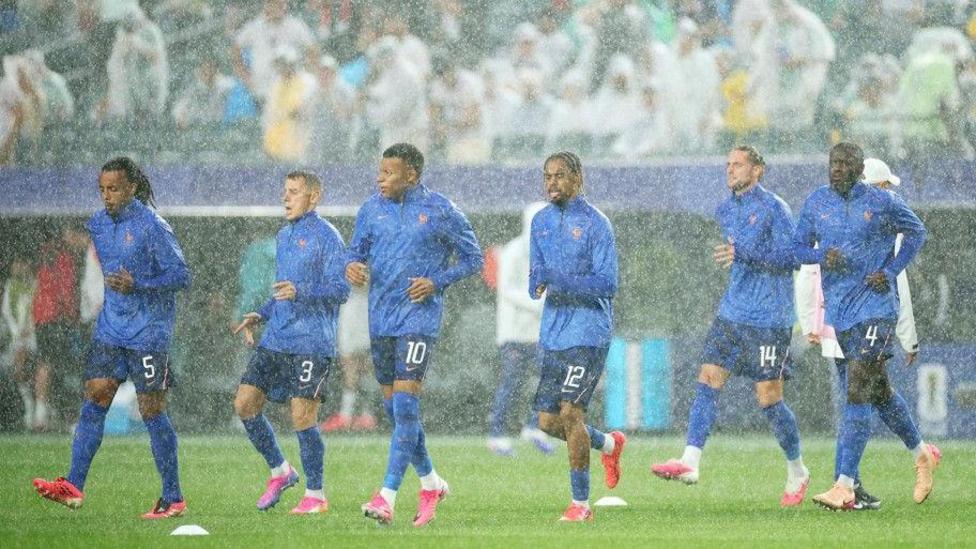
The Two-Hour Freeze: How Weather Delay Tested Tactical Patience
Weather delays in football force tactical recalibrations and test mental fortitude, as seen in the France-Iraq World Cup match.

From Genk to Stamford Bridge: Can Penders Mirror Courtois?
Chelsea's latest goalkeeping acquisition from Genk evokes inevitable Courtois comparisons, but the modern landscape demands a different calibration.
Romero's Argentina Aura Exposes the Spurs Paradox
Cristian Romero turns into football's most unflappable defender for Argentina, raising uncomfortable questions about his Tottenham form.