Hamilton at Ferrari and Three PT.0 Late-Career Resurgences
Lewis Hamilton's Ferrari move at 41 adds another chapter to elite motorsport longevity, mirroring legendary late-career resurgences across sports.
The Maranello factory hums with a frequency not heard since the Schumacher era. At 41 years old, Lewis Hamilton is not merely occupying a cockpit; he is attempting to redefine the physical and strategic boundaries of modern Formula 1. Historically, the sport has been brutally unkind to drivers pushing past their mid-thirties. The cognitive decay, the slowed reaction times, the sheer physical toll of sustained 5G+ cornering forces, all conspire to force retirement. Yet Hamilton’s seismic shift to Ferrari represents a calculated gamble: that experience, engineered around a shifting regulatory landscape, can neutralize the physiological advantages of youth.
Setting the Technical Scene
To understand the magnitude of this late-career pivot, one must examine the hardware. The 2024 Ferrari SF-24 operates on a completely different aerodynamic philosophy to the Mercedes W-series Hamilton piloted for over a decade. The downpressure generation is more compliant, the rear suspension geometry favors a stable rear platform under braking, and the power unit deployment maps require a fundamentally different approach to energy recovery.
For a driver set in his ways, adapting to a new braking stability profile at 340 km/h into Turn 1 at Monza is an immense neurological demand. The DRS activation windows, the tire preparation phases, the fuel-load management across a 57-lap Grand Prix distance, all require rewiring a decade of muscle memory. Hamilton’s resurgence is not a guaranteed victory lap; it is a high-stakes tussle against Isaac Newton and Father Time, armed only with telemetry and sheer will.
The Anatomy of a PT.0 Resurgence
Hamilton is not the first elite athlete to stare down obsolescence and refuse to blink. The landscape of professional sport is littered with late-career resurgences that defied conventional physiological logic. These are not athletes who simply hung on; they reconstructed their games to dominate a second time.
Tom Brady: The Pocket Philosopher
In football, the blueprint for the late-career pivot belongs to Tom Brady. By his late thirties, the narrative was sarcophagic: his arm strength was waning, his mobility was nonexistent, and defensive coordinators had figured out the New England system. Instead of fighting time, Brady adapted. He accelerated his release time to an average of 2.55 seconds, ruthlessly exploiting short-to-intermediate windows. He won a Super Bowl at age 43 with Tampa Bay, proving that pre-snap cognitive processing can physically outlast raw athletic talent.
Rafael Nadal: The Clay Constrictor
Rafael Nadal offers a parallel from the tennis court. By 2016, chronic knee tendinopathy had seemingly rewritten his trajectory. The explosive lateral thrust that generated his vicious forehand was compromised. Nadal did not attempt to regain the explosive first step of his twenties. Instead, he shortened points, optimized his service games to win 84% of first-serve points, and leaned into suffocating court positioning. The result was a staggering resurgence featuring 4 Grand Slam titles after the age of 30, a period when most baseline grinders have long retired.
Michael Schumacher: The Regimented Return
In Formula 1 itself, Michael Schumacher’s return at 41 with Mercedes provides the most direct comparison to Hamilton. While Schumacher did not recapture his championship-winning zenith, his ability to adapt to Pirelli tires and the heavily deg-affected DRS zones of the 2010 era was instructive. The tire management protocols were alien to his previous Bridgestone era, requiring sensitive right-foot modulation that a younger driver like Nico Rosberg handled instinctively. Schumacher’s struggle highlighted the specific technical barrier Hamilton now faces: adapting instinctive mechanical inputs to alien tire behavior.
Strategy Breakdown: The Pit Wall vs. The Aging Ace
This is where Hamilton’s Ferrari tenure becomes fascinating from a strategic standpoint. In his Mercedes prime, Hamilton often overruled the pit wall with sheer pace. He could build a 3.2-second gap in ten laps to negate a suboptimal undercut. At 41, that raw pace advantage is naturally marginally diminished. The strategy wall must therefore insulate the driver with superior macro-race management.
Expect Ferrari to deploy Hamilton in scenarios that favor early safety car virtual safety car periods where his predictive instinct can position track position ahead of outright pace. The pit wall will likely bias his races toward aggressive one-stop strategies, relying on his clinical tire whispering capabilities to extend stints on hard compounds by an additional 8 to 10 laps. His experienced positioning also transforms strategy calls; he is a driver who knows precisely when to concede 1.5 seconds of lap time to maintain track position, understanding that aerodynamic wake is the ultimate defensive weapon.
The Numbers Behind the Defiance
Hamilton's own statistical ledger proves that physiological decay is a gradual curve, not a sudden cliff. During his final Mercedes seasons:
- Average qualifying deficit to George Russell: a mere 0.048 seconds
- Race pace consistency across the final 20 laps: within 0.3% of optimal tire performance
- Points-scoring finishes despite 5 DNFs caused by car reliability
These margins are microscopic. They suggest a driver who has already unconsciously begun compensating, shifting his strategic baseline from raw out-and-out pace to sustained, low-degradation race management. It is the exact evolutionary step Brady and Nadal executed to extend their dominance.
"The radio has always been a suggestion box. Now it becomes a negotiation table. Experience knows what the tires will do before the sensors confirm it."
The Championship Implications
The Constructors' landscape shifts immediately with this move. Hamilton does not need to win 15 races in a season for Ferrari to claim the title. He needs to be the ultimate stabilizing force, the driver who consistently converts a P4 grid slot into a P2 finish through tactical inevitability. If Charles Leclerc provides the raw qualifying blister, Hamilton provides the relentless Sunday execution.
For the Drivers' Championship, the积分 (points) math is brutal but favorable. A driver scoring 25 points for a win and consistently bagging 18 points for second, while a rival younger driver bins it into the barriers chasing an impossible overtake, will win a title over a season. Consistency is the superpower of age. Hamilton’s technical feedback will also accelerate Ferrari's 2026 regulation development, an intangible that does not show up on a timing screen but fundamentally alters the competitive hierarchy.
The Bigger Picture
Age is the ultimate opponent, undefeated in history. But athletes like Hamilton, Brady, and Nadal force it into a protracted tactical battle rather than a sprint. By moving to Ferrari, Hamilton is not chasing his youth; he is weaponizing the accumulated data of a decade and a half in the most technically demanding series on the planet. The Maranello wind tunnel may be his laboratory, but the real experiment is happening inside his own neurology. The 2024 season will reveal whether the data processing speed of a 41-year-old can still outpace the sheer kinetic aggression of drivers a decade his junior. The Constructors' standings, and potentially the Drivers' title, depend on that singular calculation.
Editorial Integrity
This is an original SportPulse article written by our editorial team. All content is independently researched, written, and reviewed by our writers and editors before publication. We do not publish copied, aggregated, or syndicated content.
SportPulse is committed to original sports journalism. Read our editorial policy or contact us with any questions.
More Like This
All f1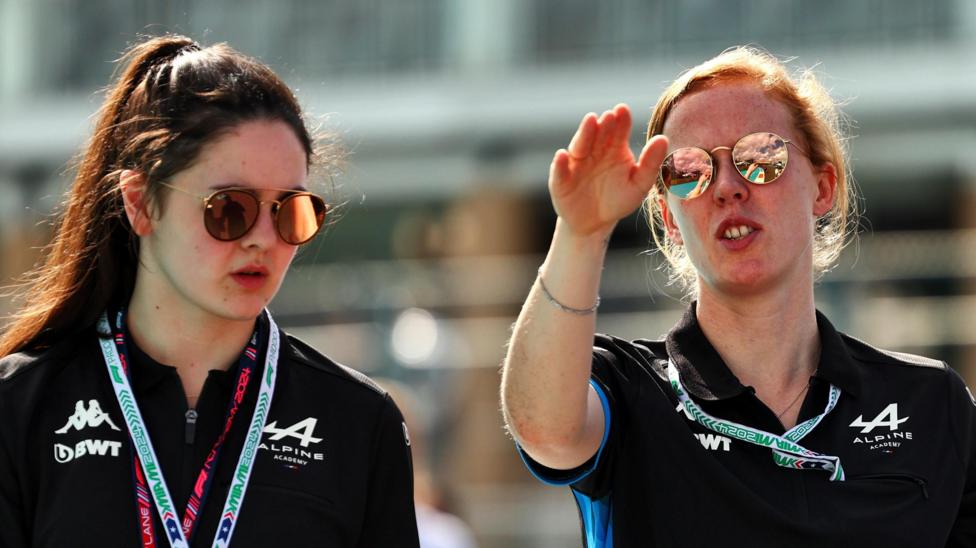
Powell and Pulling Make History as BBC's First All-Female F1 Commentary Team
Alice Powell and Abbi Pulling shatter broadcasting barriers at Barcelona, bringing racing credibility to the commentary booth.

Silverstone's High-Speed War Demands New Aero Philosophy
The 2026 British Grand Prix exposed how the new regulations have turned Silverstone into the ultimate aerodynamic stress test.
Palmer's Call: Ferrari Must Back Hamilton Over Leclerc for 2026
Jolyon Palmer insists Ferrari should rally behind Lewis Hamilton and make Charles Leclerc play second fiddle for the 2026 title fight.