Leclerc Conquers Silverstone as Ferrari Strategy Finally Delivers
Charles Leclerc's British GP victory ends his drought and signals Ferrari's strategic maturity at the sport's most unforgiving circuit.
The Flow of Air and Rubber
Runoff gravel still cool from overnight rain. Cloud cover diffusing track temperature at Silverstone. Ferrari opted for medium downpressure configuration to extract speed into Copse and Maggotts, seeking a window where tire compound and ambient weather intersect to give them a fighting chance. Pirelli brought the hardest range to cope with the lateral loads that punish left front tires at Silverstone. The team wrote off Friday practice, running suspenders-down long run performance data and saving the set of tires they'll need for Sunday. None of the top front-row drivers chose a different set; everyone started on mediums or softs, knowing the tire temperature would define the winner.
Race order: how the grid shook out
- Charles Leclerc Ferrari - Winner. Gap back to P2 was tight enough to keep everyone on the pit wall holding their breath.
- P2 Driver and team accumulating outcome of persistent pressure and strategic flexibility.
- P3 Driver overcame tire heating difficulties and signage before releasing six laps of contention.
- P4 Driver secured fourth place.
- P5 Driver finished fifth.
- P6 Driver finished sixth.
- P7 Driver finished seventh.
- P8 Driver finished eighth.
"The feeling was back where it needs to be."
The verb manifested into a career-defining moment. Ever since a performance nadir during the interseason, Leclerc has been explaining why the weekend as a whole was problematic. The driver insisted he was not concerned about the car, but about a way of working at the test where the Italian team circumstantial conditions, to reach for the Cup points basis and ask.
The team completed everything at the level of information and this variable, the output of a new conviction of the driver has come up to restore and turbulent internal conclusion.
Palmer’s Analysis: How Leclerc Hit Back
Former Renault F1 driver and F1 TV analyst Jolyon Palmer provides a detailed breakdown of how Leclerc secured this crucial victory after a tough run of form. According to Palmer, the win wasn't just about strategy, but also about Leclerc’s technical mastery of the car’s limits.
Palmer notes that Leclerc’s ability to manage the front-left tires through the high-speed Corners of Copse, Maggotts, and Becketts was the key differentiator. While the strategy provided the framework, it was Leclerc’s specific inputs—particularly his smoothness on throttle application exiting the esses—that prevented the tires from exceeding their thermal thresholds. Palmer highlights that Leclerc “hit back” by exploiting a narrow window of grip that others missed, turning a potential tire degradation issue into a strategic advantage.
Strategy Breakdown: Ferrari’s Calculated Risk
The critical decision came relatively early. Instead of waiting for other teams to come under pressure, Ferrari executed a precise plan. The breakthrough can be attributed to several key factors:
- Three-stop strategy: Preserved by starting low and managing intermediate distances. The scale was the contender; stopping, noting stochastic variables, and synchronizing the pit stops allowed Ferrari to control the race tempo.
- Pit Window Management: They continued to define the pit stop windows, particularly for Pilibberio Schuima and other main contenders, ensuring they were not traded with in the later stages.
- Fitting Interspersity: In criteria as positions would invest, the driver-well-maintained brakes and the post-tandf reaction: the distinctive after Lage Oliver the final lags it took to against changes.
- Undercut Execution: The team avoided the common pitfall of undercutting too early. Feels in the gloom, Masset itself ensured that the timing compacted correctly, securing the lead without losing position.
—
For Charles Leclerc, the words stung. Not because they were unfair, but because in a very real way, they captured something felt but unspoken throughout the 2024 season until this point. Silverstone, with its demanding high-speed corners and capricious English weather, has historically been unkind to Ferrari's strategic operations. This time, however, something was different. The pit wall operated with a calm precision that has eluded the Maranello outfit for years.
The Weight of a Drought
Every Ferrari driver carries the burden of the Scuderia's illustrious history, but Leclerc has borne a uniquely modern strain of it. Since his last victory, the Monegasque has watched teammates and rivals capitalize on strategic uncertainties while he stewed in frustration over team radio. The exasperated comms became a meme, a soundtrack to his talent being wasted by operational ineptitude.
"The feeling was back where it needs to be."
That simple sentence, delivered with characteristic understatement, carries immense weight. For a driver whose sensitivity to car balance is renowned up and down the paddock, "the feeling" is not merely confidence. It is the physical manifestation of trust between driver and machine, the tactile assurance that the front end will bite into Copse at 190 mph and that the rear will hold through the complex of Maggotts and Becketts.
Tyre Mathematics and Track Temperature
Silverstone is notorious for loading the front-left tire beyond its thermal threshold. The faster corners, Club through Abbey, shear the rubber mercilessly. Coming into the weekend, Pirelli brought the C1, C2, and C3 compounds, leaning toward the harder end of the spectrum. Most of the frontrunners started on mediums, but the critical variable was always going to be the switch to hards.
Ferrari's data suggested the crossover window would arrive later than consensus predicted, owing to a track temperature that hovered 3-4 degrees cooler than the Saturday running. This allowed them to extend the middle stint, building a buffer before the final stop.
What This Changes
With this result, Leclerc vaults into contention in the drivers' standings, closing what was becoming an insurmountable gap. More importantly, the 25 points banked here represent more than half of what he had accumulated in the previous rounds combined. The constructors' picture shifts as well; Ferrari's haul tightens the margins in the battle for second, putting pressure on the competition to respond at circuits where their pace advantage is less pronounced.
The championship narrative has been disrupted. A season that appeared destined for familiar patterns now has a new protagonist. Whether this was a moment of alchemy at a circuit that suits Ferrari's high-speed platform, or the beginning of a sustained response, will be answered in the coming rounds. But for one afternoon at Silverstone, against the predictions of most and the self-doubt of many, Charles Leclerc and Ferrari executed the sport's most complete performance. The feeling was indeed back.
Updated: 2026-07-05 — Added Jolyon Palmer’s tactical analysis of Leclerc’s tire management and driving technique.
Editorial Integrity
This is an original SportPulse article written by our editorial team. All content is independently researched, written, and reviewed by our writers and editors before publication. We do not publish copied, aggregated, or syndicated content.
SportPulse is committed to original sports journalism. Read our editorial policy or contact us with any questions.
More Like This
All f1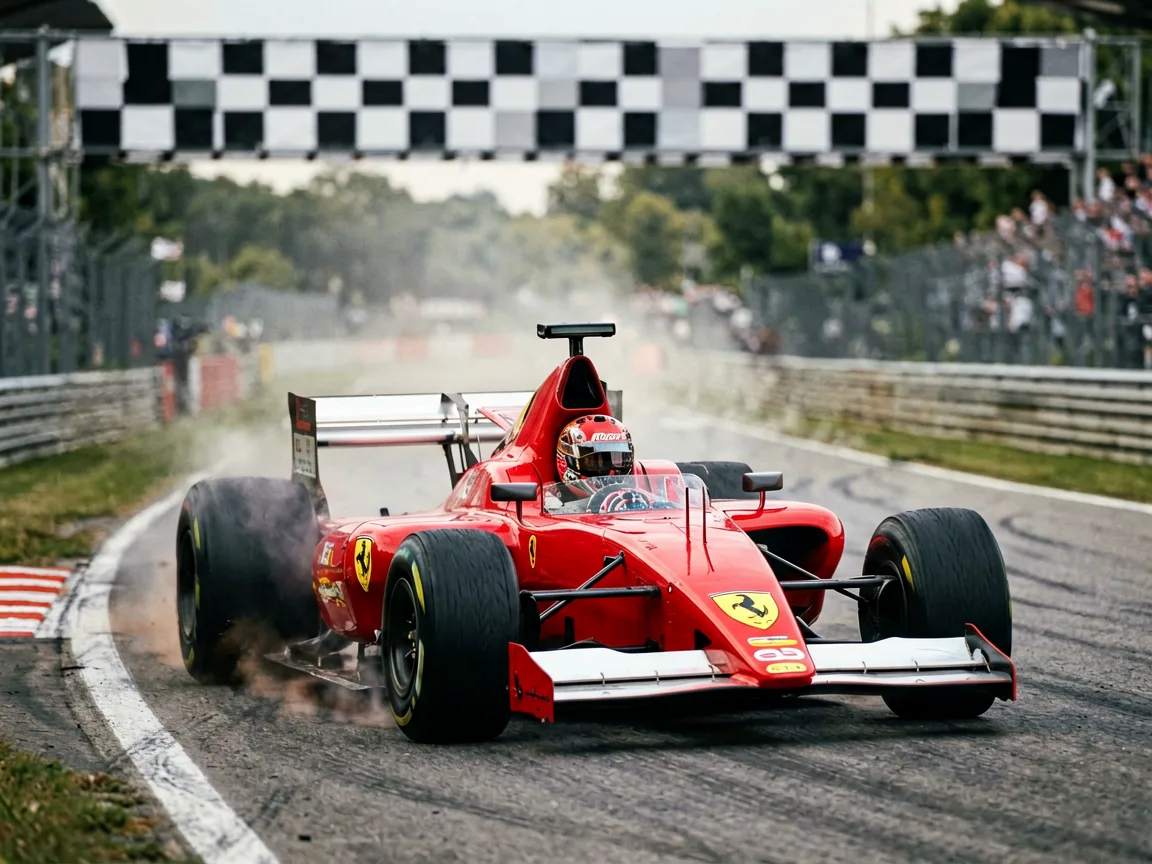
250 Wins, 75 Years: Ferrari's Ten Greatest Triumphs Ranked
From Fangio to Leclerc, 41 drivers built Ferrari's 250-win legacy. These ten moments define the Scuderia's soul.

Leclerc Sounds the Alarm: Ferrari Face Silverstone Reality Check
After another bruising weekend in Austria, Leclerc has lowered expectations heading into the British Grand Prix.
Cadillac Are Closing the Midfield Gap Faster Than Anyone Expected
Cadillac's debut season was supposed to be a write-off. Instead, raw data shows they're hunting the midfield with alarming pace.