Silverstone Awaits: Lindblad's Homecoming Tests More Than Nerves
Arvid Lindblad faces Silverstone's high-speed crucible as an F1 rookie — a circuit that separates the prepared from the overwhelmed.
The Circuit That Demands Everything
Silverstone does not care that Arvid Lindblad is 18 years old. It does not care that this is his first British Grand Prix as a full-time Formula 1 driver. The former RAF airfield turned cathedral of speed will ask him the same question it has posed to every rookie since 1950: can you commit to Copse at 190 mph with a car that has barely 600 kg of downforce pushing it into the asphalt, knowing that a moment's hesitation costs you four tenths and a moment's overcommitment costs you a front wing?
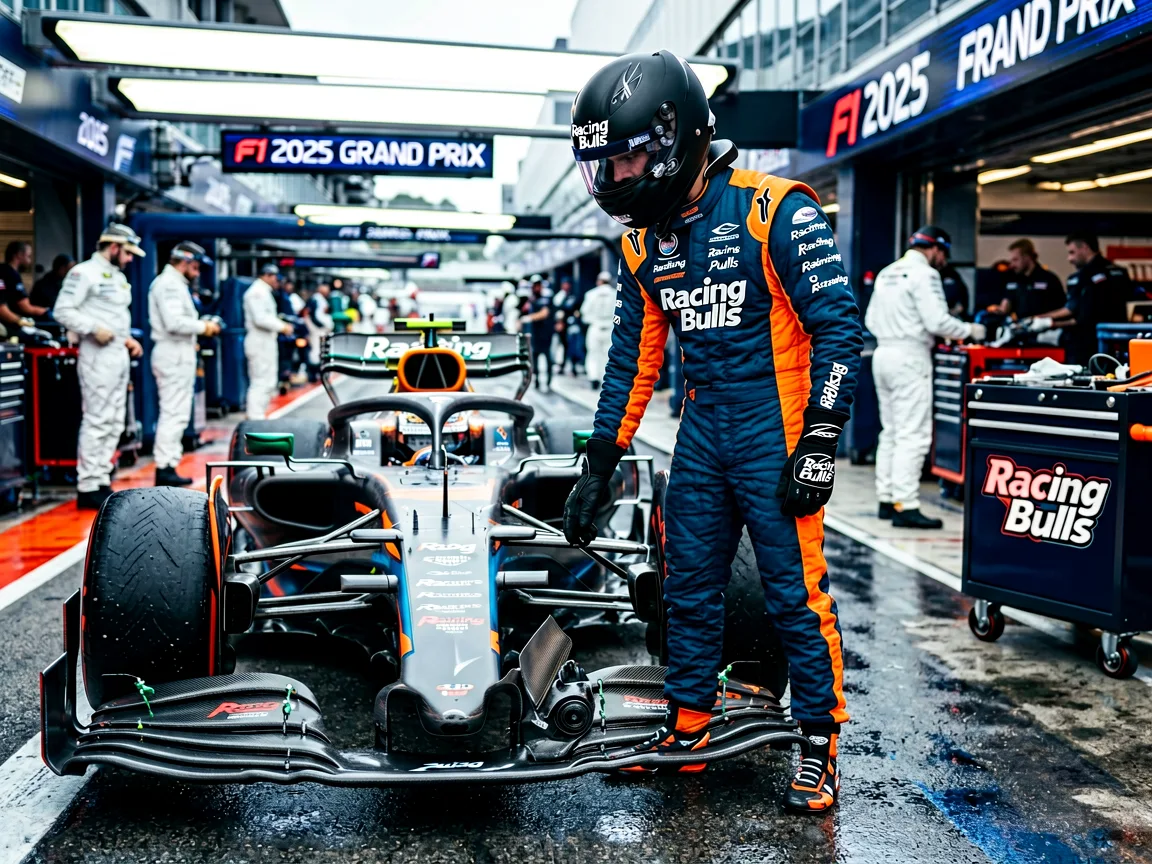
For Lindblad, driving for Racing Bulls in 2025, that question arrives this weekend layered with the emotional weight of a home crowd, a specially designed helmet, and the quiet pressure of proving that Red Bull's decision to promote him from their junior programme was the right call.
A Rookie Season Still Finding Its Shape
Lindblad's path to the 2025 grid was anything but conventional. Born in Surrey in 2007 to a Swedish father and British mother, he carried dual heritage through a karting career that caught Red Bull's attention early. A dominant F3 campaign followed, and by late 2024 the Racing Bulls seat was his. The youngest driver on the current grid stepped into a team that has historically served as a proving ground for Red Bull talent — the same pipeline that delivered Max Verstappen, Pierre Gasly, and Yuki Tsunoda.
The early races of 2025 have been a learning curve, as they are for every rookie who inherits a car with ground-effect aerodynamics that punish inexperience. Lindblad has shown flashes of raw pace, particularly in qualifying trim, but the consistency required to convert single-lap speed into points over a 58-lap race distance remains a work in progress. That is entirely normal. What is not normal is the venue for his home race.
Why Silverstone Is a Technical Gauntlet
From an engineering standpoint, Silverstone is one of the most aerodynamically demanding circuits on the 24-race calendar. The sequence from Maggotts Corner through Becketts and into Chapel is a sustained high-speed assault that requires the car to maintain peak downforce through rapid direction changes at speeds exceeding 280 km/h. Unlike street circuits where mechanical grip and traction dominate, Silverstone rewards teams that have nailed their floor geometry and porpoising management.
For the Racing Bulls VCARB car, this presents a specific challenge. The team's 2025 machine has shown stronger performance at low-to-medium speed circuits, where its rear suspension compliance and traction out of slow corners give it an advantage. Silverstone's emphasis on high-speed balance and aerodynamic efficiency will test whether the engineers have unlocked the upper operating window of their package.
The suspension geometry is critical here. Modern ground-effect cars run extremely stiff setups to maintain the floor's proximity to the track surface, but Silverstone's kerb riding through Club and Abbey demands a compromise. Too stiff and the car becomes unpredictable over bumps; too soft and you lose the consistent ride height that keeps the diffuser producing peak downforce. For a rookie like Lindblad, finding that balance in free practice sessions is a race against the clock.
Engineering Insight: The Floor Seal at Silverstone
The key technical battleground this weekend will be floor edge sealing through the high-speed sweeps. Under the current ground-effect regulations introduced in 2022, the venturi tunnels beneath the car generate the majority of total downforce. But they only work when the floor edges maintain a consistent seal against the track surface.
At Silverstone, the long-duration, high-load corners like Copse and Stowe create lateral forces that can momentarily break that seal on the inside edge of the car. When that happens, the downforce drop-off is not linear — it is sudden, creating what engineers call a snap oversteer moment. The top teams have developed sophisticated vortex generators along the floor edge that use airflow from the front wing to create an invisible curtain, effectively sealing the floor even under extreme roll angles.
For Racing Bulls, the question is whether their floor specification has reached the same level of refinement. The budget cap means teams cannot simply throw carbon fibre at the problem; every upgrade must be validated in the wind tunnel within their allocation limits. Lindblad's engineers will be poring over his telemetry from the opening laps of FP1 to see how the car behaves through the Maggotts-Becketts complex and whether the floor is holding its aero platform through those direction changes.
"Silverstone is the circuit where you find out what your car is really made of. It strips away the tricks and shows you the raw aero performance." — A common sentiment among F1 technical directors when discussing the British Grand Prix weekend.
The Helmet and the Heart
Lindblad has spoken about designing a special helmet for his home race, a tradition that has become increasingly personal in modern F1. For a driver who has spent his formative years watching British heroes race at this circuit — Lewis Hamilton's iconic Copse pass on the final lap in 2022, Nigel Mansell's legendary 1987 victory — wearing a helmet that honours that legacy while marking his own arrival carries emotional weight.
The home crowd factor is real but nuanced at Silverstone. The British fans are among the most knowledgeable in the world, filling every grandstand with over 400,000 spectators across the weekend. They will cheer for Lindblad, but they will also dissect his every lap. There is no hiding at a home Grand Prix, and for a rookie still building confidence in a car that can punish the slightest miscalculation, that visibility is both a gift and a burden.
What the Data Tells Us About His Chances
Without specific lap time data from Lindblad's season so far, the honest assessment is that points would represent a strong weekend for the Racing Bulls driver. The team has historically performed best when they execute clean strategy calls and avoid the midfield chaos that often defines the opening laps at Silverstone — Turn 1 at Abbey and Turn 3 at Village are notorious for first-corner incidents, and a rookie's ability to navigate that traffic safely can define their entire weekend.
What matters more than the result is the trajectory. Is Lindblad extracting more from the car each weekend? Are his tyre management skills improving over long stints? Is the gap to his more experienced team-mate narrowing? These are the metrics that Red Bull's management will be tracking as closely as the lap times themselves.
Looking Ahead: The Technical Test of Silverstone
Silverstone sits at an important point in the 2025 calendar. Teams are bringing their mid-season upgrade packages, and the high-speed nature of the circuit provides one of the clearest reads on aerodynamic development. For Lindblad and Racing Bulls, this weekend is as much a data-gathering exercise as it is a competitive event.
The information they collect on the car's behaviour through the high-speed sector will feed directly into development decisions for the second half of the season. If the car struggles through Becketts, that tells the aerodynamicists exactly which part of the floor or diffuser needs refinement. If Lindblad can extract competitive lap times despite the car's limitations, that tells the team something equally valuable about their young driver.
The British Grand Prix has a way of writing stories that matter. For Lindblad, the story this weekend is not about the result on Sunday evening — it is about proving, to himself and to the people who bet on his talent, that he belongs on this grid. Silverstone will not hand him that proof. He has to go out and take it, one committed corner at a time.
Editorial Integrity
This is an original SportPulse article written by our editorial team. All content is independently researched, written, and reviewed by our writers and editors before publication. We do not publish copied, aggregated, or syndicated content.
SportPulse is committed to original sports journalism. Read our editorial policy or contact us with any questions.
More Like This
All f1
Williams Wraps FW47 in Union Jack Glory for Silverstone Homecoming
Williams unveils a Union Jack-inspired livery for the British Grand Prix, merging heritage pride with a crucial development weekend.
Lawson 'wasn't the same' after Red Bull demotion, says Permane
Racing Bulls boss Alan Permane reveals the psychological toll of Liam Lawson's swift demotion from Red Bull after just two 2025 races.
Palmer's Call: Ferrari Must Back Hamilton Over Leclerc for 2026
Jolyon Palmer insists Ferrari should rally behind Lewis Hamilton and make Charles Leclerc play second fiddle for the 2026 title fight.