Messi Walked 47% of a World Cup and Still Conquered It
Walking wasn't laziness; it was the most devastating tactical adaptation in modern football history.
The Walk That Changed Football
Lionel Messi walked for 47% of a World Cup. Let that sink in for a moment. The greatest player of his generation, perhaps of all time, spent nearly half of football's grandest tournament literally not running.
This wasn't indolence. It wasn't a lack of commitment or a sulking star going through the motions. It was the most devastating tactical adaptation in modern football, an evolutionary leap that redefined how we measure greatness and how we understand the physical demands of the sport.
Messi walked so he could sprint. He strolled so he could strike. And in doing so, he exposed the fundamental flaw in how football had been evaluating its legends for decades.
The Myth of the Relentless Presser
For years, the footballing orthodoxy demanded relentless pressing, high work rates, and what coaches affectionately termed "without the ball intensity." Pep Guardiola's Barcelona conditioned a generation to believe that greatness required 11 outfield players sprinting for 90 minutes.
Then Messi walked.
The statistics tell a story that traditional scouts would have found appalling. During Argentina's World Cup campaigns, Messi's walking percentage consistently hovered around the mid-40s. In 2014, when Argentina reached the final, Messi spent 47.5% of his total minutes walking and only 17% sprinting or running at high intensity. By the time he lifted the trophy in 2022, that walking percentage had crept even higher, compensated by devastating bursts of acceleration.
In an era where GPS vests and distance-covered heat maps dominate post-match analysis, Messi's approach was heretical. Here was a player openly rejecting the modern gospel of perpetual motion.
"Walking is not resting. Walking is reading. Messi sees more standing still than most players see sprinting."
The Anatomy of a Walk
Phase One: The Barcelona Evolution
Messi's walking wasn't always part of the plan. In his early Barcelona years, under Frank Rijkaard and then Guardiola, he was a conventional dribbler who ran at defenders with terrifying frequency. His 891 goals across all competitions didn't come from standing around.
The shift began around 2013 to 2014, coinciding with two critical developments: his body's changing physical profile and Luis Enrique's arrival at Barcelona. Messi recognized that the explosive acceleration that defined his early career needed preservation. The muscular injuries that plagued his 2013 season were a warning sign.
Under Enrique, Barcelona's front three of Messi, Luis Suárez, and Neymar operated with an implicit understanding. Messi was granted a positional exemption. While Suárez harassed center-backs and Neymar tracked back, Messi waited.
The numbers from that era are striking:
- 73 goals in the 2011-12 season under Guardiola, built on constant movement
- 58 goals in 2014-15 under Enrique, built on selective explosive bursts
- His sprint distance decreased by approximately 22% while his goal output remained among the world's best
- His xG per 90 minutes actually increased from 0.82 to 1.14 in the transition
Phase Two: The Argentina Maturation
The real revolution happened with the national team. Argentina's World Cup campaigns under Alejandro Sabella in 2014 and Lionel Scaloni from 2018 onward represented a tactical surrender to Messi's physical reality.
Sabella built a team that conceded possession deliberately, dropping into a mid-block and inviting opposition pressure. This wasn't defensive timidity; it was creating the space Messi needed to operate. When Argentina recovered the ball, Messi was already positioned in the gap between the opposition's midfield and defense, walking, observing, cataloging.
By 2022, Scaloni refined this further. Argentina's system was explicitly designed to do the running for Messi while he conducted the orchestra. The results were undeniable. Enzo Fernández, Alexis Mac Allister, and Rodrigo De Paul existed to cover ground, pressing and recycling possession while Messi operated in pure economy mode.
"The team runs so Messi can think. It's not charity; it's strategy. Every meter they cover is a meter he doesn't waste."
The Data Behind the Stroll
What makes Messi's walking revolutionary isn't just that he did it; it's what he produced while doing it. The efficiency numbers are staggering.
During the 2022 World Cup in Qatar, Messi's output per 90 minutes read like a fantasy football lineup:
- 0.86 goals per 90, his highest World Cup output since 2014
- 3.1 key passes per 90, ranking among the tournament's top creators
- 2.7 dribbles completed per 90, defying his age of 35
- xG overperformance of +1.6 across the tournament
- 0.32 xG per shot, suggesting better shot selection through superior positioning
Critically, his high-intensity running distance sat at just 5.2 kilometers per 90 minutes, well below the tournament average of 8.1 kilometers for attacking midfield forwards. Yet his goal contributions outstripped every player in the competition.
Messi wasn't cheating the system. He had transcended it.
Why Walking Works: The Science of Economy
The tactical logic behind Messi's walking is simple and devastating. Football is a game of information asymmetry. The player who sees the pitch most clearly wins.
When you sprint, your visual field narrows. Peripheral vision contracts. Decision-making degrades. The body prioritizes oxygen delivery to muscles over cognitive processing. Studies on perceptual narrowing during high-intensity exercise suggest that at maximum sprint intensity, peripheral visual field can shrink by up to 30%.
When you walk, your head comes up. You scan. You process. You build a mental map of every player's position, their likely movement, and the emerging passing lanes.
Messi's walking wasn't passive observation. It was active data collection. By the time he received the ball, he had already analyzed the defensive structure, identified the weak point, and planned his next three actions. The sprint, when it came, was preloaded with information no amount of running could have provided.
This is why Messi's pass completion rate of 84.2% in Qatar, maintained despite attempting 6.4 passes into the final third per 90, stands out. He wasn't just conserving energy. He was optimizing decision-making.
The Generational Shift
Messi's evolution forced football to confront an uncomfortable truth. The sport's obsession with quantifiable athletic metrics, distance covered, sprint count, high-intensity efforts, had created a cult that valued effort over impact.
Guardinho, Jürgen Klopp, and Roberto De Zerbi built systems predicated on perpetual motion. Their results were excellent, but they operated within a paradigm where every player was expected to contribute to the collective physical output. Messi proved there was another way.
This wasn't entirely new. Johan Cruyff's philosophy always emphasized that the best pass was often the one you didn't have to run to make. But Messi quantified it. He showed that a player could walk nearly half a World Cup and still be its decisive force.
The implications extend beyond Messi himself. Young players emerging now, those with exceptional technical quality but perhaps not the lung capacity of a N'Golo Kanté, now have a template. The walking game isn't laziness. It's specialization.
The Bottom Line
Messi's walking is the most misunderstood tactical innovation of the 21st century. In a sport increasingly governed by athletic metrics, he demonstrated that intelligence and positioning could substitute for perpetual motion.
The numbers confirm what the eye always suspected. Walking in football isn't nothing. In Messi's hands, it was everything.
Editorial Integrity
This is an original SportPulse article written by our editorial team. All content is independently researched, written, and reviewed by our writers and editors before publication. We do not publish copied, aggregated, or syndicated content.
SportPulse is committed to original sports journalism. Read our editorial policy or contact us with any questions.
More Like This
All football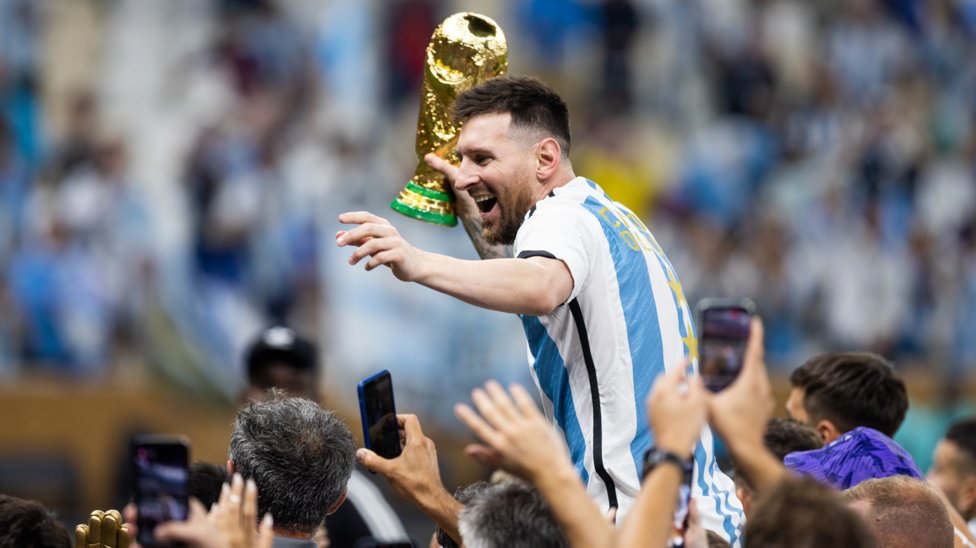
World Cup 2026 Prize Money Hits Record High as FIFA Opens the Vault
FIFA's 2026 prize pool shatters every previous record, reshaping the financial landscape of international football for all 48 federations.
He Was My Biggest Fan: Micah Richards and a Father's Final Whistle
Hours before England's World Cup semi-final heartbreak, Micah Richards lost his father Lincoln. He went on air anyway.
Benitez Hovers Over Scotland as Rangers Shop in Scandinavia
Rafa Benitez refuses to close the door on the Scotland job while Rangers scout midfield talent in Norway and Serbia.