Silverstone Sprint Steward Verdict: The Technical Reality Behind Lawson's Investigation
Stewards cleared Liam Lawson after the Silverstone Sprint, but the technical nuances of the investigation reveal deeper regulatory complexities.
The stewards' verdict is in. Liam Lawson, investigated following the conclusion of the Sprint at the British Grand Prix, has been cleared of any wrongdoing. For the casual observer, a steward's decision might appear to be a simple yes-or-no judgment on a specific incident. For those of us who look at Formula 1 through an engineering lens, the outcome represents a complex intersection of telemetry data, aerodynamic dirty air, and the delicate balance of mechanical grip that defines modern motorsport policing.
At the heart of the Silverstone Sprint investigation was the intricate dance between the stewards and the real-time data feeds they scrutinize. When the FIA Stewards Panel summons a driver, they are not simply judging what they see on the broadcast feed. They are dissecting a multi-layered digital blueprint. In Lawson's case, the investigation required analyzing the brake bias migration, the steering angle inputs, and the precise throttle pedal position traces of his RB-01 chassis.
The Telemetry Autopsy
High-speed circuits like Silverstone amplify the consequences of every microscopic input. The former airfield layout features some of the most demanding high-speed corners on the calendar, particularly through the legendary Maggotts-Becketts-Chapel complex. When cars navigate these sections, they operate on the very edge of the aerodynamic window. A millimeter too much steering lock puts you on the marbles; a millimeter too little compromises your exit speed.
The conditions at Silverstone during the Sprint weekend presented their own unique engineering challenge. Despite the historical reputation of the British venue for wet and unpredictable conditions, the Sprint itself unfolded under relatively stable surface temperatures. Lawrence's setup window for the Visa Cash App Racing Bulls team required a specific mechanical balance tailored to the smooth asphalt of the Northamptonshire track. Silverstone's surface is notoriously abrasive, demanding a high-downforce configuration that pushes the limits of the Pirelli range.
Data Points Under Scrutiny
When the stewards interrogate a moment involving a driver like Lawson, who is operating under immense pressure to prove his credentials at the pinnacle of motorsport, they are looking for specific compliance markers:
- Brake pressure trace: Assessing whether the application was linear or spiked
- Delta time varieties: The margin between the off-line moment and the ideal racing line reference
- Tire surface temperature: The direct correlation between sliding friction and ultimate grip degradation
- DRS activation history: Whether the Drag Reduction System deployment timing artificially influenced the momentum balance
- Brake-by-wire system integration mapping
The conclusion of this investigation, which ultimately saw no further action taken against the New Zealander, confirms that his inputs aligned with the expected parameters for a car dealing with transient instability.
Engineering Insight: Why Rookies Get Investigated
Formula 1's stewarding system relies on a framework that flags anomalies automatically. The FIA Race Control Data Net processes a constant feed of positioning data, comparing every car against a pre-programmed ideal racing line. When a car deviates significantly from this reference, particularly while defending or attacking, the system flags it for the human stewards to review. What makes this fascinating from a technical perspective is how the stewards quantify "leaving the track" versus "losing the backend."
Lawson's situation exemplifies a classic engineering challenge: distinguishing between a deliberate attempt to gain an advantage and a simple loss of mechanical grip due to external factors. The stewards examine the aerodynamic wake the car was traveling through. Silverstone's layout generates massive turbulence, particularly when cars are within one second of each other. The leading car's diffuser throws high-energy air upwards, creating a chaotic wash that the trailing car's front wing must ingest. This disrupted air causes a sudden drop in front downforce, sometimes by as much as 30 percent depending on the proximity.
"In these types of high-speed corners, you are relying entirely on the aerodynamic platform. If the data shows a sudden, uncommanded steering correction, it tells us we are dealing with a loss of grip from the turbulent air, rather than an intentional alteration of the racing line. The stewards have access to the same math we do, and the math is absolute."
The stewards' process involves overlaying multiple telemetry channels. They look for a correlation coefficient between the steering input and the yaw rate of the chassis. If the driver is catching a slide rather than deliberately turning to gain track position, the steering torque imprint look distinct from the deliberate action of cutting a corner. In a Sprint format, where every point matters but tire temperatures are artificially low due to the reduced race distance, the window between a legitimate save and an illegal move is vanishingly small.
The Car Beneath the Driver
The VCARB team has made significant strides in understanding the ground effect floor regulations introduced in 2022. The current iteration of the car features a dramatically redesigned floor fence geometry compared to last year's contender, aimed at stabilizing the underbody aerodynamics when the car is subjected to high yaw angles. Silverstone tests this to the absolute maximum. The pressure curve beneath the floor plenum must remain stable even when the chassis slides slightly, to prevent the dreaded porpoising effect from returning.
Lawson's driving style throughout the Sprint showcased a high degree of sensitivity to these aerodynamic shifts. The telemetry from his car indicated a setup that prioritized aero balance over pure mechanical rotation, a sensible choice given the nature of the British track. By running a slightly stiffer anti-dive geometry at the front, the mechanics ensured the front wing remained at a consistent ride height, critical for generating outwash effectiveness. This setup philosophy minimizes the time spent in the transitional phase of cornering, but it also means the car is less forgiving when the rear slip angle exceeds the optimal window.
Race Control's Data Evolution
The investigation also highlights the continuing evolution of Race Control's technological capabilities. In years past, a verdict like this might have hinged entirely on onboard camera footage. Today, the stewards have access to a live feed of raw ECU data from every car on the grid. They can see, in real time, how the Energy Recovery System was deploying, whether the differential lock was ramping up, and exactly how much brake migration Lawson was applying at the apex.
The decision to close the investigation without penalty demonstrates the maturity of this data-driven stewarding model. It also reflects the understanding that modern F1 cars are extremely sensitive to dirty air. When two cars are battling through a complex like Copse or Stowe, the trailing car operates in a completely different aerodynamic environment. The stewards' verdict implicitly acknowledges that when a driver like Lawson is wrestling a 1000-horsepower** hybrid machine through turbulent air, certain deviations from the ideal line are the result of physics, not intent.
Looking Ahead: The Hungaroring Challenge
With the Sprint investigation concluded, the technical focus immediately shifts to the next challenge. The paddock now looks ahead to the Hungarian Grand Prix at the Hungaroring, a circuit that presents a completely opposite aero challenge to Silverstone. While the British track rewards high-speed aero efficiency and brave commitment, the tight and twisty layout outside Budapest demands maximum cornering downforce and excellent slow-speed mechanical grip.
For Lawson and the technical team at VCARB, the setup philosophy will undergo a complete inversion. The front wing flap angles will increase significantly to generate more front-end response. The differential settings will be softened to allow better rotation through the tight second-gear corners. Where Silverstone punished any instability in the aero map, Hungary will test the tire thermal management strategy. The track surface is notoriously smooth, meaning the suspension kinematics must be dialed in to generate enough vertical load to switch on the Pirelli compounds without overheating the surface rubber.
The stewards' verdict at Silverstone is more than just a line in a race report. It is a testament to the fact that in modern Formula 1, the data never lies. When the physics of the situation match the telemetry of the car, justice is done. The next race will provide a different set of variables, a different aero challenge, and a fresh canvas for the engineers to paint their next masterpiece.
Editorial Integrity
This is an original SportPulse article written by our editorial team. All content is independently researched, written, and reviewed by our writers and editors before publication. We do not publish copied, aggregated, or syndicated content.
SportPulse is committed to original sports journalism. Read our editorial policy or contact us with any questions.
More Like This
All f1
Câmara Conquers Chaos in Spa-Francorchamps F2 Thriller
Rafael Câmara fought back through red flag chaos to claim a dramatic F2 Feature Race victory at Spa-Francorchamps.
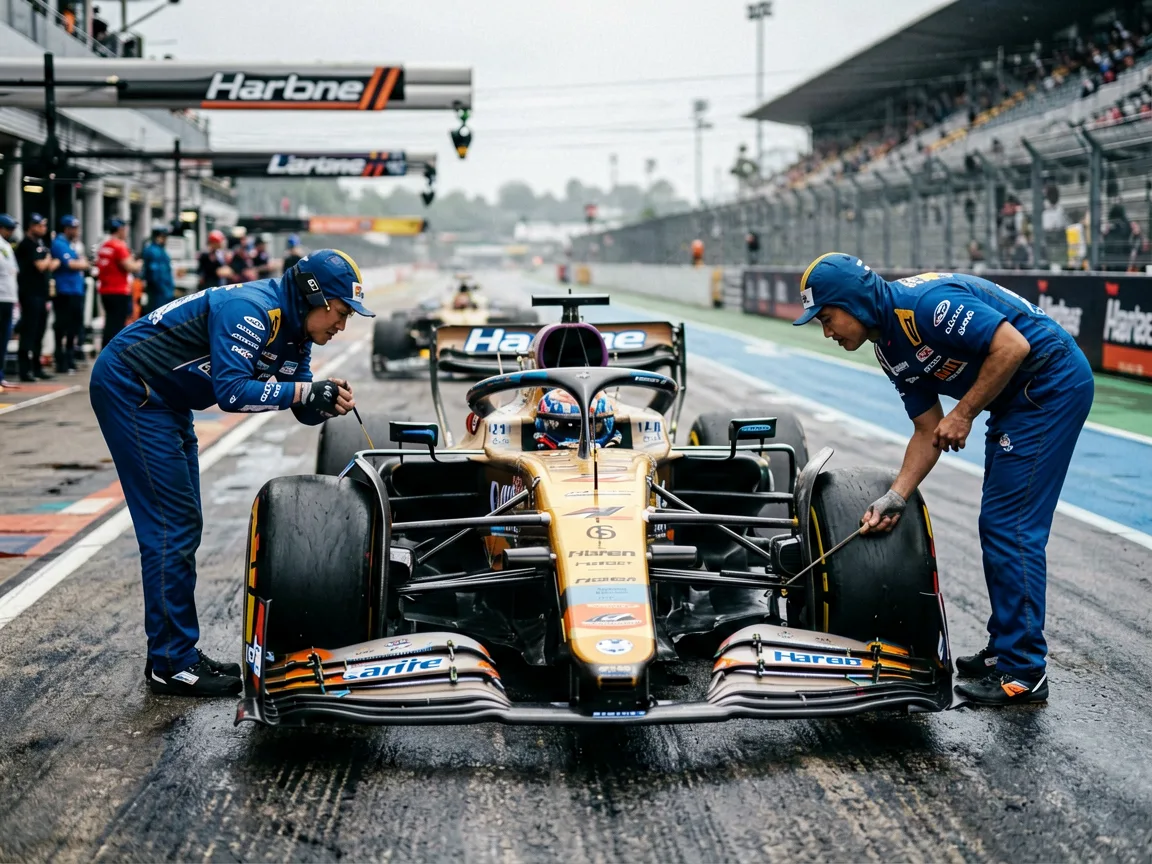
McLaren's Upgrade Reset: The Anatomy of a Philosophy Shift
Andrea Stella overhauls McLaren's development philosophy mid-season, prioritizing correlation and conceptual clarity over raw lap-time delivery.
The School in the Shadow of the Pit Lane: How Silverstone UTC Is Feeding F1's Engineering Hunger
A college overlooking Silverstone is quietly solving Formula One's most critical bottleneck: sourcing the next generation of engineering talent.