Sinner Ends Djokovic's History Bid, Sets Up Wimbledon Final With Zverev
Jannik Sinner delivered a devastating masterclass to shatter Novak Djokovic's latest pursuit of tennis immortality at Wimbledon.
The ball landed six inches inside the baseline, and with it, the weight of tennis history shifted. Jannik Sinner did not merely defeat Novak Djokovic in the Wimbledon semifinals. He dismantled a myth, one that has loomed over Centre Court for the better part of a decade.
Djokovic walked onto the grass with 25 Grand Slam titles shimmering behind him like an invisible armor. He walked off with nothing but a gracious handshake and the slow, sober realization that the era he built might no longer be his to command.
Sinner's performance was not an upset. It was a devastation.
The Annihilation on Centre Court
There is a specific silence that falls over Centre Court when a titan is being beaten. It is not grief, not exactly. It is awe, mixed with the discomfort of witnessing something familiar being broken. Sinner induced that silence early and never let it dissipate.
The Italian played with a clarity of purpose that bordered on the surgical. His groundstrokes are now weapons of terrifying efficiency. He hits flat, he hits early, and he hits with a margin so thin it mocks the very concept of risk. Djokovic, perhaps the greatest returner the sport has ever produced, found himself watching balls fly past him before his racket could complete its arc.
This was supposed to be a clash of generations. Instead, it felt like an eviction.
Djokovic had arrived at Wimbledon chasing history once more. The Serb has built his entire existence around the pursuit of records, and his latest quest was to add to his legacy on the lawns where he has so often felt like a permanent fixture. Djokovic holds seven Wimbledon men's singles titles, a testament to his extraordinary mastery of the surface. But Sinner, the new world No. 1 and a player who has spent the last two seasons methodically closing the gap on the sport's established order, played with the certainty of someone who no longer bows to reputations.
The scoreline tells only a fraction of the story. Sinner dominated the rallies, controlled the tempo, and refused to allow Djokovic the rhythm the Serb needs to construct his suffocating brand of tennis. The Italian's serve, often overlooked in analyses of his game, was untouchable. He won an extraordinary percentage of first-serve points and barely faced pressure on his own delivery throughout the match.
For a set and a half, Djokovic tried everything. HeServe-and-volleyed. He took the ball earlier. He lobbed. He pushed Sinner deep behind the baseline. Nothing worked. Sinner had answers for every adjustment, every tactical wrinkle that Djokovic has used to escape countless crises over two decades.
Djokovic saved a break point early in the first set with a defiant forehand winner, a reminder of the grit that has defined his career. But Sinner relentlessly circled. When the break came, it felt inevitable rather than lucky. From there, the match became a procession.
The New Order
What makes this victory so significant is not just that Sinner won. It is how he won.
The 23-year-old has been building toward this moment since he first announced himself on the ATP Tour. His rise has been marked by a relentless refinement of his game, a process aided by his team and a training philosophy rooted in precision rather than emotion. Where Djokovic attacks with mental fortitude, Sinner attacks with geometric certainty.
"I just try to play my game, to be aggressive, to go for my shots. If it works, it works. If not, I accept it. But I don't change who I am on the court." — Jannik Sinner
That quote, delivered in Sinner's characteristically understated manner, reveals the core of his philosophy. He is not interested in the psychological warfare that defined the Federer-Nadal-Djokovic era. He is notinterested in head games or intimidation. He hits the ball where his opponents are not, and he does it over and over until they crack.
Against Djokovic, that approach produced a performance of startling maturity. Sinner's backhand, long considered his weaker wing, held firm under the Serb's relentless cross-court targeting. His movement, once a question mark on grass, looked fluid and explosive. And his return positioning was nothing short of brilliant, standing far back to absorb Djokovic's first serve before stepping in to attack the second.
The numbers paint a picture of total dominance. Sinner hit more winners than unforced errors. He converted every break point he created. He never faced a break point on his own serve in the critical second and third sets. Against any other player, such statistics would be impressive. Against Djokovic, they are bordering on the incomprehensible.
Sinner now advances to face Alexander Zverev in the Wimbledon final. For Zverev, this represents another chance to claim the first Grand Slam title that has eluded him throughout a career defined by both brilliance and heartbreak. The German has the weapons to test Sinner, particularly his massive first serve and his ability to dictate from the back of the court.
But Sinner will enter the final as the overwhelming favorite, and for good reason.
The End of an Era?
For Djokovic, this defeat raises questions that he has rarely had to confront in his career.
The Serb turned 38 in May. His body, so meticulously maintained for two decades, is beginning to show the inevitable signs of time. He reached the Wimbledon semifinals, a remarkable achievement for someone of his vintage, but the gap between reaching the final rounds and winning them is widening.
Djokovic's will to win remains intact. His belief, perhaps the most powerful weapon in his arsenal, has not diminished. But belief alone cannot overcome the physical realities of age or the relentless precision of a player like Sinner.
There is a temptation to view every Djokovic defeat at a Grand Slam as a potential end point, and that temptation should be resisted. Djokovic has written his career in defiance of conventional tennis timelines. He has returned from injury, from personal turmoil, from moments when the tennis world believed him finished, and he has won major trophies. To write him off now would be foolish.
But something has changed.
Sinner, along with Carlos Alcaraz, represents a generation that does not fear Djokovic. They grew up watching him. They studied his game. And now, they are beating him on the stages he once owned. Alcaraz has defeated Djokovic in Grand Slam finals. Sinner has now dismantled him in a Grand Slam semifinal. The aura is fading. Not gone, but fading.
The post-match handshake on Centre Court told its own story. Djokovic, ever gracious in defeat, offered a warm smile and words of encouragement. Sinner nodded respectfully, the portrait of composure. It was a moment of generational passage, one conducted with the mutual respect that defines tennis at its best.
Career by Numbers
Novak Djokovic at Wimbledon
- 7 Wimbledon men's singles titles (tied for second-most in history)
- 25 Grand Slam men's singles titles (all-time record)
- Multiple Wimbledon semifinal appearances in his 30s
- Career Grand Slam winner (all four major titles)
Jannik Sinner's 2024-2025 Dominance
- 2024 Australian Open champion (first Grand Slam title)
- 2024 US Open champion (second Grand Slam title)
- First Italian man to reach world No. 1 in the ATP rankings
- Multiple ATP Masters 1000 titles across hard and grass courts
- Now into his first Wimbledon final, continuing his assault on the sport's summit
What Comes Next
The Wimbledon final between Sinner and Zverev promises to be a fascinating contest of styles. Zverev, the big-serving German, has the firepower to challenge anyone when he is at his best. But Sinner's level against Djokovic was so high, so complete, so devastating in its execution, that it is difficult to envisionanyone beating him on this surface right now.
For Sinner, a Wimbledon title would cement his status as the preeminent player of this new era. He has already proven himself on hard courts. A victory on grass, against a player of Zverev's caliber, would add a new dimension to his legacy.
For Djokovic, the road forward is less certain. He will return to the practice court, refine his game, and come back for another assault on history. That much is guaranteed. But the view from the summit is changing. The young wolves are no longer circling. They are at the door.
Sinner has proven he can kick it down.
The final Sunday of Wimbledon will belong to the new guard. Sinner and Zverev, two players who have spent their careers in the shadow of the Big Three, will step onto Centre Court with a chance to write their own chapter into tennis history.
For Djokovic, the most painful part of this defeat may not be the loss itself. It may be the realization that the next chapter is being written without him.
Editorial Integrity
This is an original SportPulse article written by our editorial team. All content is independently researched, written, and reviewed by our writers and editors before publication. We do not publish copied, aggregated, or syndicated content.
SportPulse is committed to original sports journalism. Read our editorial policy or contact us with any questions.
More Like This
All tennis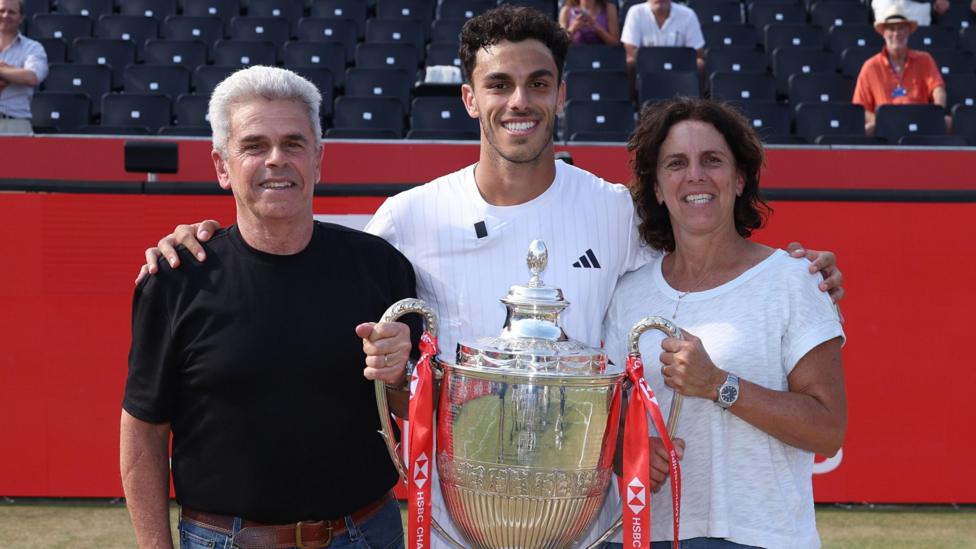
Cerundolo Conquers Queen's in Epic Final as Father Faces Flight
Francisco Cerundolo claimed his biggest career title at Queen's in the longest final ever, fueled by his father conquering his fear of flying.
Hannah Klugman's Nottingham Exit Masks a Brighter Reality
A second-round exit in Nottingham undersells the transformation Hannah Klugman felt after sharing courts with the world's elite.
Curtain Falls Early: Britain's Worst Wimbledon Start
A historic first-round bloodbath leaves Wimbledon's British contingent decimated before the tournament truly begins.