South Africa Stutter Past Bangladesh to Turn Heat on India
South Africa overcame their own dysfunction at Lord's to edge Bangladesh, shifting the T20 World Cup semi-final pressure squarely onto India.
South Africa did exactly what SouthAfrica do best at global tournaments: they made the straightforward agonizingly difficult before eventually securing the result. Their victory over Bangladesh at Lord's does not tell the story of the match, nor does it accurately reflect the shifting dynamics of Group 2. What it does do is apply unmistakable pressure on India in the race for the T20 World Cup semi-finals.
The Proteas walked off the hallowed Lord's turf with two points, but the manner of the performance will have given head coach Rob Walter more questions than answers. Afghanistan showed earlier in the tournament that navigating subcontinental spin on wearing tracks requires fearless intent. South Africa opted for a different, far more perilous route: sheer survival.
The Anatomy of a Stutter
Chasing a modest target on a surface that favored the bowlers, South Africa's top order inexplicably surrendered the initiative. When a team boasts power-hitters capable of clearing the Lord's slopes, grinding out singles against a disciplined Bangladesh spin attack appears counterintuitive. Yet, that is precisely the trap the Proteas fell into.
The middle overs have been a persistent black hole for this batting unit throughout the tournament. Against Bangladesh, the scoring rate plummeted to a claustrophobic 6.42 runs per over between overs 7 and 15. This is not just a dip in tempo; it is a tactical malfunction. Batters retreated into their shells, allowing the required rate to creep upward while the spinners tightened the noose. One partnership briefly stabilized the innings, but the constant loss of wickets at crucial junctions ensured the chase was never comfortable.
On a pitch offering appreciable turn, the inability to rotate the strike amounted to self-sabotage. Boundary options were surrendered in favor of dead-bat defensiveness, a strategy that almost invited Bangladesh back into a contest they had no business winning at the halfway mark.
The Numbers That Matter
- 107 dot balls faced by South Africa in their chase, a staggering indicator of stagnation
- 4 boundaries hit during the entire middle phase (overs 7-16), highlighting a critical lack of intent
- 3.5% boundary percentage in the middle overs, ranking among the worst passages of play by any top-six side in the tournament
- 7 wickets falling to spin across the two innings, emphasizing the pitch dynamics
Bangladesh's Missed Moment
Bangladesh will look back at this fixture as a primal scream of missed opportunity. Their spinners executed the game plan perfectly, dragging the asking rate up and exposing South Africa's chronic vulnerability to slow, radical turn. For 15 overs, they were the superior tactical unit.
However, their batters completely failed to read the room. Setting a target on a wearing Lord's pitch requires guts and preemptive aggression. Instead, the Tigers' batting innings was characterized by the same tentative prodding that would later plague their opponents. A total of under 120 was never going to be enough, even against a South African side seemingly determined to chase it in the most chaotic manner possible.
The powerplay overs were particularly wasteful for Bangladesh. They crawled to 28 for 2 in the first six overs, surrendering the golden period for batting before the spinners took hold. On a ground like Lord's, where the square boundaries demand precise hitting, failing to capitalize on fielding restrictions is a death sentence.
"We had them exactly where we wanted them, but you have to finish the job. We didn't have enough runs on the board to back up the bowling performance." — A harsh but accurate assessment of the Bangladesh batting implosion.
The Bottom Line: Bangladesh possesses the bowling artillery to trouble the very best in these conditions, but their batting blueprint remains fundamentally fractured. Until the top order learns to counter pace with aggression and spin with decisive footwork, they will remain trapped in the tier of nearly-teams.
The Tournament Math: India in the Crosshairs
This is where the result truly resonates. By navigating their way to victory, however unconvincingly, South Africa have moved the goalposts in the semi-final race. The points table now demands a reaction from India.
India's remaining fixtures suddenly carry amplified weight. Net run rate, that perennial tiebreaker, could yet decide the semi-final lineup, and South Africa's scratchy chase actually did them no favors in that specific column. Yet, by getting the win, they have forced India into a corner where draw management is no longer an option.
The pressure itself is a tangible commodity in World Cup cricket. India possess the depth and the star power to dictate terms, but they also carry the crushing weight of a billion expectations. South Africa's ungraceful stumble past Bangladesh simply adds a few more kilograms to that load. If India drop even a single point, the qualifying mathematics become increasingly dependent on other results.
Current Semi-Final Race Metrics
- South Africa: Controlling their own destiny with games in hand
- India: Must win remaining fixtures to guarantee qualification without NRR stress
- Australia: Lurking with superior net run rate, waiting for a slip-up
- Bangladesh: Mathematically alive but practically eliminated after this loss
What Lies Ahead
For South Africa, the immediate task is plumbing the depths of their own inconsistency. You cannot win a T20 World Cup by playing in fits and starts. The bowling attack possesses the venom to trouble any top order, but a batting unit that panics at the sight of spin is a glaring vulnerability that Australia and India will ruthlessly exploit.
The upcoming fixtures will demand a drastic improvement in strike rotation and middle-overs intent. If the Proteas continue to accumulate dot balls at a rate of 100+ per innings, they will eventually be punished by teams with superior bowling depth.
India, meanwhile, must recalibrate. They cannot afford to view the group stage as a gentle warm-up anymore. South Africa have ensured that every match from here on out is a sudden-death eliminators. The Lord's pitch has already shown what happens to sides that fail to adapt: they stutter, they stall, and they eventually surrender.
Verdict: Style points do not matter in tournament cricket. South Africa have the points, the position, and the initiative. But borrowing against the capital of luck is a dangerous game in knockout arenas, and India know they must soldier through high-pressure matches. The race for the semi-finals has suddenly become a technical and psychological battle, and South Africa, despite their stutters, just played their opening hand.
Editorial Integrity
This is an original SportPulse article written by our editorial team. All content is independently researched, written, and reviewed by our writers and editors before publication. We do not publish copied, aggregated, or syndicated content.
SportPulse is committed to original sports journalism. Read our editorial policy or contact us with any questions.
More Like This
All football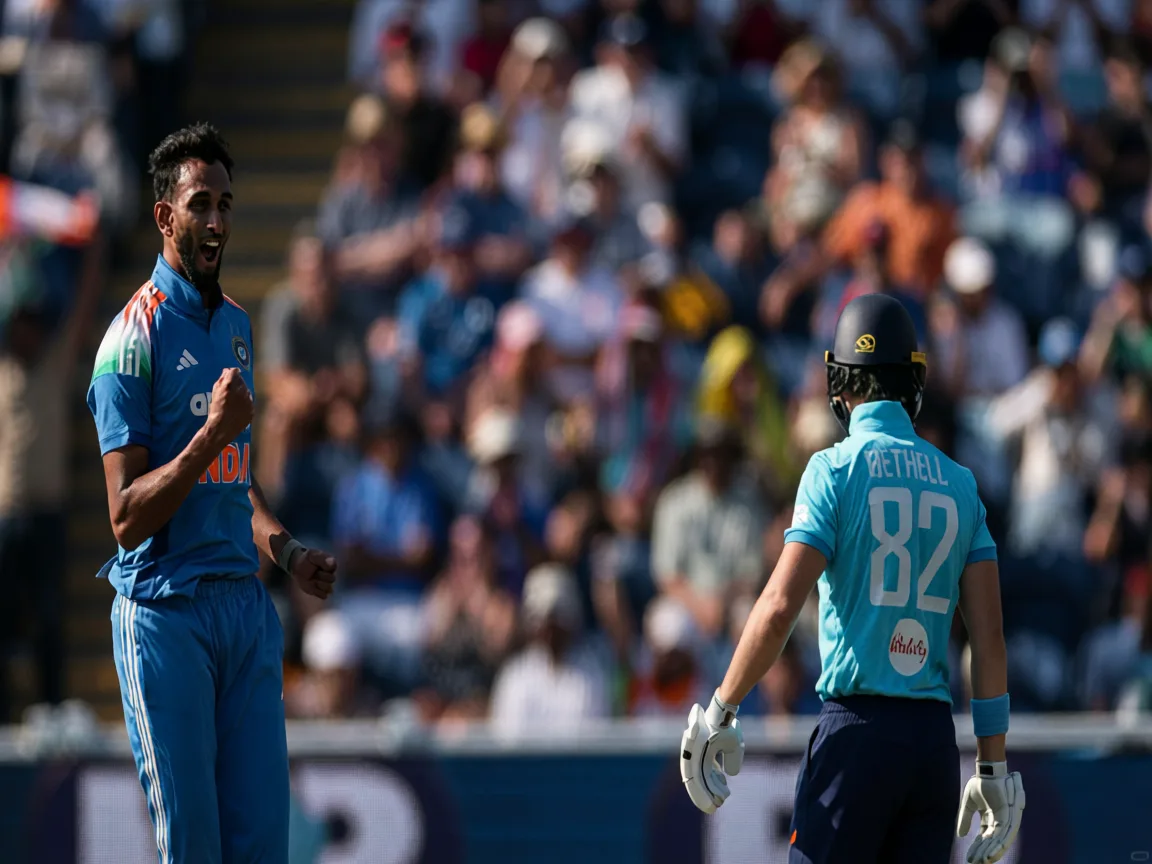
England Top Order Crumbles as India Dominate Cardiff Chase
England slumped to 8-2 inside four overs against India in Cardiff, exposing a top-order crisis that demands urgent reassessment ahead of the World Cup.

Enzo Fernández Dictates Tempo as Argentina Outmaneuver England
A masterclass in spatial control and transitional pressure defines Argentina’s tactical victory over England.

Messi, Yamal, and the Photo That Defies Footballing Logic
A baby bath photo connects Messi to Yamal across decades. Spain's coach calls it destiny, but the tactical lineage is undeniable.