88 Years of Hurt: Switzerland Shatter Their World Cup Curse
Ndoye and Embolo fire Switzerland past Algeria, ending an 88-year knockout stage drought that haunted generations of Swiss football.
The Weight of 88 Years, Lifted in Vancouver
There is a particular kind of suffering that belongs only to nations who keep showing up to the biggest stage in football only to stumble at the same door, over and over and over again. Switzerland know that suffering intimately. For 88 years, the Swiss had failed to win a single knockout match at the World Cup. Since their famous victory over Germany in the 1938 tournament, every generation of Swiss footballers had walked into the round of 16 with hope and walked out with the same hollow, familiar disappointment.
Until now.
Goals from Dan Ndoye and Breel Embolo sealed a comprehensive 2-0 victory over Algeria in Vancouver, sending Switzerland into the quarterfinals of the 2026 World Cup and burying one of international football's most stubborn hoodoos. This was not a scrappy, backs-to-the-wall survival. This was controlled, purposeful, and overdue.
A Pattern of Pain
To understand what this result means, you have to understand what came before it. Switzerland have not been a bad World Cup team. Far from it. They have qualified consistently, produced talented squads, and entered knockout rounds as credible contenders. But the round of 16 has been their Bermuda Triangle.
In 2006, they lost to Ukraine on penalties. In 2014, an extra-time goal from Ángel Di María sent them home against Argentina despite a gutsy defensive display. In 2018, Sweden edged them 1-0 in a match where the Swiss created chances but couldn't convert. And then came the nadir: the 6-1 demolition by Portugal at the 2022 World Cup in Qatar, a result so humiliating it threatened to define an entire generation of Swiss football.
That Portugal loss was supposed to be the breaking point, the moment where the psychological scar tissue became too thick to overcome. Instead, Switzerland used it as fuel.
How It Unfolded
From the opening minutes in Vancouver, there was a different energy about this Swiss side. Manager Murat Yakin set up with an aggressive pressing structure that targeted Algeria's build-up play through the centre of the pitch. The Swiss midfield, anchored by the metronomic passing of Granit Xhaka, controlled tempo and territory from the first whistle.
Dan Ndoye opened the scoring with a moment of individual brilliance. The Bologna winger, who has emerged as one of Serie A's most dynamic wide threats over the past two seasons, cut inside from the right flank and struck a low effort that found the bottom corner. It was the kind of goal that separates players who perform in league football from those who perform when the world is watching. Ndoye has been building toward this stage, and he seized it with both hands.
Algeria, to their credit, pushed for an equaliser. They are a proud footballing nation with their own World Cup frustrations, and they showed enough quality in transitional moments to keep Swiss defenders honest. But this was not a day for North African celebrations. Switzerland's defensive shape held firm, with the centre-back pairing winning aerial duels and cutting out through balls with positional discipline.
Breel Embolo sealed the victory in the second half. The Monaco striker, whose career has been interrupted by significant injuries, demonstrated exactly why he remains the focal point of this Swiss attack. His movement in the box was intelligent, his finish clinical. For a player who has missed so much football through ACL and knee problems, this was a moment of pure catharsis.
Tactical Breakdown: Yakin's Masterplan
What made this Swiss performance so impressive was not just the result, but the manner of it. Yakin has clearly learned from the tactical naivety that contributed to previous knockout exits. Against Algeria, Switzerland were structured in possession, patient in build-up, and ruthless in transition.
The Midfield Triangle
Xhaka's role was pivotal. Operating as the deepest midfielder, he dictated rhythm with an unusually high pass completion rate, recycling possession and spraying diagonal balls to stretch Algeria's defensive block. Ahead of him, the more advanced midfielders made intelligent runs into half-spaces, creating overloads that Algeria struggled to track.
Wide Threat
Ndoye's performance on the right flank was a masterclass in modern wing play. Rather than hugging the touchline, he repeatedly drifted inside to create central overloads, forcing Algeria's left-back into impossible decisions: follow him inside and leave space for the overlapping fullback, or hold position and give Ndoye the shooting angles he craved.
Defensive Discipline
Switzerland conceded very few clear-cut chances. Their defensive line was well-coordinated, pressing triggers were executed cleanly, and the back four showed a composure that was entirely absent during the Portugal debacle in Qatar. This was a team that had done its homework on Algeria's attacking patterns and neutralised them methodically.
The Bottom Line: This was a complete performance, the kind Switzerland have been capable of producing for years but have consistently failed to deliver when it mattered most. The tactical framework was sound, the execution was near-flawless, and the mentality was that of a team tired of being defined by its failures.
The Embolo Redemption Arc
Few players in this Swiss squad carry as much emotional weight as Breel Embolo. Born in Cameroon, raised in Basel, and representing Switzerland at senior level since 2015, Embolo has always been a player of immense physical talent whose career trajectory has been repeatedly disrupted by injury.
His ACL injury in 2022 was particularly cruel, robbing him of months of football at a time when he was establishing himself as one of Ligue 1's most effective strikers with Monaco. The recovery was long, the doubts were real, and the road back to full fitness was neither linear nor guaranteed.
His goal against Algeria was not just a number on a scoresheet. It was validation. Validation that the hours of rehabilitation, the patience, the mental fortitude required to return from repeated serious injuries were worth it. Embolo played with the intensity of a man making up for lost time, pressing Algeria's defenders relentlessly and holding the ball up with the physicality that has always been his calling card.
What This Means for Swiss Football
Switzerland have long punched above their weight in international football. A country of fewer than nine million people, they have produced consistent World Cup qualifiers, developed talent in elite European leagues, and maintained a ranking that keeps them in the conversation among the sport's second tier of nations.
But the knockout stage drought was a psychological barrier that threatened to undermine all of that progress. Every tournament exit in the round of 16 fed the narrative that Switzerland were perennial underachievers, a team good enough to get to the dance but not good enough to dance once they arrived.
That narrative is dead now. By beating Algeria 2-0 in a convincing, authoritative performance, Switzerland have proven they can handle the pressure of knockout football at the highest level. The 88-year wait is over. The curse is broken. And for the first time since 1938, Swiss fans can look ahead to a quarterfinal with genuine belief.
Looking Ahead
The quarterfinal awaits, and with it comes a sterner test. But Switzerland have earned the right to dream. This squad has the depth, the tactical sophistication, and now the psychological evidence that they belong at this stage.
Xhaka's experience, Ndoye's explosive wing play, Embolo's goal threat, and Yakin's tactical adaptability give Switzerland multiple avenues to compete against anyone left in the draw. The defensive improvements shown against Algeria suggest this is a team that has learned from its past mistakes rather than simply hoping to outrun them.
Eighty-eight years is a long time to wait for anything. For Swiss football, this victory in Vancouver was not just a match won. It was a generation-long burden lifted, a historical anomaly corrected, and perhaps the beginning of something that previous Swiss teams could only imagine.
Verdict: Switzerland didn't just beat Algeria. They beat history. And in doing so, they announced themselves as genuine contenders at this World Cup with a performance that married tactical intelligence with ruthless finishing. The knockout stage hoodoo is over. What comes next could be even more interesting.
Update:
新内容是瑞士vs阿尔及利亚的比赛报道,与已发布的文章报道的是同一场比赛,仅多了Manzambi表现和纽卡斯尔转会兴趣的描述性细节。
Editorial Integrity
This is an original SportPulse article written by our editorial team. All content is independently researched, written, and reviewed by our writers and editors before publication. We do not publish copied, aggregated, or syndicated content.
SportPulse is committed to original sports journalism. Read our editorial policy or contact us with any questions.
More Like This
All football
Lewandowski to Chicago Fire: The Final Act of a Goal Machine
Robert Lewandowski brings 697 career goals to MLS, signing with Chicago Fire through 2028 in a franchise-altering gamble.
City Smash British Transfer Record with £130m Anderson Deal
Manchester City's £130m move for Elliot Anderson signals a seismic shift in how English talent is valued.
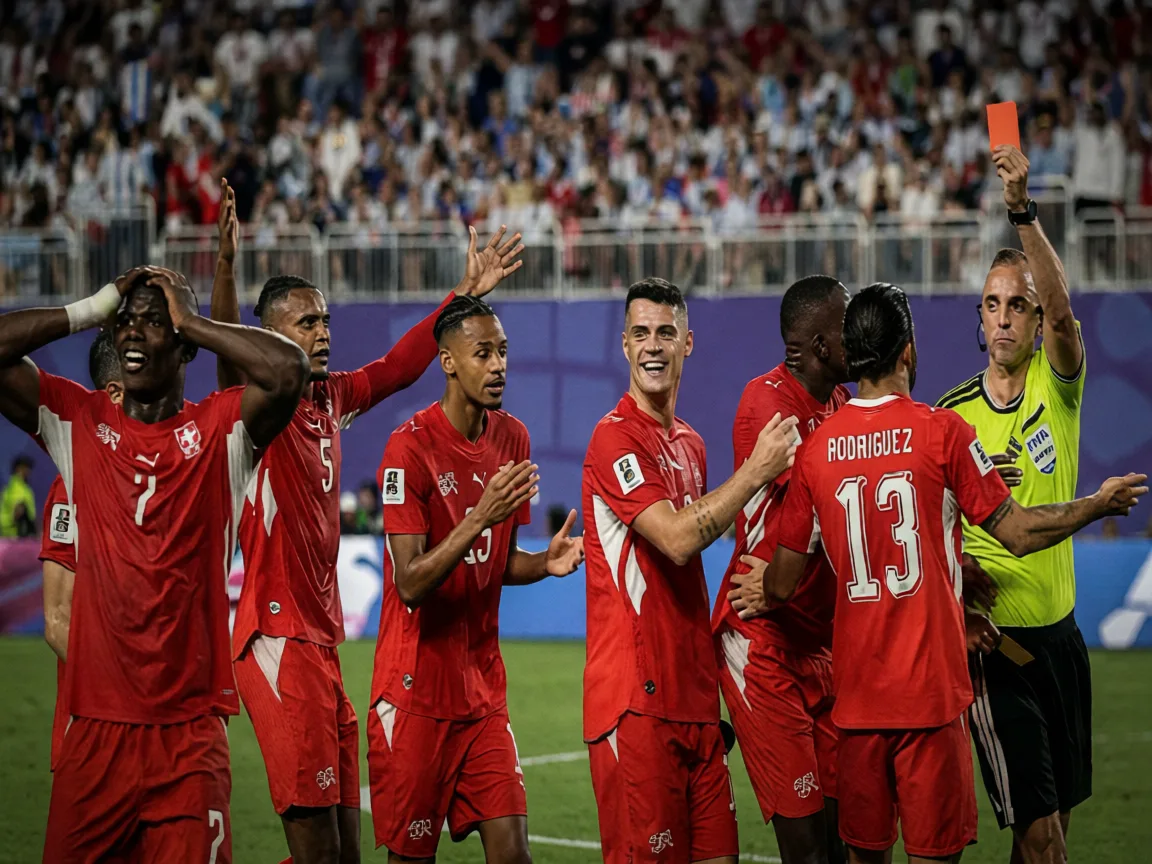
Embolo Makes World Cup History With Bizarre Red Card
Switzerland striker Breel Embolo became the first World Cup casualty of the mistaken identity rule.