Tonali Pursuit Exposes Newcastle's Shrinking Market Power
Tottenham targeting Sandro Tonali proves Newcastle can no longer rely on premium allure to bridge the gap to the elite.
When Sandro Tonali arrived at St James' Park in the summer of 2023, the transfer was heralded as a transformative moment for Newcastle United's Project Reboot. Here was a regista of undisputed European pedigree, a midfielder forged in the tactical crucible of Serie A, choosing the sporting project on Tyneside over the established hierarchy. Yet barely a year later, the competitive landscape has shifted drastically. Tottenham Hotspur, a side that scrapped for their top-flight survival until the penultimate week of the previous campaign, are reportedly circling the Italian. This is not merely a transfer rumor; it is a brutal exposure of the chasm Newcastle must still bridge to firmly establish themselves among England's financial and sporting elite.
The very existence of this pursuit lays bare the structural realities of the modern Premier League. Tottenham, despite their 17th-place finish last season and the chaotic implosion that required a final-day miracle to stave off the drop, retain a gravitational pull that Newcastle are struggling to match consistently. The North London club's enduring draw is rooted in a combination of geography, a 61,000-capacity stadium, and historical cache. For a player of Tonali's profile, the prospect of residing in the capital while earning a Champions League-caliber wage at a club with a recognized global brand remains an intoxicating proposition, regardless of recent on-pitch dysfunction.
Newcastle's initial transfer strategy under the PIF ownership relied heavily on offering Champions League football and an ambitious project to players who would otherwise be out of reach. Following their 4th-place finish in the 2022-23 season, the Magpies leveraged that elite European competition to secure marquee targets. However, the PSR (Profit and Sustainability Rules) constraints that forced the sales of Elliot Anderson and Yankuba Minteh last summer have fundamentally altered the club's operational DNA. They can no longer simply outbid the traditional 'Big Six'. Instead, they must sell to buy, a reality that immediately dilutes their negotiating power when a club of Tottenham's commercial standing enters the frame.
Tonali's specific technical profile makes him an exceptionally coveted asset in the modern market. He is not a conventional destroyer or a purely defensive number 6. He is a deep-lying orchestrator, capable of executing in a double pivot or operating as a single pivot in a 4-3-3. His ability to progress the ball under pressure, combined with a passing range that broke the 100-pass mark on multiple occasions in his final season at AC Milan, makes him the rare midfielder who dictates the tempo of a match without requiring dominant possession statistics.
For Newcastle, Tonali represents the ideological soul of Eddie Howe's evolving tactical system. Howe's preferred 4-3-3 relies on a single pivot who can shield a high defensive line while simultaneously possessing the vision to locate the flanking runs of Anthony Gordon and the interior surges of Alexander Isak. When Tonali found his rhythm before his betting suspension, Newcastle's pressing structure operated with a coordinated intensity that suffocated opposition build-ups. The Italian's positional intelligence allowed the advanced number 8s, Bruno Guimaraes and Joelinton, to compress the space in the half-spaces, knowing the central zone was secured.
Tottenham's interest, however, is rooted in a tactical desperation that stems from their own structural failures. Under Ange Postecoglou, Spurs committed to a highly aggressive 4-3-3 built on an unwavering high line and proactive pressing. Yet the system repeatedly collapsed in transition because the midfield lacked a reliable anchor. Yves Bissouma, for all his physical attributes, struggles with the tactical discipline required for the single pivot role, frequently drifting out of position and leaving the center-backs exposed. Pape Matar Sarr offers industry but lacks the progressive passing range to negate elite counter-pressing. Tonali is the missing thermostat for Postecoglou's tactical boiler room.
The Tactical Shift
The potential movement of Tonali from Tyneside to North London represents a fascinating tactical inflection point that transcends the mere exchange of playing staff. If Newcastle were to lose their primary regista, Howe's entire build-up structure faces immediate downgrading. The manager would be forced into a 4-2-3-1 pivot, pairing Guimaraes with Sean Longstaff or Sandro's replacement. This fundamentally alters the geometry of Newcastle's attack, as Guimaraes would be chained to deeper zones, robbing the team of his revolutionary box-crashing runs from the left half-space that yielded 8 goals and 7 assists across all competitions. The verticality of Newcastle's transition play would be severely blunted.
Conversely, the integration of Tonali into Postecoglou's rigid 4-3-3 would function as the ultimate system stabilizer. The Italian's mastery of rest-defense positioning, the tactical concept of arranging players to immediately win the ball back should possession be lost, would cure Spurs' chronic defensive hemorrhaging on transitions. By reliably occupying the central lane and protecting the vacated space behind the advancing fullbacks, Tonali would de-risk the Australian's all-or-nothing tactical philosophy.
The Financial Reality
The broader context of this transfer tussle is the stark financial divergence between the two clubs, a gap that PSR rules have paradoxically widened. Tottenham possess the luxury of a subsidised stadium and commercial revenue streams that Newcastle's executive team are still desperately trying to engineer. This financial muscle allows Spurs to absorb the risk of a £50m+ acquisition even after a catastrophic season. Newcastle, constrained by the ceiling of their current commercial portfolio, must weigh every significant outlay against the strict parameters of the league's financial rules.
"We have to be incredibly precise in the market. Every signing carries a weight that impacts the next three windows, not just the immediate squad." — Eddie Howe on Newcastle's transfer strategy
The Premier League's enforced financial equilibrium means Newcastle cannot simply absorb the loss of a monumental asset and immediately replace him with a like-for-like upgrade of equal financial value. They are forced to pivot to secondary or tertiary markets, targeting undervalued profiles in leagues with lower commercial pull. This is the precise motivation behind their admiration of players like Martin Zubimendi, whose €60m release clause at Real Sociedad represents a fixed, knowable cost in an inflating market. However, competing for the Spaniard's signature brings them into direct conflict with Arsenal and Liverpool, clubs who possess a far more compelling European narrative.
What This Means for the Hierarchy
The Tonali situation serves as a barometer for Newcastle's current standing in the English football ecosystem. They have successfully completed the first phase of their project: acquiring elite talent, qualifying for the Champions League, and establishing a top-half baseline. The second phase, retaining that talent when the traditional elite come calling, requires a degree of inertia that can only be generated by consistent qualification for Europe's premier competition. A club hovering in the 5th to 8th positions cannot simply project ambition; it must demonstrate functional superiority.
Tottenham's brazen pursuit, despite their own well-documented dysfunction, indicates that the market still views Spurs as a bigger club. They are backed by a stadium that generates matchday revenue exceeding £100m annually. They offer the cultural and commercial pull of London. Until Newcastle can consistently outperform Tottenham on the pitch to secure Champions League football, they will repeatedly find themselves on the defensive in transfer negotiations of this magnitude.
Looking Ahead
As the summer window intensifies, the resolution of the Tonali saga will dictate the strategic trajectory of both clubs. Should Newcastle retain their midfield cornerstone, it represents a critical psychological victory, a demonstration that their project is robust enough to withstand the gravitational pull of the metropolis. For Howe, keeping Tonali is paramount to executing the high-intensity, possession-dominant style that marks his tactical evolution. His preseason tactical drills will revolve entirely around the Italian's availability.
If Tottenham successfully destabilize the deal and secure his signature, it serves as an unambiguous reminder of the entrenched hierarchy. Postecoglou would finally receive the tactical insurance policy he craves, transforming his high-wire 4-3-3 from a chaotic lottery into a sustainable pressing machine. The next phase of the transfer market will not merely dictate where Tonali plays his football; it will reveal whether Newcastle can genuinely bridge the chasm to the established elite, or whether they must resign themselves to being a stepping-stone in the Premier League's relentless food chain.
Update:
New gossip item adds Rashford and Rogers transfer rumors alongside existing Tonali Spurs link.
Editorial Integrity
This is an original SportPulse article written by our editorial team. All content is independently researched, written, and reviewed by our writers and editors before publication. We do not publish copied, aggregated, or syndicated content.
SportPulse is committed to original sports journalism. Read our editorial policy or contact us with any questions.
More Like This
All football
United target Camavinga and Berge to complete Carrick's midfield rebuild
With Casemiro gone and Ugarte injured, United eye two more midfielders after already spending £83m.
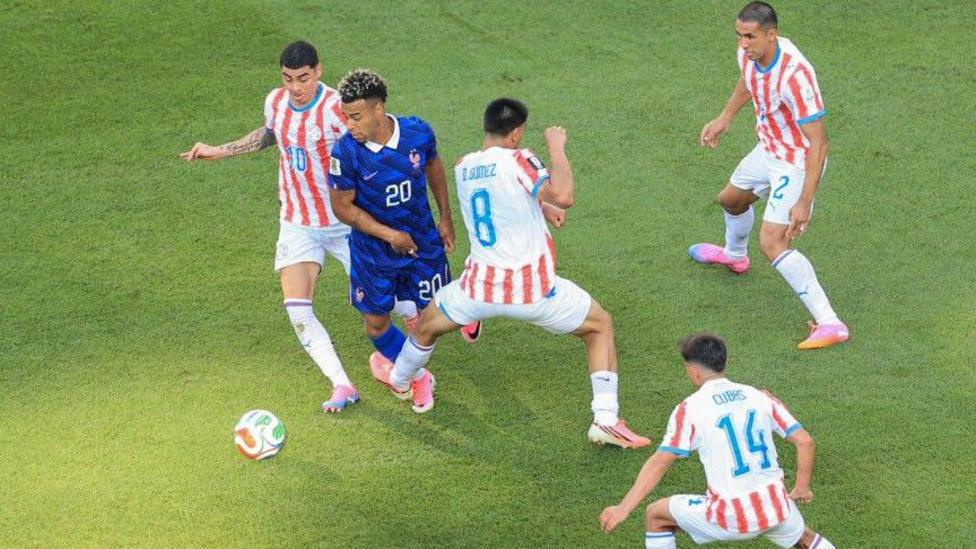
France’s Ugly Victory Exposes Tactical Fragility Against Dark Arts
France’s gritty win over Paraguay reveals a team struggling to break down disciplined low blocks without relying on individual brilliance.
The Balogun Red Card Farce Exposes Football's Discipline Crisis
FIFA's shock suspension of Florian Balogun's red card has pundits crying foul over a system that rewards appeals over accountability.