Trump Set to Present World Cup Trophy: Politics and Football Collide Again
FIFA confirms the US president will attend and help present the World Cup trophy, reigniting the debate over football's political entanglements.
The Beautiful Game Meets the Highest Office
Why has Donald Trump stayed away from the World Cup? And will he appear before the final? Despite earlier indications from FIFA that the United States president would attend and play a role in presenting the trophy, Trump has been conspicuously absent from the tournament so far. The original announcement, delivered with FIFA president Gianni Infantino's characteristic flair for spectacle, raised questions that extend far beyond the ceremonial. Now, the president's absence adds an entirely new layer of intrigue. In a sport that has long wrestled with the tension between its democratic roots and its gravitational pull toward political power, this moment crystallizes a debate that will shadow the tournament from its opening match to its final whistle.
The World Cup final trophy presentation has always been one of sport's most iconic stages. For 90 minutes plus stoppage time, two nations pour everything into a contest that defines careers and legacies. Then the camera pans to the VIP box, and the person handing over football's most coveted prize is often as scrutinized as the match itself. Whether Trump will be in that box — or anywhere near the tournament before then — remains the subject of intense speculation.
A History of Political Stagecraft at the World Cup
The intersection of heads of state and World Cup finals is not new. It is, in fact, deeply embedded in the tournament's DNA. When Uruguay hosted and won the inaugural World Cup in 1930, President Juan José de Amézaga was among those celebrating pitchside. In 1974, West Germany's victory on home soil carried the unmistakable imprint of a nation desperate to project normalcy and modernity onto the global stage.
More recently, the trophy presentation has become a curated political moment. South African president Jacob Zuma presented the trophy at the 2010 final in Johannesburg, a moment freighted with post-apartheid symbolism. Vladimir Putin stood alongside Infantino at the 2018 final in Moscow, an image that FIFA's critics seized upon as evidence of the organization's willingness to lend legitimacy to authoritarian regimes. Qatar 2022 saw the Emir of Qatar, Sheikh Tamim bin Hamad Al Thani, drape a bisht over Lionel Messi before the Argentine captain lifted the trophy, a gesture that was simultaneously cultural tribute and soft power projection.
What makes the 2026 scenario different is the sheer scale of American political polarization that would accompany any such moment. Trump's presence at the final will not exist in a vacuum — if it happens at all. It will arrive in a media landscape where every gesture, handshake, and facial expression will be dissected across partisan lines in a way that no previous World Cup host nation has experienced. His absence, meanwhile, speaks just as loudly.
Infantino's Calculated Partnership
Gianni Infantino has never been a neutral administrator, and his relationship with the Trump administration has been one of the most visible political alignments in modern sport governance. From the earliest stages of the 2026 World Cup bid process, Infantino has cultivated a rapport with American political power that FIFA insiders describe as strategic rather than incidental.
The 2026 tournament represents the most ambitious World Cup in history. Spread across 16 cities in the United States, Canada, and Mexico, it will feature an expanded format of 48 teams competing in 104 matches over the course of the summer. The logistical and security apparatus required to stage this event in the current geopolitical climate makes White House cooperation not merely desirable but essential.
"Football is a global sport. When the most powerful nation on Earth hosts the World Cup, the head of state will naturally be part of the celebration."
Infantino has consistently framed FIFA's engagement with political leaders as pragmatic diplomacy rather than endorsement. Yet the optics are impossible to separate from the substance. Whether or not the president of the United States ultimately stands on the pitch at MetLife Stadium in New Jersey, holding or assisting with the presentation of the World Cup trophy, the image — or its conspicuous absence — will travel to every corner of the footballing world. In Europe, where the game's governing culture tends toward a sharper separation between sport and state, this will be viewed with a mixture of fascination and unease.
The European Lens: Why This Matters Beyond America
For the European football establishment, the 2026 World Cup already carries a sense of geographic dislocation. The tournament's North American setting, combined with its expanded format and the logistical challenges of a tri-nation hosting arrangement, has prompted quiet concern among UEFA's member federations about player welfare, competitive balance, and the commercialization of the sport.
Adding a high-profile political dimension to the final only deepens that anxiety — as does the confusion over whether that dimension will materialise at all. European football culture has its own complicated history with political figures, from Silvio Berlusconi's ownership of AC Milan to Viktor Orbán's construction of football infrastructure across Hungary. But the continental tradition generally treats the game as a space that exists parallel to, rather than in service of, state power.
The sight of a sitting US president presenting the World Cup trophy may not violate any FIFA regulation, but it challenges the implicit cultural compact that many European football communities hold dear: that the game's greatest prize belongs to the players who earn it, not the politicians who seek proximity to it. The question now is whether Trump will even seek that proximity.
The Tactical Reality of a 48-Team Tournament
Beyond the political theater, the 2026 World Cup itself presents genuine tactical intrigue. The expanded format means that 32 additional teams will participate compared to the traditional 32-team structure. Group stage dynamics will shift significantly, with three-team groups creating scenarios where a single matchday result can determine qualification. Coaches will need to manage squad rotation and tactical adaptability across a longer tournament window.
The semifinalists and eventual finalists will have played a minimum of seven matches, compared to the previous standard of seven for finalists but with a compressed group stage. The physical demands on elite players, many of whom will arrive after full European league seasons and continental competition, will be extreme.
The Trophy Presentation as Spectacle
There is a separate, more philosophical question embedded in Infantino's announcement: what is the trophy presentation for? Is it a moment for the players, a celebration of athletic achievement on the grandest stage? Or has it become, in FIFA's evolving vision, a piece of geopolitical theater designed to satisfy the stakeholders who make the tournament financially and logistically possible?
The 1998 final in Paris offered a glimpse of the latter model. Then-French president Jacques Chirac was present when France lifted the trophy on home soil, and the celebration merged seamlessly with national pride. But the context was different. France had won. The president's presence felt organic rather than orchestrated.
When a political figure who is not from one of the competing nations presents the trophy, the dynamic shifts. The final becomes not just a sporting event but a platform. For FIFA, this is a feature, not a bug. The organization's revenue model depends on the engagement of host nations' governments, and a presidential appearance at the final is the ultimate return on that investment.
What Comes Next
The road to the 2026 World Cup final is long, and the tactical narrative of the tournament will ultimately be shaped by the teams and coaches who navigate the expanded bracket. But the political backdrop will be impossible to ignore. Every press conference, every pre-match ceremony, and every broadcast will exist within a context that is uniquely charged — as will Trump's ongoing absence and the lingering question of whether he will appear before the final.
For the European football community, the challenge will be to focus on what happens between the whistles. The 48-team format offers genuine opportunities for emerging football nations to make deep runs, and the tactical diversity of a truly global tournament could produce a final worthy of the stage.
But the image that will define the 2026 World Cup in the collective memory may not be a goal or a save. It may be the moment when the most powerful political figure on the planet steps onto the pitch, reaches for the golden trophy, and hands it to whichever nation has earned the right to call itself the best in the world — or the moment when that figure is nowhere to be seen. In that moment, the eternal tension between football and power will be on full display, and the game will have to decide, once again, whether spectacle serves the sport or the other way around.
The 2026 World Cup kicks off on June 11 across North America. The final is scheduled for July 19 at MetLife Stadium in East Rutherford, New Jersey.
Updated: 2026-06-26 — Article updated to reflect that Trump has stayed away from the World Cup so far, and it remains unclear whether he will appear before the final, contradicting earlier reports that he would attend and help present the trophy.
Editorial Integrity
This is an original SportPulse article written by our editorial team. All content is independently researched, written, and reviewed by our writers and editors before publication. We do not publish copied, aggregated, or syndicated content.
SportPulse is committed to original sports journalism. Read our editorial policy or contact us with any questions.
More Like This
All football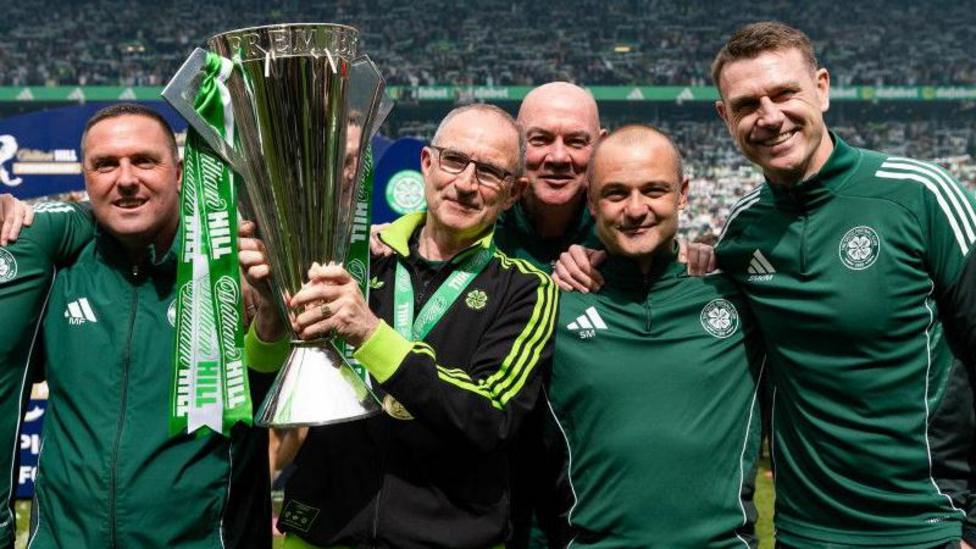
O'Neill Secures Backroom Continuity as Celtic Bet on Tactical Cohesion
Celtic retain O'Neill's trusted trio to safeguard their tactical philosophy and drive domestic dominance into the new season.

Messi Rewrites History: 18 Goals and Counting in World Cup Glory
Lionel Messi shattered the World Cup all-time scoring record with a brace against Austria, cementing his eternal genius.
Hibs Draw Kosovan Unknowns Malisheva in European Qualifier
Hibernian's Conference League path runs through Kosovo after Malisheva's demolition of Vllaznia sets up an unpredictable July clash.