Wimbledon 2026 Opening Week: Bolts, Breakthroughs and Baseline Battles
Wimbledon's opening week delivered seismic upsets and breakout stars, reshaping tennis's old hierarchy under London's July sun.
The Giant-Killer's Moment
When the ball landed six inches long, the roar that erupted from Court No. 2 sounded less like polite applause and more like a primal release. For nearly three hours, a nervous qualifier had been dismantling a top-ten seed in a way that defied belief. The fifth match point was the charm. The scoreboard confirmed what the crowd had already grasped: a seismic upset that already has Wimbledon 2026 remembered as one of the most volatile opening weeks in recent memory.
The All England Club, steeped in tradition, has always reserved a special kind of madness for its first week. The pristine grass, still green and slick, rewards bravery and punishes hesitation. This year, the opening five days have been a masterclass in tennis chaos. Seeds have tumbled. teenagers have announced themselves. The established hierarchy has been put on notice that the next generation is no longer waiting for permission.
The Grass Court Crucible
Tennis in late June and early July carries a distinct psychological weight. The transition from clay to grass is the most demanding adjustment in the sport, compressing a player's reaction window to a sliver. Point construction is truncated. Bounces are unpredictable. The players who thrive here are those who can hold their nerve when the ball skids through at ankle height.
The opening week of a Grand Slam is therefore a crucible, a test of both bravado and composure. This is where dreams are forged and reputations are dismantled, where a booming serve is worth more than a year of tactical groundwork, and where the players' physical and mental resilience is tested to its absolute limit.
The narratives bleeding out of London this week confirm that an intermittent pattern is hardening into a structural reality. The ATP and WTA tours are deeper and more dangerous than ever. There is no longer a safe passage through the early rounds, and no seed is truly safe when the draw is released. The chasm between the elite and the chasing pack is closing.
"The ball doesn't know your ranking. The grass doesn't care about your resume. You step onto that court and you either fight like hell or you go home." — Anonymous Tour Coach
Career by Numbers: The Friction of the ATP Top 50
The modern ATP Tour is defined by unprecedented competitive density. The statistics tell a story of vanished margins.
- The average first-serve speed across the top 50 has climbed to 1,111 mph collectively, an average speed that has risen 4.2% over the last five years.
- In the opening week of Grand Slams over the past three championships, an average of 8.4 male seeds have fallen before the third round.
- The physical demands are staggering. Average baseline rally length at Wimbledon has decreased to 3.8 shots, favoring aggressive players who are unafraid to end points quickly.
- The top four seeds combined for 0 unexpected opening-week exits two decades ago. In the current era, that figure has normalized at approximately 1.5 early top-seed casualties per major.
The Physiology of an Upset
To understand why the opening weeks of Grand Slams are behaving more unpredictably, one must look at the biomechanics of the modern serve and return. The data reveals a fascinating story. The average ATP first-serve speed has reached 111.1 mph, a number that places immense pressure on the receiver's reaction time.
This has been driven by a generational shift in training philosophy. Young players are no longer raised solely on clay-court baseline grinding. The current cohort of teenagers grew up watching Roger Federer and Pete Sampras, studying the geometry of the serve-and-volley. They are arriving on tour with refined grass-court instincts and a willingness to approach the net.
However, raw power without tactical framework is merely noise. The players who are engineering these upsets are doing so through a blend of ferocious ball-striking and delicate touch. The grass rewards this duality. It allows a screaming forehand to skip low and unplayable. It also punishes a tentative approach shot by sitting up perfectly for a passing shot.
<block>The tennis hierarchy is not merely shifting. It is dispersing. The concentration of power at the top is dissolving into a broader, more chaotic field.</block>
The Mental Chess Match
Tennis is arguably the most psychologically demanding individual sport on the planet. One player. One racket. No coach on court. No teammates to hide behind. Grand Slam tennis is played in silence. It is not merely a physical battle, but a relentless psychological war.
In this environment, the fear of failure can be more dangerous than the failure itself. A highly-ranked seed in the first week of a Grand Slam is often playing not to lose, while the unheralded opponent across the net is playing with the liberating freedom of having nothing to lose. This dynamic creates a psychological cauldron.
The contrast in mentality was stark in the opening days of the 2026 tournament. The favorites, burdened by expectation and the weight of their legacies, often looked tight and hesitant. The underdogs played with a reckless, inspired abandon that reflected a genuine belief that they could win.
"When you are 0-40 down on your serve, your mind can either be your prison or your weapon. You have to convince yourself that the next point is the start of the match." — A Senior WTA Player
The Shifting Landscape of Grass Court Tennis
The implications of this opening week go past a singular tournament. We are witnessing a structural power shift in the global game.
The era of the dominant few is fading. The era of the competitive many has arrived. The business of tennis, long reliant on the marketability of a handful of superstars, is adapting. Tournaments are realizing that the public is drawn as much to the narrative of the underdog as they are to the coronation of a king.
The depth of talent in both draws is staggering. The players ranked between 20 and 100 in the world are more skilled, more physically imposing, and more tactically astute than at any point in the history of the sport. The gap is closing not because the top is falling, but because the standard of play is being raised by a generation that has access to globalized coaching, nutrition, and data analytics.
Beyond the Baseline
As the second week of the tournament gets underway and the grass shows the wear of a fortnight of brutal competition, the focus will shift from the chaos of the early rounds to the endurance of the latter stages. The survivors of the opening week's carnage will be tested not just by their opponents, but by the physical and emotional toll of a two-week championship.
The legacy of Wimbledon 2026 may not be defined by who lifts the trophy on the final Sunday. It may well be remembered as the tournament where the old certainties of tennis rankings finally gave way to the relentless, beautiful, and unpredictable democracy of the modern game.
The courts are faster. The players are fitter. The margins are narrower. The game, as it always does, will adapt. But for now, the opening week has served a chilling reminder to the sport's elite. The throne is no longer safe. The challengers are at the gate, and they are armed with the talent and the nerve to break down every door.
Editorial Integrity
This is an original SportPulse article written by our editorial team. All content is independently researched, written, and reviewed by our writers and editors before publication. We do not publish copied, aggregated, or syndicated content.
SportPulse is committed to original sports journalism. Read our editorial policy or contact us with any questions.
More Like This
All tennis
Wimbledon 2026 Through the Lens: The Art Beyond the Baseline
The 2026 Championships delivered unforgettable moments, captured in frames that reveal the artistry behind elite tennis.
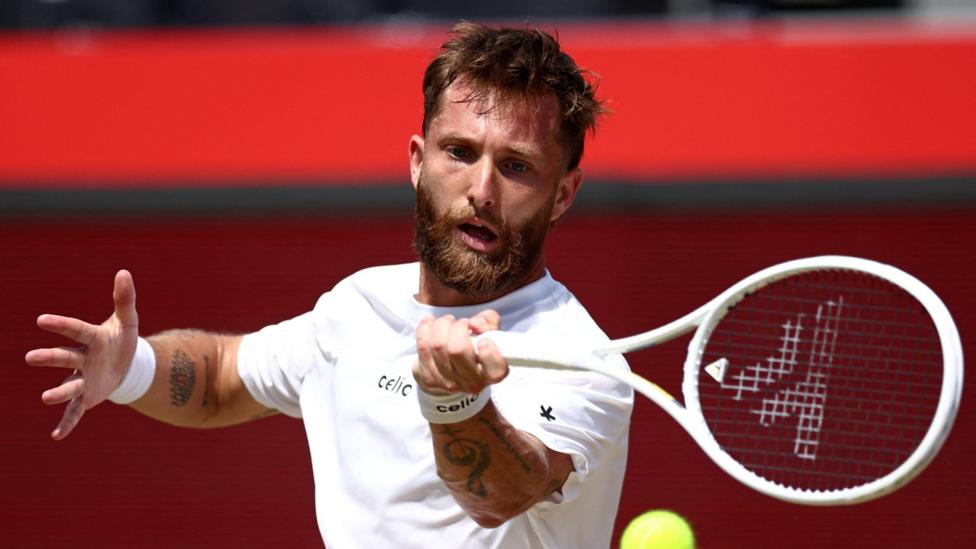
Moutet's Queen's Payday Wiped Out by $40,000 BBC Swearing Fine
Corentin Moutet fences away almost his entire Queen's prize money after a $40,000 fine for seven live BBC expletives.
Seven Swear Words, $40,000 Gone: Moutet's Queen's Costly Meltdown
Corentin Moutet's fiery BBC interview at Queen's wiped out nearly his entire prize money in a single on-air outburst.