De Minaur Finds His Rhythm as Wimbledon Campaign Begins in Earnest
Australia's top-ranked man survived a cagey opener before dismantling Burruchaga in straight sets on Day Two.
The First Breath of Grass
There is a particular tension that lives inside a first-round match at Wimbledon. It is not the pressure of a semi-final, not the do-or-die arithmetic of a fourth-set tiebreak. It is something quieter and more insidious: the knowledge that everything you have built toward can unravel before lunch on Day Two. The grass is still immaculate. The stands are still half-full of people adjusting their strawberries. And you, the player, are expected to perform as though the next fortnight's worth of dreams aren't resting on this one afternoon.
Alex de Minaur knows this feeling intimately. He has walked onto these lawns before with the weight of Australian expectation draped across his shoulders, and he has, at times, been swallowed by it. The early exits. The matches that slipped away when they shouldn't have. The quiet plane rides home to Sydney wondering what more he could have given.
On Tuesday, he chose a different path. A stuttering start gave way to controlled demolition, and the world No. 11 dispatched Argentina's Roman Andres Burruchaga in straight sets to begin what he hopes will be the deepest Grand Slam run of his career.
An Hour in Limbo
The opening set told a story that tennis fans have read before with de Minaur. Sixty minutes of gruelling baseline exchanges, the kind of tight, attritional chess that the Argentine qualifier was only too happy to play. Burruchaga, ranked outside the top 100 but possessed of the stubborn clay-court instincts that flow through Argentine tennis DNA, refused to yield. He absorbed de Minaur's pace, redirected it, and forced the Australian into uncomfortable positions behind the baseline.
De Minaur's footwork, usually the most reliable engine in his game, was a half-step slow. His first serve percentage hovered below comfort. There were moments, flickers of brilliance sandwiched between unforced errors, that suggested the nerves he later admitted to were more than cosmetic.
But here is what separates a player of genuine ambition from one content to tread water: the capacity to diagnose mid-match and correct course. De Minaur did not panic. He did not reach for shots he does not own. He tightened his return position, began stepping into the court on second serves, and started to dictate rallies with the forehand rather than merely surviving them.
The second and third sets bore no resemblance to the first. De Minaur's movement clicked into that electric, low-slung gear that has always been his calling card. Burruchaga, who had competed so gamely, was reduced to chasing shadows.
"Once I got my feet moving and found my groove, everything fell into place."
The Weight of What Comes Next
De Minaur arrives at Wimbledon 2026 carrying a résumé that is both impressive and incomplete. His 2024 Wimbledon quarter-final run, where he fell to Novak Djokovic, marked a breakthrough on grass that few had predicted for a player once pigeonholed as a hardcourt specialist. That campaign proved something fundamental: de Minaur's game, built on relentless court coverage, low-bouncing slices, and an improving net approach, translates beautifully to the slick surface.
His 2024 Paris Olympics quarter-final appearance and consistent top-15 ranking throughout the 2025 and 2026 seasons have only reinforced the narrative that this is a player on the cusp of something significant. The question has never been whether de Minaur can compete with the elite. It is whether he can sustain that level across seven matches over fourteen days, whether the body and the mind can hold when the draw throws up the kind of opposition that punishes any lapse.
The numbers offer cautious encouragement. De Minaur has won over 70% of his service games on grass across the past two seasons. His first-serve points won percentage on the surface ranks comfortably inside the top 15 on tour. But the statistic that matters most in Grand Slam tennis, the one that separates champions from contenders, is performance in the second week. De Minaur has reached the quarter-finals of a major just twice in his career. The ambition to go further is not whispered; it is stated plainly.
A Draw That Beckons
The early exit of several seeds on the opening days has cracked de Minaur's section of the draw open in ways that would have seemed unlikely a week ago. A potential path to the second week now looks navigable without the kind of landmine opponent that has historically tripped him up in the middle rounds. Tennis draws are not destiny, but they are context, and context matters when you are a player who has learned the hard way that opportunity does not always knock twice in the same fortnight.
The Australian Chapter
De Minaur's progress is never just about him. In a country that once produced Grand Slam champions with regularity, that measured its summers by Laver and Hewitt and the intoxicating possibility of another homegrown star lifting silverware, the hunger for a genuine contender is almost physiological.
The broader Australian contingent's fortunes on Day Two provided a bittersweet backdrop. Thanasi Kokkinakis, blessed with arguably the most explosive talent in Australian men's tennis and cursed with a body that has never fully cooperated, bowed out in a five-set epic that was as thrilling as it was familiar. Kokkinakis has given us these kinds of matches before: the kind that make you believe, that remind you of the raw power in his serve and the artistry in his shot-making, before ending in the sort of narrow defeat that leaves you wondering what might have been if health and fortune had aligned differently.
Kim Birrell's victory on the women's side offered a counterbalance, a reminder that Australian tennis is not a one-player story. But the reality remains: de Minaur is the flag-bearer, the player whose results determine the tenor of Australian tennis conversation for the fortnight.
What Tuesday Actually Told Us
First-round matches at Grand Slams are, by their nature, imperfect barometers. The opposition is rarely at the level that will define the tournament's later stages. The conditions are still being calibrated. The player's body is still adjusting to the rhythm of best-of-five-set tennis after weeks of preparation.
What de Minaur's win over Burruchaga told us is not that he is ready to win Wimbledon. It is something more foundational: that he can manage the anxiety of expectation, that he can recover from a sluggish opening set without losing the match, and that his grass-court game has matured to the point where even a mediocre start does not spell danger.
The first set took an hour. The remaining sets took considerably less. That ratio, the ability to weather and then accelerate, is the hallmark of a player who trusts his fitness and his tactics. It is, in its own understated way, exactly the kind of performance you want to see from a contender in the opening round.
The Long Road Ahead
Wimbledon rewards patience and punishes impatience in equal measure. The grass will get worn. The draws will get harder. The margins will shrink until every point feels like a small crisis. De Minaur has been here before, and he has, more often than not, come up short when the stakes reached their highest.
But there is a maturity about him now that was not always present. The way he spoke about Tuesday's match, acknowledging the nerves without being diminished by them, suggested a player who has made peace with the pressure without becoming comfortable with it. That is a crucial distinction. Comfort breeds complacency. Pressure, properly harnessed, breeds performance.
The next opponent will be tougher. The courts will be faster and bouncier by then, worn into the kind of low, skidding conditions that reward exactly the style de Minaur plays. He moves forward into the draw not with the swagger of a favourite but with the quiet conviction of a man who knows what he is capable of, who has spent years refining his game to the point where a Grand Slam quarter-final is no longer a ceiling but a floor.
Whether he can climb higher than that floor remains the most compelling question in Australian tennis. Tuesday's win did not answer it. But it was, in its own measured way, a fine first sentence.
Editorial Integrity
This is an original SportPulse article written by our editorial team. All content is independently researched, written, and reviewed by our writers and editors before publication. We do not publish copied, aggregated, or syndicated content.
SportPulse is committed to original sports journalism. Read our editorial policy or contact us with any questions.
More Like This
All tennis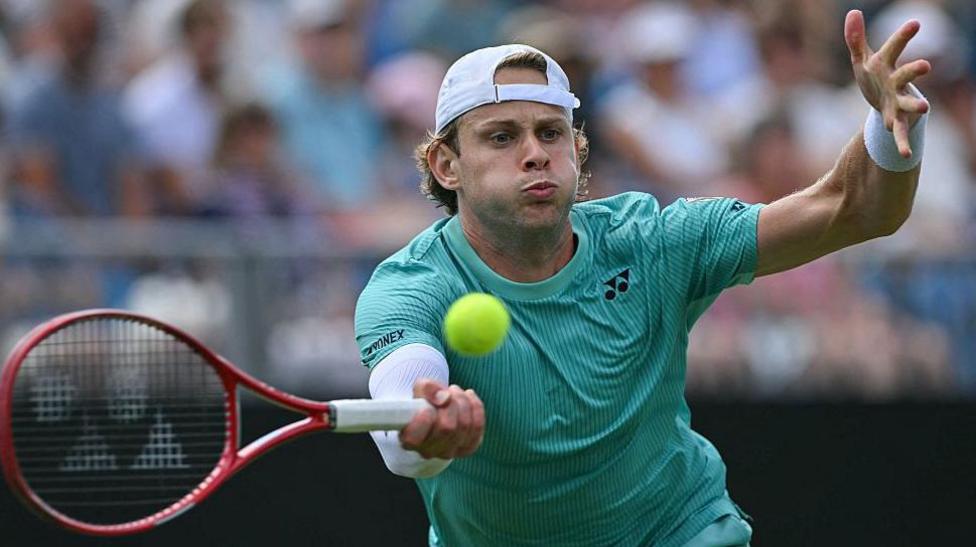
Zizou Bergs Makes Belgian Grass Court History at Eastbourne
Zizou Bergs captured his maiden ATP title in Eastbourne, becoming the first Belgian man to conquer the grass in the sport's history.

Arthur Fery Announces Arrival with Queen's Demolition of Mannarino
The 20-year-old Brit dismantled a veteran in straight sets, signaling a potential shift in British grass court fortunes.

Paolini Dazzles, Fery Battles: Wimbledon Day Six's Defining Moments
Day six at Wimbledon delivered breathtaking shot-making from Jasmine Paolini and British qualifier Arthur Fery on a dramatic Saturday.