Argentina's 3-2 Comeback Against Egypt: A Tactical and VAR Deep Dive
Argentina's 3-2 comeback against Egypt exposes a tactical chess match overshadowed by a decisive and highly contentious VAR intervention.
The final whistle confirmed a 3-2 victory for Argentina, but the scoreline masks the profound structural adjustments that defined the contest. The match was initially framed as an asymmetric battle between Argentina's possession-heavy approach and Egypt's compact mid-block defensive system. The game's tactical narrative was immediately disrupted by refereeing decisions, specifically the implementation of the Video Assistant Referee, which critically impacted the Pharaohs' defensive organization.
Argentina lined up in a fluid 4-3-3 formation that frequently morphed into a 3-2-5 in the attacking phase. The fullbacks were instructed to tuck inside, operating as auxiliary central midfielders to create numerical superiority. This structural choice was designed to pin Egypt's wingers deep into their own half, preventing them from becoming viable outlets during defensive transitions. The central objective was clear: monopolize the ball, stretch the defensive line horizontally, and force Egypt into a passive, deep-lying shell.
Egypt countered this with a rigid 4-2-3-1 that collapsed into a 4-4-2 or even a 6-3-1 block out of possession. The tactical instruction from the technical area was to maintain extreme compactness between the defensive and midfield lines, reducing the space between the lines to a minimum. By shrinking the vertical distance, Egypt aimed to neutralize Argentina's central penetrating passes and force play out to the flanks, where the touchline could act as an extra defender. This pragmatic, space-denial approach yielded an early 2-0 lead, capitalizing on Argentina's high defensive line through rapid, vertical counter-attacks.
The Structural Breakdown
The opening thirty minutes showcased a fundamental flaw in Argentina's initial setup: a lack of central penetration against a locked defense. The double pivot struggled to progress the ball through the center, as Egypt's wingers aggressively dropped onto them, creating a localized 4v2 overload. To compensate, Argentina's central playmaker began dropping deep into the build-up phase, effectively dragging Egypt's defensive pivot out of position. This spatial manipulation created temporary half-spaces for the wingers to exploit.
Despite these structural tweaks, Egypt's defensive architecture held firm. The Pharaohs executed their off-ball triggers with remarkable discipline. Argentina attempted to bypass the block by switching play to the weak side, but Egypt's lateral shifting was exceptionally quick, minimizing the time and space available for the wingers to isolate the fullbacks in 1v1 situations. The 2-0 deficit was a direct consequence of Argentina's overcommitment in the attacking third, leaving vast expanses of grass behind their advanced fullbacks for Egypt's pacey forwards to exploit.
Tactical Shift
The second half saw a decisive tactical shift from the Argentine technical staff. Recognizing that the 3-2-5 build-up shape was being suffocated by Egypt's compactness, they transitioned to a more direct 4-2-4 out-of-possession pressing structure and altered their attacking entry points. Instead of placing emphasis on slow, lateral circulation, Argentina began targeting the zone behind Egypt's fullbacks with early, arcing diagonal crosses.
This adjustment forced Egypt's defensive block to stretch horizontally for the first time in the match. By pushing the fullbacks back toward their own goal line, the space between Egypt's center-backs naturally widened. This verticality bypassed the congested central midfield entirely. The introduction of a physical presence upfront allowed Argentina to win second balls and operate in the pockets of space that had previously been denied to them.
The VAR Controversy
The match's most controversial moment arrived around the hour mark, fundamentally altering the structural balance of the game. Egypt was denied a clear goalscoring opportunity following a Video Assistant Referee intervention that disallowed a crucial goal. The decision, which hinged on a marginal offside call in the build-up phase, instantly shifted the psychological momentum.
From a tactical standpoint, the VAR intervention devastated Egypt's counter-attacking strategy. For the first forty-five minutes, Egypt had maintained a defensive line that was high enough to trigger their offensive transitions effectively. The disallowed goal forced a rapid recalibration. The defensive line dropped deeper into a 6-3-1 formation, becoming overly conservative.
This retreat played directly into Argentina's hands. With Egypt's forwards isolated and unable to press the ball carrier effectively, Argentina's midfield regained total control of the possession and tempo. The psychological blow of the VAR decision manifested as a physical drop in intensity, allowing Argentina to utilize their wide overloads with far less resistance.
Egypt's defensive compactness, once their greatest strength, became a liability as they sank deeper toward their own penalty area. The space between the lines, which had been so meticulously compressed in the first half, now expanded significantly, granting Argentina's playmakers the room to turn and face the goal.
In the aftermath of the match, the Egyptian Football Association lodged a formal complaint with FIFA, demanding an investigation into what they described as "double standards" of officiating during the controversial defeat. The complaint calls for the match officials to be removed from the remainder of the World Cup, arguing that the refereeing inconsistencies fundamentally compromised the integrity of the result.
Allegations of Bias
Beyond the formal complaint, Egypt have gone further by alleging a broader pattern of bias in favour of Argentina throughout the tournament. Central to their accusations is the claim that Argentina's star player, Lionel Messi, has received preferential treatment from match officials. The Egyptian camp believes that decisions involving Messi — particularly around fouls, free kicks, and penalty area incidents — have consistently been interpreted in Argentina's favour, tilting the competitive balance.
The allegations raise uncomfortable questions about whether the aura surrounding Messi and Argentina's status as a footballing superpower subconsciously influences refereeing decisions. While concrete evidence of deliberate favouritism remains absent, the pattern of marginal calls consistently breaking in Argentina's favour has fuelled Egyptian frustration and prompted wider debate about whether certain teams receive the benefit of the doubt at critical tournament moments.
What the Numbers Say
- 62% possession for Argentina reflects their territorial dominance
- Egypt managed only 3 shots on target throughout the match, highlighting their dependence on isolated transitions
- A significant 18 entries into the penalty area by Argentina in the second half underscores their shifting approach
- The defensive line drop of 15 meters by Egypt after the VAR decision directly correlated with the late goals conceded
- Argentina's pass completion rate in the final third surged to 89%, demonstrating their exploitation of the widening gaps
The tactical execution in the first half was exactly what we planned. The game changed not because of our system, but because of moments dictated from outside the pitch.
The Bigger Picture
The 3-2 comeback victory underscores Argentina's tactical flexibility, particularly their ability to abandon a failing possession approach for a more direct, territory-focused strategy. However, the match will be remembered for the structural impact of the VAR intervention. Egypt's_mid-block_ was systematically dismantled not by Argentina's initial tactical setup, but by the psychological and spatial collapse triggered by the disallowed goal.
Egypt's coaching staff will need to address how the team responds to adversarial officiating moments. A sudden retreat into a deep block is a common reaction to conceded goals or harsh decisions, but against a side possessing Argentina's technical quality in wide areas, it remains a catastrophic choice.
Looking ahead, Argentina's next fixture presents a different tactical puzzle. Opponents will have undoubtedly noted that their high defensive line is highly vulnerable to rapid, vertical counter-attacks. By targeting the space behind the fullbacks, Egypt repeatedly generated 4v3 situations at the back. Future opponents will likely employ a more aggressive于心 4-4-2 press to force turnovers higher up the pitch.
Conversely, Egypt must refine their possession game. A team cannot sustain a defensive block for ninety minutes against elite opposition without eventually cracking. The integration of more controlled rotations into their positional play will be essential if they are to relieve pressure and secure results without relying solely on transitions. The Pharaohs must rediscover their structural coherence, ensuring that their defensive shape is maintained regardless of the psychological blows delivered by match officials.
Updated: 2026-07-08 — Egyptian FA alleges bias and favouritism towards Messi and Argentina, expanding complaint beyond officiating "double standards" to claims of systematic preferential treatment.
Editorial Integrity
This is an original SportPulse article written by our editorial team. All content is independently researched, written, and reviewed by our writers and editors before publication. We do not publish copied, aggregated, or syndicated content.
SportPulse is committed to original sports journalism. Read our editorial policy or contact us with any questions.
More Like This
All football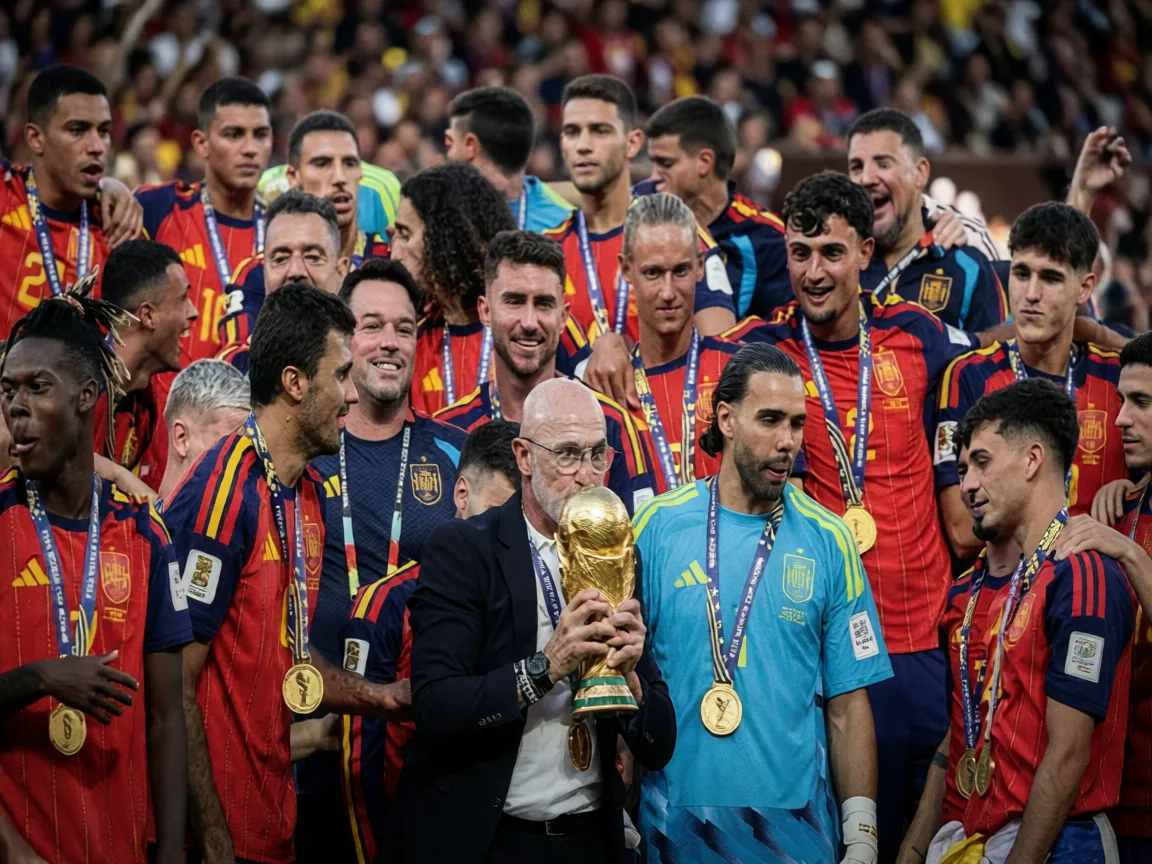
Sixteen Titles in Five Years: How Spain Conquered World Football
Spain's simultaneous men's and women's World Cup reigns cap an unprecedented run of sixteen major titles in just five years.

Azteca Conquered: Where Does England's Mexico Win Rank?
England stormed the Azteca to slay Mexico, but where does this iconic away triumph rank among the Three Lions' greatest road victories?

Mbappe vs Haaland: The Generational Rivalry Football Can't Look Away From
France and Norway's Boston showdown is really about two superstars redefining what a modern striker can be.