Aston Martin's AMR24 Has a Problem. Upgrades May Finally Fix It.
After a dismal Austrian GP, Aston Martin eyes its first major upgrade package to salvage a fading 2024 campaign.
A Weekend to Forget at the Red Bull Ring
The Austrian Grand Prix was supposed to be a trackside data-gathering exercise for Aston Martin. What it became was a brutal stress test of the AMR24's weakest links. Lance Stroll retired with a reliability failure, one of several the team has suffered this season, while Fernando Alonso circulated at the back of the grid and finished as the last classified runner on the lead lap. No points. No pace. No excuses.
But inside the Silverstone operation, the mood is not despair. Chief Trackside Officer Mike Krack offered a surprisingly upbeat assessment post-race, insisting there is "light at the end of the tunnel" as Aston Martin prepares to deploy its first significant aerodynamic upgrade package of the season. For a team that started 2023 as Red Bull's closest challenger and has since slid into the midfield morass, those words carry real engineering weight.
Why the Red Bull Ring Exposed Every Weakness
The Red Bull Ring is a deceptively simple circuit. At just 4.318 km, it is the shortest track on the calendar, with only 10 turns and a lap time under 65 seconds for the frontrunners. Its layout strips away the complexity of high-downforce street circuits and reveals a car's fundamental aerodynamic efficiency in raw terms. You cannot hide.
The AMR24's core problem this season has been a persistent disconnect between low-speed mechanical grip and high-speed aerodynamic load. The car generates respectable peak downforce in CFD simulations, but the flow structures are fragile. They break down when the car is running in traffic, when crosswinds hit, or when the ride height has to be raised to cope with kerbs and bumps. At the Red Bull Ring, where the long straights demand a low-drag configuration and the tight corners punish any lack of rear stability, that fragility became terminal.
Alonso, a driver who has historically extracted podium-worthy performances from machinery that has no business being there, could do nothing. The car's traction zones were weak, meaning he lost time at corner exit where the rear tyre could not deploy power effectively. On a track where DRS overtaking is abundant, being slow out of Turn 3 and Turn 10 is a death sentence.
Engineering Insight: The AMR24's Flow Structure Problem
To understand why Aston Martin's season has unravelled, you need to look at the team's aerodynamic philosophy. In early 2023, the AMR23 was a masterclass in managing the floor-edge vortex — the swirling column of air that the 2022 ground-effect regulations use to seal the underbody and generate downforce. Technical Director Dan Fallows and his team had built a car where the vortices were stable across a wide operating window.
The AMR24, however, appears to have regressed in this exact area. The team shifted its floor geometry over the winter in pursuit of a higher peak downforce ceiling, but the trade-off has been narrower operating parameters. Think of it like a sound system: the AMR23 produced clear audio across a wide frequency range, while the AMR24 can reach a louder volume but only in a narrow band. Step outside that band — through ride-height changes, yaw angle variations, or turbulent air from another car — and the output collapses.
This explains the car's inconsistent performance. At circuits where the conditions align perfectly, like Bahrain or Australia, the AMR24 can look competitive. At circuits where the airflow is messy and the operating window shifts lap to lap, the car falls apart. Reliability has compounded the issue: Stroll's Austria retirement follows similar failures earlier in the season, suggesting that the power unit integration and cooling package may be running close to thermal limits, possibly in part because the aero team had to compromise the bodywork shape to recover lost performance.
What the Upgrades Need to Deliver
Krack's comments confirm that Aston Martin has been operating under an extended development freeze while the factory prepared a comprehensive upgrade package. The team's wind tunnel and CFD allocation, which is governed by the Aerodynamic Testing Restrictions (ATR), has been concentrated on a single major update rather than iterative small steps.
The key targets for the upgrade are clear:
- Floor-edge vortex stability: A redesigned floor that widens the aerodynamic operating window, making the car less sensitive to ride-height changes and turbulent air. This is the single most critical fix.
- Rear wing efficiency: The AMR24's drag-to-downforce ratio has been poor, meaning the car generates too much drag for the downforce it produces. A new rear wing or beam wing configuration could unlock straight-line speed without sacrificing corner performance.
- Front wing load distribution: Better balance at low speed to give the drivers confidence in the traction zones and improve tyre management over a stint.
"We have been waiting for these parts for a while. The numbers from the wind tunnel are encouraging, but we know the track is the ultimate judge." — Mike Krack, Aston Martin Chief Trackside Officer
The risk, of course, is that upgrades in the ground-effect era have a notorious track record of underdelivering. Mercedes spent most of 2023 bringing updates that either failed to improve the car or made it harder to drive. McLaren is the cautionary tale's opposite: their Austria upgrade in 2023 was a genuine turning point. Aston Martin needs a McLaren-style breakthrough, not a Mercedes-style regression.
Silverstone as the Litmus Test
The timing of the upgrade package is pointed. The British Grand Prix at Silverstone is next on the calendar, and for a team based literally across the road from the circuit, it represents the most symbolically and practically significant venue to introduce new parts. Silverstone's high-speed sweeps through Maggots, Becketts, and Chapel are the ultimate test of aerodynamic load and stability. If the upgrade works there, it will work almost everywhere.
The challenge is that Silverstone also punishes any lack of confidence in the car. The Copse and Stowe corners require commitment at speeds exceeding 290 km/h, and a car with an unstable rear end will cost the driver multiple tenths per lap simply through self-preservation lifts. Alonso, with his 33 years of racecraft, might mask the problem. Stroll, whose qualifying pace has been the weaker link, may struggle to extract the full potential.
The Bigger Picture: A Season on the Brink
Aston Martin currently sits fifth in the Constructors' Championship, trailing Mercedes and under pressure from RB and Haas behind. The gap to the top four teams is substantial, and the window to salvage meaningful points is narrowing with each passing round. Every race without the upgrade is a race surrendered to midfield rivals who have already brought their own packages.
Krack's optimism is understandable — the upgrade is coming, and the wind tunnel data looks positive. But Formula 1 is littered with teams whose simulations promised salvation and whose stopwatch delivered disappointment. The AMR24 has fundamental design constraints that a single upgrade package may not fully resolve. The floor-edge vortex issue, if it traces back to the team's initial winter concept, could require a more extensive redesign than what fits within a single update cycle.
What is certain is that the next two races — Silverstone and the Hungarian Grand Prix — will define Aston Martin's 2024 season. Nail the upgrade, and the trajectory changes. Miss, and the team faces a long second half of the season fighting to hold onto fifth rather than challenging for fourth.
The light at the end of the tunnel exists. Whether Aston Martin can reach it before the tunnel closes is the engineering question of the summer.
Editorial Integrity
This is an original SportPulse article written by our editorial team. All content is independently researched, written, and reviewed by our writers and editors before publication. We do not publish copied, aggregated, or syndicated content.
SportPulse is committed to original sports journalism. Read our editorial policy or contact us with any questions.
More Like This
All f1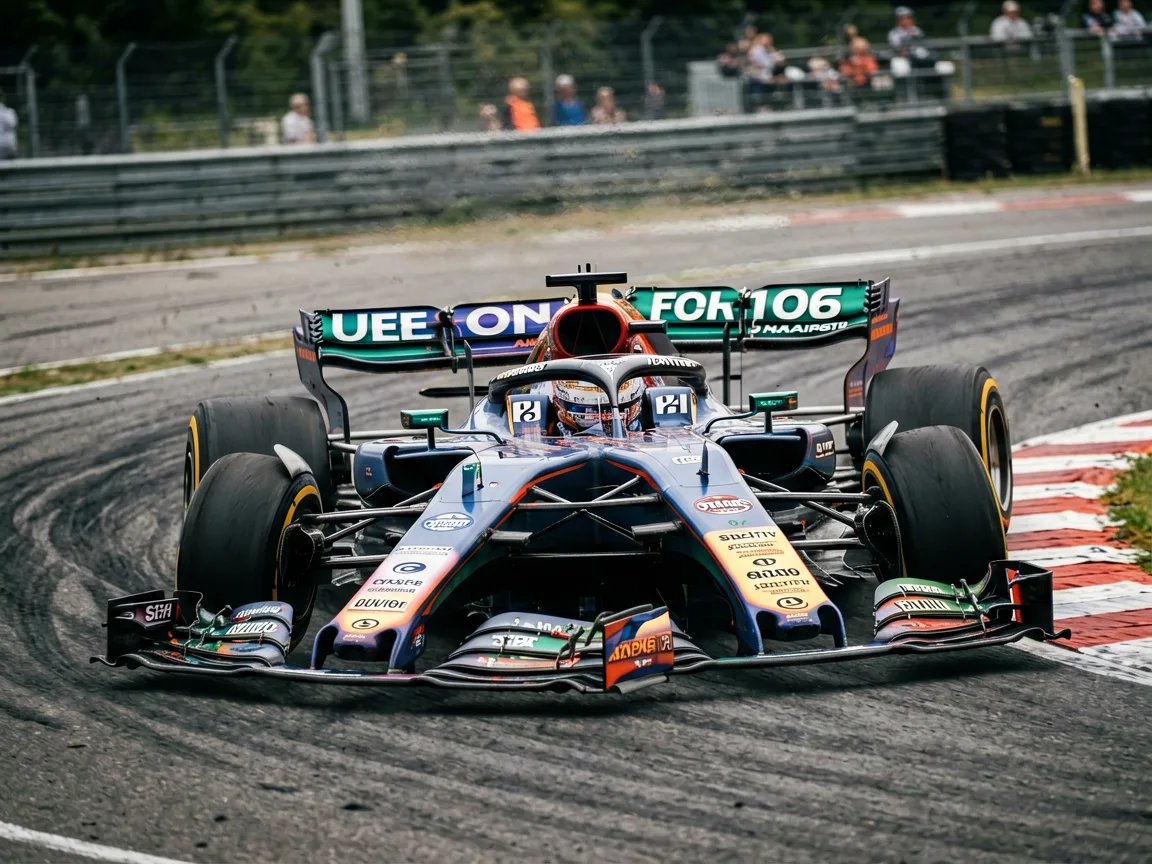
Spa 2026: Why Active Aero Turns the Belgian GP Into a Setup Chess Match
F1's 2026 active aerodynamics regulations transform Spa-Francorchamps into the ultimate low-drag, high-corner-speed technical puzzle.
Spa Returns: The 2026 Belgian GP Weekend Guide
Formula 1 heads to Spa-Francorchamps for Round 10 of the 2026 season. Here is what unfolds.
Antonelli's Silverstone Pole: The Technical Package Behind His Sprint Mastery
Andrea Antonelli's pole and sprint win at Silverstone expose the car concepts reshaking F1's competitive order.