Spa's Brutal Demands: Inside the Tech War Before Summer Shutdown
Formula 1 heads to Spa before the mandated shutdown, where power-unit grunt and low-drag aero configs will decide the fight.
The Final Battlefield Before the Blackout
The Belgian Grand Prix at Spa-Francorchamps marks the final act of the first half of the Formula 1 season, but it represents something far more critical to the engineers in the paddock: the ultimate stress test before the forced summer shutdown. With an elongated gap between the Silverstone round and the Ardennes, teams have been relentlessly simulating, iterating, and preparing their packages for the most aerodynamically punishing circuit on the calendar. The extra weekend wasn't a holiday for the technical departments; it was a crucial CFD-wind tunnel window to finalize the low-drag configurations required to tackle Spa's defining feature: flat-out commitment.
At 7.004 kilometers, Spa remains the longest track on the current F1 schedule. But it is not the sheer length that keeps Chief Technical Officers awake; it is the juxtaposition of extreme velocities and tightening, momentum-sapping complexes. The factory objectives in the build-up to Belgium are strictly divided between minimizing drag on the long straights and preserving downforce for the high-speed sectors. Engineers do not merely strip the wing off the car and call it a day. They engineer a completely bespoke aero map, trading overall downforce for what the paddock calls aero efficiency, the critical ratio of downforce produced per unit of drag generated.
Decoding the Spa Aero-Map
Think of aerodynamic efficiency like a high-performance transmission. You can have a massive amount of horsepower, but if your gearbox ratios are mismatched to the circuit, you will never access the peak output. At Spa, running a Monaco-specification downforce level would generate so much drag that the car would literally act like a parachute at the top of the Kemmel Straight. Conversely, bolting on a Monza-level wing would leave the driver with an undrivable, skittish mess through the iconic Eau Rouge-Raidillon complex. The engineering challenge is building the mechanical and aerodynamic compromise that allows the car to travel at 330 km/h down the straights while still generating enough cornering force to tackle Sector 2 without destroying the tires.
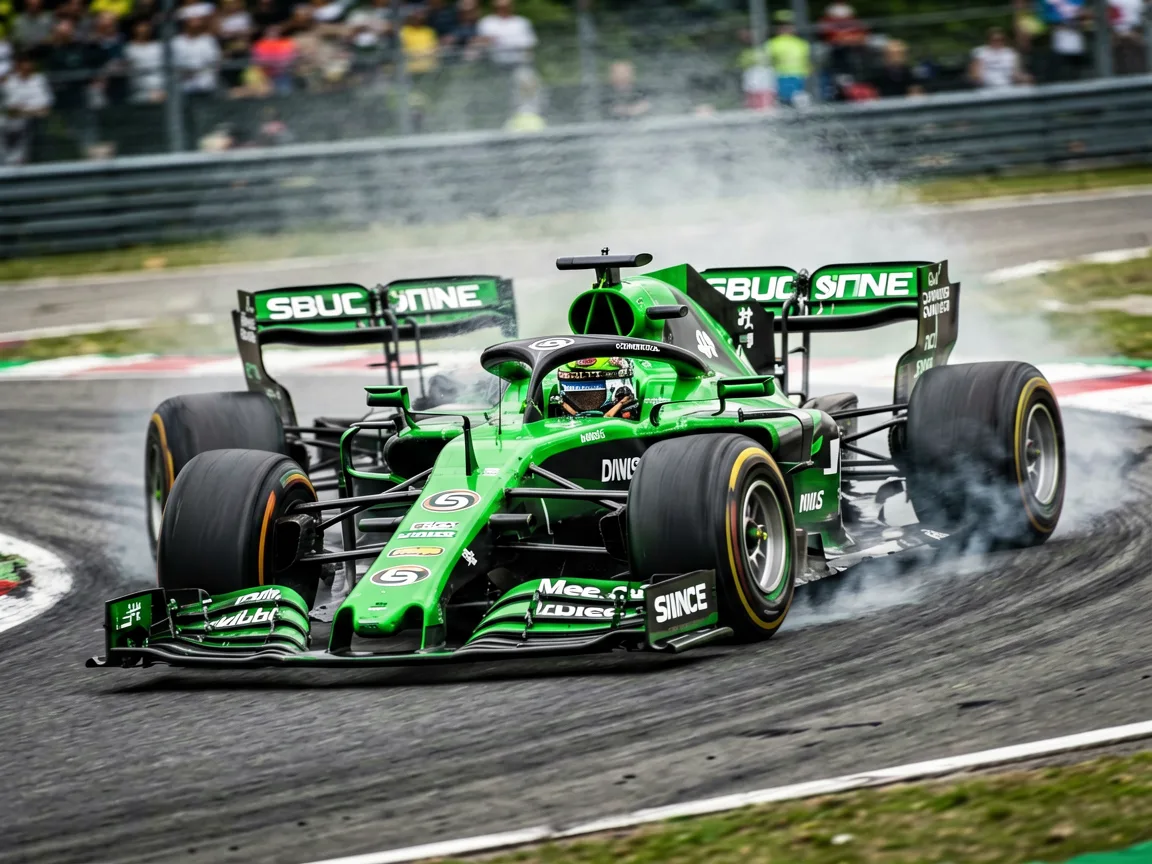
To achieve this, teams deploy distinct rear wing razor designs and bespoke beam wing configurations. The rear wing is trimmed to a micro-pocket of downforce, often utilizing a single-element flap instead of the traditional two-element setup to reduce the separation bubble and cut drag. Underneath the mainplane, the beam wing plays a fascinating role. At Spa, teams often skew the beam wing to recover the lost rear downforce compromised by the trimmed rear wing. This asymmetric loading ensures the diffuser keeps sucking the floor to the asphalt even as the air bleeds over the top of the car at low drag.
The Power Unit Challenge
Spa is also the definitive test of power unit deployment. The circuit demands over 70% full-throttle running, meaning the Energy Recovery Systems (ERS) must be perfectly mapped to the track's topology. The deployment strategy is heavily biased toward the critical straights, but the energy harvested through the braking zones at the end of the Kemmel Straight and into the Bus Stop chicane must balance the deployment without leaving the driver electrically bankrupt.
Thermal efficiency becomes the silent battleground. The altitude of the Ardennes plays a subtle trick on the internal combustion engine; the thinner air slightly reduces the oxygen density available for combustion, forcing engine manufacturers to adjust the turbo-compressor to spin faster to maintain the mandated boost pressure. If the turbo cannot recover the atmospheric loss, the engine produces less horsepower, and the straight-line speed collapses. It is a complex thermodynamic puzzle where cooling and airflow must be balanced without disrupting the aero map.
Engineering Insight: The Eau Rouge Aero-Balance
"Eau Rouge and Raidillon are unique because the corner is essentially a long compression with a rising exit. The center of pressure of the car shifts backwards as the track climbs, which inherently unloads the front axle. If you do not mechanically correct that aero shift, you will hit the wall at the top of Raidillon." — A leading F1 Technical Director
The Engineering Insight at Spa centers on anti-dive suspension geometry and its crucial role in surviving Eau Rouge. When an F1 car bottoms out at the bottom of Eau Rouge, the suspension compresses violently. With standard suspension geometry, this dive causes the front wing angle of attack to spike, generating a sudden, unpredictable surge of front downforce that snaps the car into oversteer.
To counter this, engineers utilize specific anti-dive geometry built into the carbon fiber suspension wishbones. By angling the front suspension arms, they force the suspension to resist the dive under heavy braking and compressions. This keeps the rake angle of the chassis stable, preventing the front wing from dipping into the track surface. A stable rake angle means the underfloor aerodynamics remain in their optimal window. If the floor stalls even for a millisecond at the apex of Raidillon, the rear of the car steps out, and the driver becomes a passenger.
Tire Management on an Asphalt Warhead
The Pirelli tire compounds for Spa represent a massive mechanical engineering challenge. The track's aggressive, high-energy asphalt combined with the high-speed lateral loads through Blanchimont and Pouhon absolutely destroys the left-front tire. The temperature gradient across the tread surface is the harshest of the season. Engineers use specific tire temperature blankets and laser-aligned camber settings to manage the energy put into the tire.
Running excessive negative camber tilts the top of the tire inward, increasing the contact patch during cornering. However, at Spa, too much camber under-drives the inside shoulder of the tire, generating a massive temperature differential that leads to thermal degradation. Engineering a setup that walks this tightrope is what determines whether a driver can push for 20 consecutive laps or is forced into a costly pit stop.
The Post-Race Paradox and the Mandatory Shutdown
The technical battle at Spa ends with a fascinating paradox. Because the Belgian Grand Prix is the final race before the mandatory factory summer shutdown, it is effectively a data-collection point for solutions that cannot be developed until the factories reopen. Any new wing, floor edge, or cooling update discovered as a weakness at Spa will be noted, simulated, and stored, but not actively developed.
The teams have spent the extra weekend between Britain and Belgium validating upgrades in the wind tunnel. But the CFD bucket for the current regulatory period is nearly empty. Under the sport's strict Aerodynamic Testing Restriction (ATR) limits, teams have to weigh the value of running extra wind tunnel hours for Belgium versus banking that time for the critical second half of the season, where the development arms race truly heats up.
The Path Forward
Looking beyond the Belgian Grand Prix, the technical focus shifts radically to Zandvoort for the Dutch Grand Prix. The contrast between Spa and Zandvoort could not be more extreme for the engineers. While Belgium rewards low-drag efficiency and power unit brute force, Zandvoort is a high-downforce, mechanical grip festival.
The engineering departments will return from the summer shutdown to immediately tackle the banked corners of Zandvoort, which introduce massive lateral articulation into the tires and suspension setups. The ride height must be raised slightly to accommodate the extreme banking of Turns 3 and 14, the Hugenholtz and Arie Luyendyk bocht.
For now, the paddock's focus is locked onto the Ardennes. Spa will reveal who has truly mastered the art of aero efficiency and power mapping. But once the checkered flag falls on Sunday, the lights in the factories will be cut, the CFD clusters shut down, and the engineers will step away. They will return a few weeks later to tackle a completely different beast, carrying the technical data harvested from the ultimate high-speed crucible of the season.
Editorial Integrity
This is an original SportPulse article written by our editorial team. All content is independently researched, written, and reviewed by our writers and editors before publication. We do not publish copied, aggregated, or syndicated content.
SportPulse is committed to original sports journalism. Read our editorial policy or contact us with any questions.
More Like This
All f1
Ferrari's Hidden Weapon: How New Rear Rims Are Taming Their Tyre Woes
Ferrari's Barcelona upgrade quietly revolutionised their thermal management through redesigned rear wheel rims.
Audi Breaks Point Drought at Silverstone Through Bortoleto Grit
Audi's P8 at Silverstone ended a ten-round drought, revealing how aero balance and tire management finally converged for Kick Sauber.
Red Bull's Austria Upgrade Unlocks Season-Best Pace at the Home of Bulls
A major upgrade package transformed Red Bull's fortunes at Spielberg, delivering Verstappen's strongest result of 2025.