The Invisible War: How F1's 2024 Title is Being Won in the Wind Tunnel
Beyond the drivers, F1's constructors' championship is a brutal, sub-millimeter battle of aero, suspension, and clever engine maps.
The Anatomy of an Advantage
Forget the driver duels for a moment. The true 2024 championship is being waged in the sterile, high-pressure environments of wind tunnels and CFD simulations. While Max Verstappen and Lando Norris trade track-time victories, the constructors' table reveals a different, more technically brutal narrative: Red Bull Racing clings to a slender lead over McLaren, with Ferrari breathing down their necks. This isn't a race of horsepower alone; it's a war of incremental aerodynamic gains, suspension kinematics, and meticulously calibrated power unit mappings. Every update package, every subtle tweak to a front wing flap or diffuser geometry, is a strategic move in this invisible war.
The recent podcast conversation between Harry Benjamin and Becky Evans, touching on the week's big stories, underscores this reality. The "big stories" in 2024 are rarely about on-track collisions. They're about the floor upgrades, the sidepod inlets, and the beam wing configurations that teams deploy at each circuit. The dominant narrative isn't who passed whom, but which team has unlocked the next 0.2 seconds per lap in the tunnel.
Deconstructing the Dominant Packages
Red Bull's RB20 remains the benchmark, but its advantage has eroded. Their technical genius, Adrian Newey, has always exploited the rulebook's grey areas, and the 2024 car features innovative solutions to the ground effect era's constraints. The car's anti-dive and anti-squat suspension geometry keeps the platform remarkably stable, allowing the underbody venturi tunnels to work consistently. However, rivals are closing in on two fronts: peak downforce and, crucially, operational window.
McLaren's MCL38 is the story of the season. Their Miami upgrade wasn't just a new floor edge; it was a philosophy shift. By introducing a revised sidepod undercut and a more aggressive rear wing mounting pylon, they've expanded the car's aerodynamic balance range. This means the car works in a wider variety of conditions, from the low-speed twists of Hungary to the high-speed sweeps of Suzuka. Their bouncing issues are a memory, replaced by a consistent, high-downforce platform that lets the drivers attack curbs.
Ferrari's SF-24 is a masterclass in suspension dynamics. Their heave spring setup is uniquely sophisticated, offering incredible mechanical grip and allowing the car to run with a lower, stiffer ride height without bottoming out. This translates directly to low-speed traction, a previous weakness. Their recent Canadian Grand Prix package, focusing on cooling efficiency for the hybrid system, shows a team understanding that optimizing the energy recovery system (ERS) deployment is as vital as any winglet.
Engineering Insight: The Flexi-Wing Conundrum
The talk of the paddock isn't just about outright pace; it's about load management. The FIA's static load tests on wings are well-known, but teams are masters of designing structures that pass these tests while deforming strategically under high aero loads on track. A front wing that flexes down at 300 kph reduces the car's drag on the straights, giving a "free" top-speed boost without a major DRS deficit. The recent scrutiny on McLaren's rear wing and Red Bull's front wing highlights this cat-and-mouse game. The key is material science: carbon fiber layup patterns that are stiff in the direction of the FIA's test probe but compliant in the direction of airflow. It's engineering at the boundary of physics and regulation.
"We are constantly pushing the boundaries of what is physically possible within the regulations. The goal is to design a component that is perfectly legal when static, but performs a useful function when it interacts with the real-world aerodynamic forces." — Pat Fry, Ferrari Technical Director
The Power Unit: More Than Just Brute Force
The MGU-K and MGU-H are not just power-adders; they are tools for chassis control. Engine mappings now dictate so much of the car's character. A "traction map" for a low-speed circuit like Monaco is vastly different from a "top-speed map" for Monza. Mercedes, despite their chassis deficit, have arguably the most driveable and efficient power unit. Their thermal management allows for more aggressive hybrid deployment over a race stint, which is why Lewis Hamilton can often be faster in the final laps.
Red Bull's Honda-derived powertrain excels in peak power and energy recovery through the exhaust-driven turbine (MGU-H), giving them an edge in qualifying. However, McLaren's customer Mercedes engine is perfectly integrated into their lightweight chassis, resulting in superior power-to-weight ratio and center of gravity.
The Strategic Outlook: Monza and Beyond
The next battlefield is the Temple of Speed—Monza. Here, the technical war shifts from peak downforce to minimum drag. Teams will deploy their skinniest rear wings and most efficient cooling packages. The challenge is multifaceted: minimize parasitic drag from bodywork while maintaining enough low-speed mechanical grip for the chicanes. Suspension compliance over the aggressive curbs at the second chicane will be critical.
The teams that have mastered load management and flexible aero will have a distinct advantage. Expect McLaren to be strong, given their improved top-speed performance. Red Bull will unleash a Monza-specific low-downforce package, while Ferrari will hope their home crowd's energy translates into a perfect power unit calibration.
Conclusion: The True Championship
As the European season reaches its climax, remember: the driver who wins the World Championship will be the one in the best car. That car is the product of thousands of hours of engineering, targeting gains measured in hundredths of a second. The constructors' fight is the purest expression of Formula 1's essence—a relentless, technical arms race where the true victors are those who best master the invisible forces of air, rubber, and hybrid energy. Watch the update packages; they tell the real story of this season's fight.
Editorial Integrity
This is an original SportPulse article written by our editorial team. All content is independently researched, written, and reviewed by our writers and editors before publication. We do not publish copied, aggregated, or syndicated content.
SportPulse is committed to original sports journalism. Read our editorial policy or contact us with any questions.
More Like This
All f1
Russell Snatches Austria Pole After Verstappen Crash Shakes Q3
George Russell seized a shock Austrian GP pole for Mercedes after Max Verstappen's Q3 crash cleared the path for a dramatic Ferrari front-row lockout.
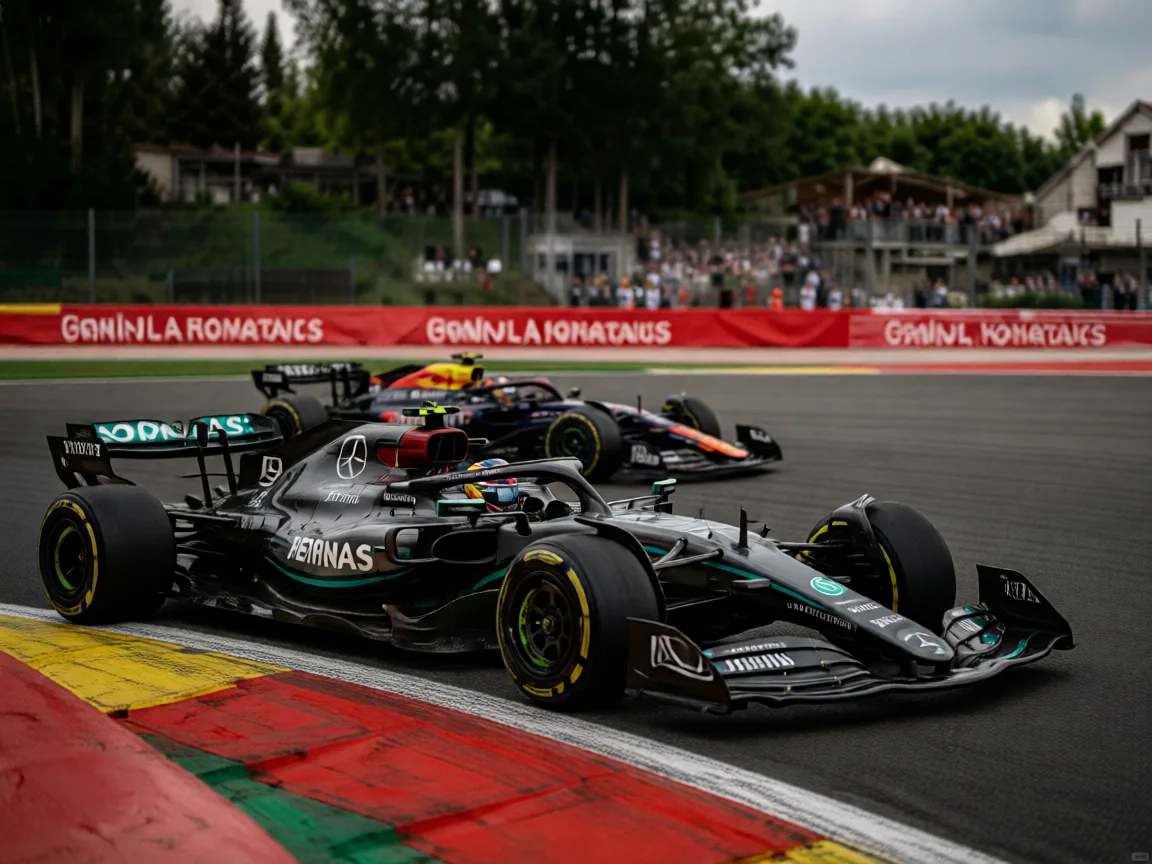
Spa Carnage: Russell Out as Hamilton Clash Triggers Early Safety Car
Lap 1 chaos at Spa-Francorchamps ends Russell's race after contact with Hamilton, summoning the Safety Car and reshuffling the Grand Prix.
Fornaroli gets second FP1 call as McLaren stack Hungary upgrades
McLaren hand Leonardo Fornaroli another practice outing in Budapest while bringing a batch of new parts for the MCL40.