Lost in Translation: Hamilton Baffled by Ferrari's Austrian Collapse
Lewis Hamilton's fifth-place finish at the Red Bull Ring exposed deeper questions about Ferrari's 2025 package.
The Admission That Says Everything
There is a particular kind of post-race debrief that tells you more than the timing screens ever could. When Lewis Hamilton stood before the media after Sunday's Austrian Grand Prix, he framed the team's underwhelming performance as a "reality check" after the euphoria of his first win with the Scuderia in Spain. He admitted Ferrari had "a good car but are down on pace," a diagnosis more alarming than any mechanical failure or strategic blunder, as it points to a fundamental performance gap.
Hamilton could only manage fifth place at the Red Bull Ring, a circuit that rewards precision, power unit performance, and aerodynamic efficiency in roughly equal measure. For a driver who joined Ferrari with the explicit ambition of challenging for an eighth world championship, the result raises uncomfortable questions about where the Scuderia's 2025 campaign is actually heading.
The Red Bull Ring: A Diagnostic Nightmare
The Spielberg circuit is deceptively simple on paper. At just 4.318 kilometers, it is the shortest lap on the calendar, a relentless sequence of long straights punctuated by heavy braking zones and elevation changes that punish any weakness in a car's package. There is nowhere to hide. If you are losing time, the data screams it at you every 68 seconds or so.
What makes Austria particularly revealing is the altitude. Sitting at roughly 670 meters above sea level, the thinner air reduces downforce and drag simultaneously, which means teams running high-downforce configurations lose less straight-line speed than they would at sea-level circuits but also gain less through the corners. It is an equalizer of sorts, but one that tends to expose power unit deficits and drag coefficients with brutal honesty.
Ferrari have historically performed erratically at this venue. The SF-25's aerodynamic philosophy, which has leaned toward a lower-drag concept to maximize straight-line speed, should theoretically suit the Red Bull Ring's layout. Yet Hamilton's fifth-place finish suggests the car was losing time in the corners where mechanical grip and driver confidence matter most, sectors two and three in particular demand commitment through the rapid changes of direction.
Strategy Breakdown: What the Pit Wall Saw
Without access to Ferrari's internal radio communications and strategy models, we can still piece together the likely picture from the lap time deltas and pit stop windows.
The Austrian Grand Prix typically features a one-stop strategy as the baseline, with the medium and hard compound tires offering sufficient durability across the 71-lap distance. Tire degradation at the Red Bull Ring is moderate but highly sensitive to front-left loading through the long, fast right-handers that dominate the circuit. Any car struggling with front-end grip will see its tire life collapse in the second stint, forcing either an earlier stop or a painful decline in lap times.
Hamilton's pace deficit likely widened in the middle phase of the race, where tire management becomes the primary variable. If the Ferrari was generating excessive front tire slip through the high-speed corners, Hamilton would have been forced to either back off and preserve the rubber or push through and suffer the consequences later. Either scenario costs position to cars with a more balanced mechanical platform.
Ferrari's strategy wall would have faced an unenviable choice: cover the undercut from behind and risk emerging into traffic, or extend the stint and pray the tire cliff does not arrive before the pit window closes cleanly. At a circuit where the pit lane time loss is relatively short due to the low-speed nature of the pit entry and exit, the undercut carries more potency than at longer venues. If Ferrari misjudged the window even by a single lap, the time hemorrhage could easily account for one or two positions.
The Bigger Problem: Consistency Across Circuits
One difficult result can be written off as an anomaly. But the pattern emerging from Ferrari's 2025 season suggests something more structural. The car appears to operate within a narrow performance window, competitive at certain track characteristics and conspicuously absent at others. This is the hallmark of a platform that has not fully resolved its aerodynamic balance.
Hamilton's comment about being "down on pace" while having "a good car" is particularly telling. A driver of his experience, with over 350 race starts and decades of reading a car's behavior through the seat of his pants, identifying a pace deficit without an obvious cockpit-reason means the deficit was systemic. That points to a fundamental issue rather than a setup problem, suggesting the car's limitations are baked into its concept, not something that can be cured with a different front wing angle or a revised suspension geometry.
For Ferrari, this is the scenario they feared when they committed to Hamilton's signing. The appeal of bringing in a generational talent is obvious, but the value only materializes if the machinery beneath him is capable of operating at the sharp end. Hamilton can extract the maximum from a car, but he cannot conjure grip where the physics do not permit it.
The Standings Implications
Fifth place delivers 10 points, a respectable haul in isolation but a damaging one when measured against the championship ambitions Ferrari set for themselves this season. The result has seen Hamilton drop to third in the drivers' championship, behind Mercedes' George Russell, who won in Austria, and his teammate Kimi Antonelli, who now leads the standings. Every race where Hamilton finishes outside the podium positions is ground ceded to the leaders, and in a title fight that could be decided by margins of fewer than 20 points, the mathematics become unforgiving quickly.
The constructors' championship picture is equally concerning. Ferrari need both drivers extracting consistent results to maintain pressure on the teams ahead, and a fifth-place finish from their lead driver at a track where the car should have been competitive is the kind of result that erodes confidence throughout the organization, from the factory floor to the strategy room.
Hamilton's form relative to his teammate will also come under scrutiny. Internal competition at Ferrari has a way of becoming public very quickly, and with Antonelli now ahead in the championship, the narrative shifts from a car problem to a driver problem, fair or not.
What Comes Next
The calendar offers no respite. The coming races feature a mix of high-downforce and low-drag circuits that will test whether Ferrari can solve the inconsistency that plagued them in Austria. Hamilton's ability to adapt to a car that does not respond to his inputs the way his Mercedes machinery once did is the central storyline of his Ferrari tenure.
The summer break is still several races away, and Ferrari's technical department will be poring over the Austria data with forensic intensity. The question is whether the findings point to a solvable problem or a fundamental limitation of the current regulations combined with their aerodynamic philosophy.
Hamilton's "reality check" was necessary. Ferrari need to find the answer before the championship window closes completely. In Formula 1, talent without a platform is just spectacle. And spectacle does not score points.
Updated: 2026-06-28 — Added Hamilton's direct quotes ("reality check," "good car but down on pace") and updated drivers' championship standings to reflect his drop to third behind Russell and Antonelli.
Editorial Integrity
This is an original SportPulse article written by our editorial team. All content is independently researched, written, and reviewed by our writers and editors before publication. We do not publish copied, aggregated, or syndicated content.
SportPulse is committed to original sports journalism. Read our editorial policy or contact us with any questions.
More Like This
All f1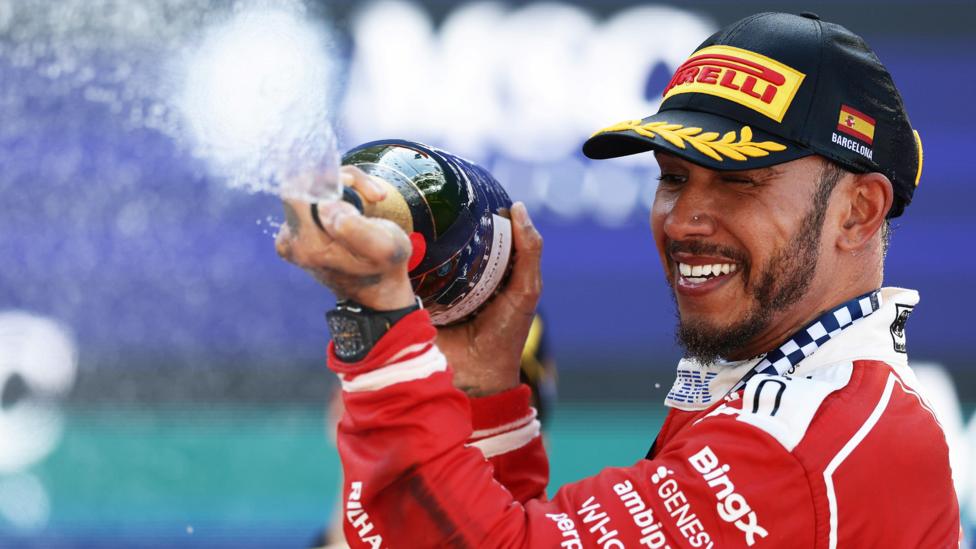
Seven-Time Glory Restored: Hamilton Silences Every Doubt in Barcelona
Lewis Hamilton's Barcelona victory wasn't just a win for Ferrari — it was a reckoning with every voice that said his best days were gone.
Racing Bulls' Spa Upgrade Package Passes Its First Real Test
Arvid Lindblad scored points at Spa, but the real story is whether Racing Bulls' upgraded aero package fundamentally shifts the car's operating window.
Spa and Hungaroring Demand Opposite Engineering Philosophies
Formula 1's 2026 double header tests aerodynamic efficiency against mechanical grip across two radically different circuits.