Why The Hungaroring's High-Downforce Tech Demands Dictate Race Pace
With 14 slow-speed corners punishing tyre temperatures and aerodynamic wake, Hungary's stop-start layout makes it a technical puzzle for engineers.
The Hungarian Grand Prix stands as the season's definitive slow-speed, high-downforce challenge. Coming just one week after the sweeping fast-flowing curves of Silverstone, the transition to the tight and twisty confines of the Hungaroring forces teams into a completely different aerodynamic and mechanical philosophy. For drivers, it is famously described as a physical kart track. For engineers, it is a weekend spent chasing tyre temperature, battling underbody aerodynamic stall, and chasing the perfect mechanical grip window.
Unlike circuits where outright engine horsepower dominates the lap time charts, the 4.381-kilometre Hungaroring features 14 corners and only one meaningful straight. The heavy stop-start nature of the circuit keeps average speeds low, forcing teams to run maximum downforce configurations. This creates a paradox for engineers: high downforce naturally increases aerodynamic drag, but the Hungaroring's winding layout is the rare exception where the massive drag penalty is tolerated because straight-line speed is rarely the differentiator. Instead, the focus shifts entirely to cornering stability.
Aerodynamic Wake and Downforce Maximization
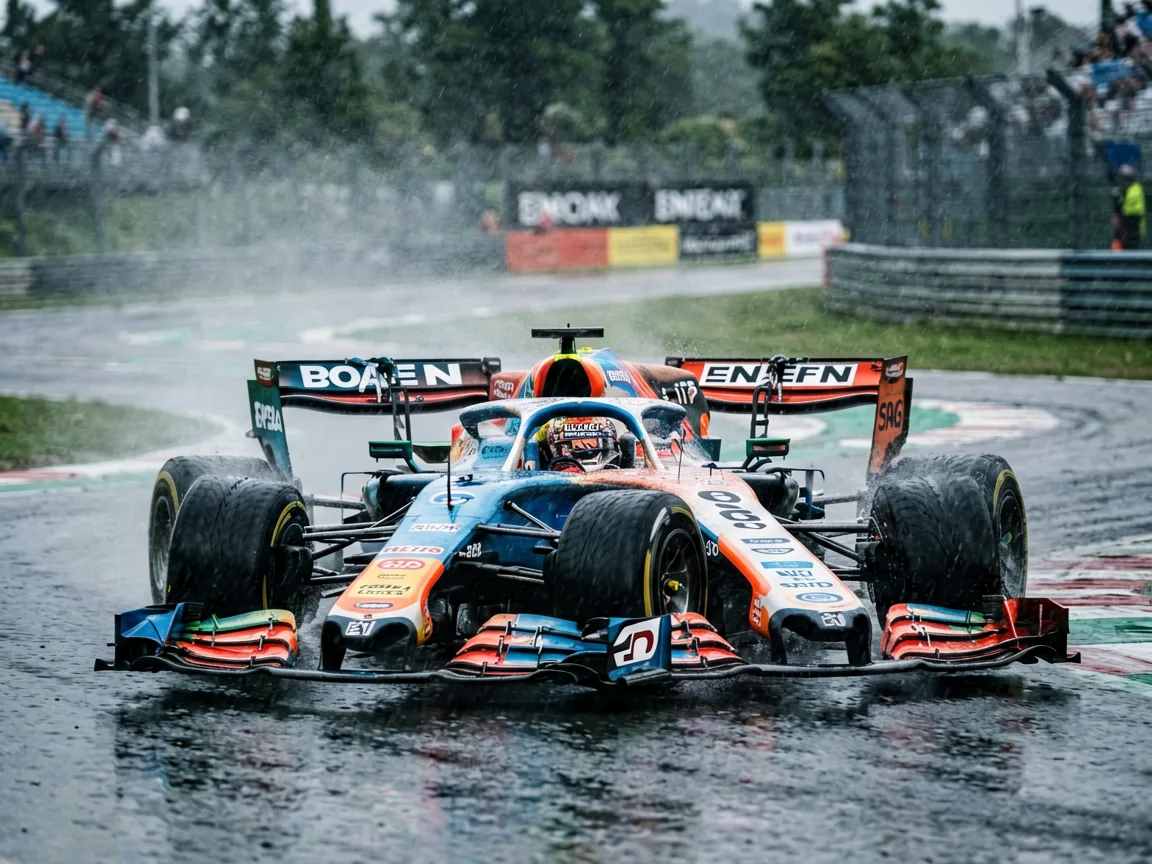
The primary technical focus at the Hungaroring is maximizing cornering force through the slow-speed Esses. Teams typically upgrade to their largest rear wing specifications of the season, paired with aggressively loaded rear corner aero profiles. If you imagine the rear wing as an inverted airplane wing, pushing the car into the asphalt to create cornering grip, the Hungaroring requires the thickest, heaviest version of that wing. The trade-off is straight-line drag, but track topology overrides drag concerns.
The critical challenge lies in the follow-up aerodynamic elements, particularly the beam wing and rear corner aerodynamics. The beam wing sits below the main rear wing and helps extract air from the underbody, driving the diffuser harder. This connection is crucial because modern ground-effect F1 cars rely heavily on sealing the floor edges. In slow corners where car speed is low, airflow energy drops. The entire downforce generation system becomes fragile, and the diffuser stalls if the airflow separation becomes too severe.
To combat this, engineers maximize the lower wing elements to keep the underbody flowing. Teams will also adjust the brake duct aero wings to condition airflow around the rear axle. This is analogous to smoothing the ripples in a stream before it reaches a water wheel. If the water arrives turbulent, the wheel struggles to turn. If the airflow reaches the diffuser chaotically, it stalls and the car loses grip at the rear, plaqueing the car with understeer.
Mechanical Grip and Suspension Kinematics
While aerodynamics dominate the conversation, mechanical grip is the underlying foundation of a strong lap time in Hungary. The track surface is notoriously bumpy and low-grip, initially described as dusty during its early years on the calendar. This puts extreme demand on the suspension kinematics.
The challenge for engineers is softening the mechanical platform enough to let the tyres grip the track through weight transfer. A soft suspension acts like a sponge, allowing the chassis to pitch and roll smoothly so the tyres stay planted. However, if the suspension is too soft, the car becomes unstable in rapid direction changes, leading to a sluggish feel and potential instability.
Engineering Insight: Anti-Dive Geometry and Tyre Temperature
Anti-Dive and the Tyre Temperature Struggle
A critical technical weapon in Hungary is anti-dive geometry. This refers to how the front suspension arms are angled to resist the car diving forward under braking. If you watch an F1 car from the front during heavy braking, the front wing visibly drops toward the asphalt. High anti-dive geometry stiffens this motion, keeping the front wing stable and maintaining consistent aerodynamic performance. In slow corners, this stability is crucial because it keeps the underbody flow attached and prevents the airflow from separating.
However, there is a narrow operating window. When anti-dive is high, the suspension absorbs less of the braking force, transferring that load directly to the front tyres. This can overload the front-left tyre in particular, generating excess heat. The hardest part of the weekend at the Hungaroring is getting the front tyres into the correct temperature window.
The Thermal Limit
The front-left tyre takes the brunt of the load through the long right-hand corners. If it overheats, the surface temperature spikes, the rubber degrades rapidly, and the driver faces severe understeer. If it runs too cold, the tyre lacks the stickiness to grip the asphalt, creating severe understeer and plunging lap times. The track layout makes this the most difficult puzzle on the calendar. The absence of long straights means the tyre has no time to cool down and reset, generating heat continuously.
To manage this, teams run aggressive engine braking settings, using the powertrain to rotate the car into corners and try to manage tyre temperatures. Engine maps are adjusted to shift the brake bias forward, helping the front tyres absorb braking energy and maintain temperature in the critical early phase of a stint.
Engineering The Setup Stiffness
The suspension geometry choices directly influence tyre degradation. A high anti-dive and anti-squat geometry can be a performance booster but must be balanced against mechanical grip. The narrowest operating window of the season is here in Hungary. Engineers try to find the magic compromise.
"The track layout makes it the most difficult puzzle on the calendar. The absence of long straights means the tyre has no time to cool down and reset, generating heat continuously." — F1 Technical Director
Tyre temperatures and degradation rates are critical here because track position is hard to maintain. If the car in front is running slightly cooler tyres and sliding more, it acts as an air blockage, stripping the pursuing car of downforce and pushing its front tyres out of the thermal window.
Implications For Race Strategy And Pace
Understanding these technical demands completely reframes race predictions and betting angles for the weekend. The Hungaroring is famously difficult for overtaking. The main straight is short, meaning the speed deficit required due to aerodynamic wake, known as dirty air, is large. The pursuing car must be significantly faster to make a pass.
This transforms the pursuit of track position into a race won or lost in pit strategy and tyre management. A team that can protect the front-left tyre through careful suspension setup and aero balance will maintain their pace far longer into a stint. Conversely, a team that burns their tyres early will find themselves helpless to defend track position, even if their car has the raw pace advantage.
In this environment, qualifying position is incredibly decisive. Start at the front, control the pace, and manage the tyres. Getting bogged down in traffic is a race-ruining scenario, as the aerodynamic wake prevents overtaking and the tyre temperatures spiral out of control, destroying the race plan.
Looking Ahead: The Spa-Francorchamps Contrast
The technical focus immediately shifts from the high-downforce demands of Hungary to the opposite extreme at the upcoming Belgian Grand Prix. Spa-Francorchamps is the season's ultimate low-downforce challenge, demanding the thinnest rear wings on the calendar to minimize drag along the long Kemmel Straight.
Engineers face a rapid turnaround, stripping the heavy Hungarian aero packages and replacing them with low-drag configurations. The mechanical setup softness required for the bumpy Hungaroring will be stiffened for the high-speed compressions of Eau Rouge and Raidillon. The contrast highlights the extreme adaptability required of modern F1 cars. The engineers who master both ends of the aero and mechanical setup spectrum are the ones who consistently deliver race-winning performance throughout the season.
The Hungarian Grand Prix is a technical litmus test. It exposes weaknesses in underbody aero efficiency, mechanical grip balance, and tyre management. For those analyzing race predictions and performance trends, the team that wins this weekend will be the one that best masters the intricate dance between downforce generation, temperature control, and mechanical compliance.
Editorial Integrity
This is an original SportPulse article written by our editorial team. All content is independently researched, written, and reviewed by our writers and editors before publication. We do not publish copied, aggregated, or syndicated content.
SportPulse is committed to original sports journalism. Read our editorial policy or contact us with any questions.
More Like This
All f1
F1's Retail Play: How Flagship Stores Signal a New Era for the Sport
F1's new permanent stores at Silverstone and Oxford Street reveal Liberty Media's aggressive push to turn racing into a lifestyle brand.
Silverstone Sprint Qualifying: Where Aero Meets Aggression in 2026
Sprint Qualifying at Silverstone demands maximal downforce and perfect tire temperature management on the most demanding calendar weekend.
Spa Returns: Five Storylines Defining F1's 2026 Belgian GP
Round 10 of the 2026 season hits Spa-Francorchamps with title fights, midfield chaos, and regulation drama all colliding.