Irish Premiership Clubs Are Rewriting European Football's Rules
Northern Ireland's finest are no longer making up the numbers in Europe. They are breaking coefficient ceilings and redefining what small leagues can achieve.
European football used to be a polite excursion for Irish Premiership clubs. A bonus pre-season trip, a chance to test the legs against continental opposition, and an early exit that allowed domestic title charges to proceed without distraction. Those days are finished. The narrative has shifted, driven by tactical evolution, expanded European competition formats, and clubs that increasingly refuse to settle for merely participating. The question is no longer whether Irish teams can win a single European tie. The question is how deep they can advance and whether any club can push beyond the third qualifying round this season.
The Recent History Changing the Paradigm
It was Linfield's remarkable run in 2020 that fundamentally altered the psychology of the Irish Premiership. Reaching the Europa League third qualifying round, including a famous away win against HB Torshavn and a competitive showing against Slovan Liberec, proved that progression from the early preliminary rounds was not an anomaly but a genuine possibility.
Since then, the bar has only climbed higher. Consider the trajectory:
- Linfield's 2020 Europa run, reaching the third qualifying round and securing vital prize money that underpinned domestic dominance.
- Cliftonville and Glentoran pushing deep into preliminary rounds against sides with exponentially larger wage bills.
- The expanded Europa Conference League, introduced in the 2021-22 season, providing an additional European pathway for clubs from nations ranked outside the top 50 in UEFA's coefficient table.
Northern Ireland currently sits in the low-to-mid 40s in the UEFA coefficient rankings, a position that historically guaranteed one Champions League slot and a scattering of Europa and Conference League entries across the domestic campaign. But coefficient points accumulated through competitive results directly influence the number of European berths available to the league in future seasons. Every draw, every victory, sends ripples through the entire structure of Irish football's European access.
The Financial Asymmetry
To grasp why any Irish Premiership run in Europe qualifies as an overachievement, one must confront the financial reality. Top-flight clubs in Northern Ireland operate on budgets that are modest even by League of Ireland standards. A club like Linfield or Cliftonville might boast an annual operating budget in the region of £600,000 to £1.5 million. This is a fraction of what a mid-tier Swedish or Czech club, typically their direct European opponents, would allocate just for player wages.
Wage disparities directly translate into squad depth limitations. When an Irish Premiership champion faces a side from a higher-ranked association, they are competing against professionals with full-time training regimens and deeper benches. The Irish sides, often blending professional contracts with semi-professional players holding day jobs, must survive late-match pressure that would break most part-time teams. The statistical reality of goals conceded after the 75th minute in early-round European ties historically haunts smaller clubs, a cruel reflection of depleted stamina.
Tactical Pragmatism Behind the Progress
The progress of Irish Premiership clubs in Europe is neither accidental nor merely a product of luck. It stems from a distinct tactical pragmatism that prioritises defensive structure, physical endurance, and calculated opportunism. Modern Irish sides facing continental opposition typically deploy a compact low block, operating with an average defensive line depth of just 38-42 meters from their own goal, compared to the 50-plus meters common among mid-table sides in top European leagues. A disciplined low block forces technically superior opponents into sterile possession around the perimeter of the final third.
This defensive rigidity, however, is only a foundation. Crucially, the transition phase, converting a defensive interception into a genuine goal-scoring opportunity within a five-second window, separates competitive Irish sides from also-rans. Linfield's victory against HB Torshavn was constructed exactly this way, with the opening goal originating from a midfield turnover and finished within three passes, a biomarker of effective counter-attacking football.
But the tactical gap remains. When Irish clubs progress to face seeded opponents from higher-ranked associations, the sheer volume of opposition chances invariably tells. A typical Irish Premiership side in Europe might concede 12 to 15 shots per match, relying on a shot-to-goal conversion rate from opponents dropping below 8% to secure a result. Sustaining that level of defensive resistance across the gruelling early qualifying ties requires elite fitness.
European football is a relentless financial arms race. For clubs operating outside the top 30 associations, coefficient survival means matching tactical discipline with sheer physical willpower.
The Bottom Line: Irish clubs are not progressing because they are out-technicaling opponents. They are surviving because they have learned to maximise defensive efficiency and exploit transition moments with surgical precision.
The Expanded Format Opportunity
The introduction of the Europa Conference League fundamentally changed the landscape for clubs from lower-ranked nations. Until recently, being eliminated in the early rounds of either the Champions League or the Europa League meant the immediate end of the European campaign. Now, a defeated side in the Champions League pathway drops into the Europa League. Subsequent failure there can mean a parachute into the Conference League. For clubs like Linfield, Cliftonville, Glentoran, and Crusaders, this format provides multiple lives.
UEFA's prize money structure also heavily incentivises progression. Merely reaching the play-off round of the Conference League can guarantee a payout in the region of €850,000. For an Irish Premiership club, that sum is transformative. It can underpin an entire domestic season's operations, fund necessary infrastructure improvements, and facilitate the transition toward fully professional squad models.
The stakes are high because the financial windfall directly translates into a competitive advantage back home. The domestic dominance of the club that secures the most European prize money creates a cyclical reinforcement. Success in Europe breeds domestic financial supremacy, which in turn breeds further European qualification. Breaking that cycle is the primary challenge facing the chasing pack in the Irish Premiership.
What the Numbers Say
- 3 UEFA coefficient points earned by Northern Irish clubs in a successful campaign can elevate the nation's ranking by up to two places.
- The financial gap between reaching the Conference League group stage and elimination in the second qualifying round exceeds €2.5 million.
- Linfield's European prize money in recent seasons has frequently accounted for roughly 20% to 30% of the club's total annual revenue.
- An average pass completion rate of 68% in European away matches is the threshold Irish clubs must cross to remain competitive against seeded opposition.
- The xG threshold for Irish clubs in Europe generally sits around 0.9 per match, meaning they must convert nearly every high-quality chance to secure a positive result.
What Must Change to Make More History
Progressing deeper into Europe for an Irish Premiership club demands three specific changes, moving beyond mere participation to sustained advancement.
First, domestic scheduling must adapt to the European calendar. Competing in six qualifying rounds across the summer while simultaneously fulfilling early-season domestic fixtures strains an already thin squad. League administrators must consider fixture flexibility for European representatives, ensuring clubs play their qualifying ties without the punishing burden of Saturday-Tuesday-Saturday exertion cycles.
Second, Irish clubs must improve their home record against higher-seeded opposition. Historically, the aggregate results have been heavily skewed by narrow away defeats and draws at home being undone by travel-leg losses. Securing a lead at Windsor Park or Solitude, then managing the away leg with a structured defensive shell, is the only viable mathematical path to progression. In recent European campaigns, Irish clubs have managed to win roughly 40% of home legs but have overturned first-leg deficits on the road less than 15% of the time, a statistical chasm that must narrow.
Third, investment in sports science and data analytics is no longer a luxury. Understanding opposition set-piece routines and pressing triggers can level the playing field against financially dominant sides. The gap in raw player quality cannot be closed through transfer spending, but the gap in tactical preparation can absolutely be narrowed through accessible video analysis and data scouting tools.
The dream of reaching a European group stage is no longer fantasy. It is a logistical puzzle awaiting the right combination of draw, timing, and ruthless execution.
The Verdict: Making more history will not require a revolution. It will demand the quiet accumulation of marginal gains: smarter fixtures, improved set-piece efficiency, and a ruthless edge in transition moments.
The Bigger Picture
As the new European season approaches, the Irish Premiership's representatives carry a heavier burden than their predecessors. They are no longer just playing for their own club's glory. They are playing for the league's coefficient, determining how many European slots Northern Ireland will retain in the seasons to come. A poor campaign across the board could see the association lose a qualifying berth. A successful one could lock in an extra place for years to come.
The narrative is set. Irish Premiership clubs are no longer in Europe just for the experience. They are there to win, to progress, and to break the coefficient ceiling once and for all. Whether this season delivers the historic breakthrough remains the defining question of their campaign.
Editorial Integrity
This is an original SportPulse article written by our editorial team. All content is independently researched, written, and reviewed by our writers and editors before publication. We do not publish copied, aggregated, or syndicated content.
SportPulse is committed to original sports journalism. Read our editorial policy or contact us with any questions.
More Like This
All football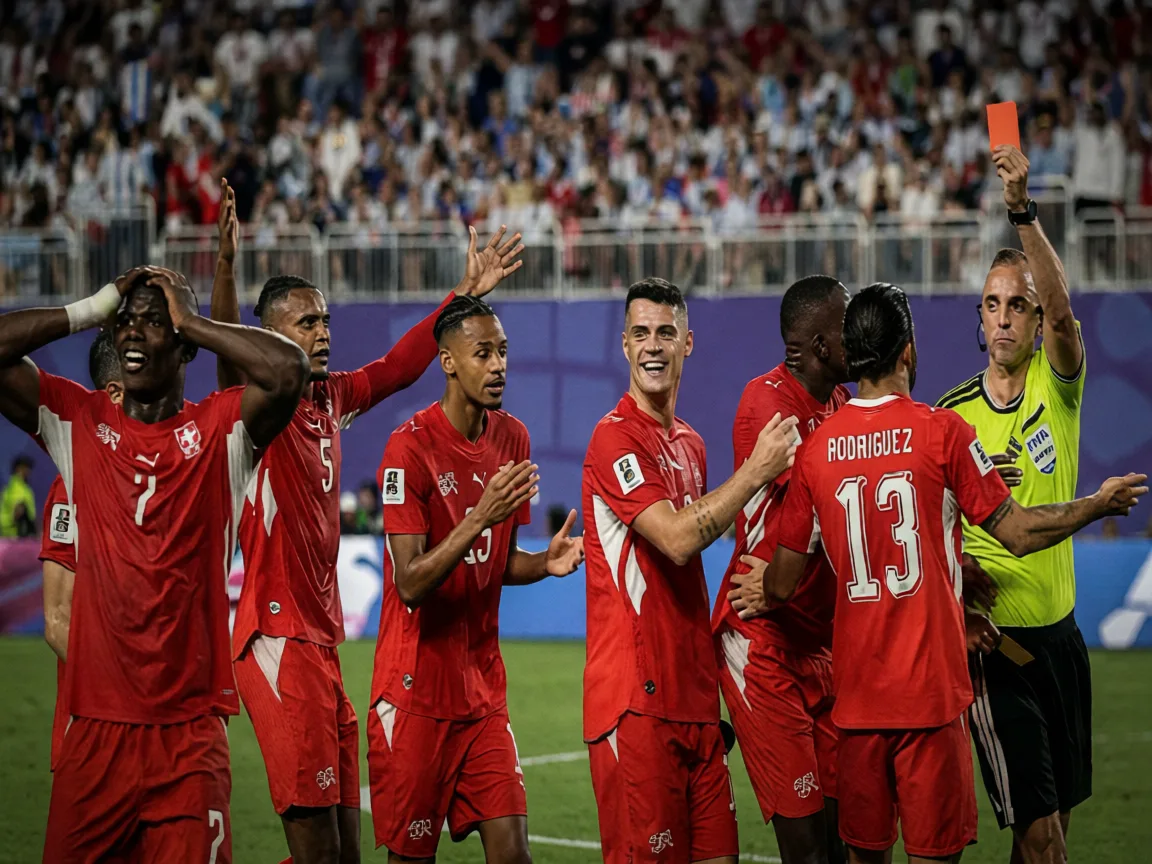
Embolo Makes World Cup History With Bizarre Red Card
Switzerland striker Breel Embolo became the first World Cup casualty of the mistaken identity rule.

England Forced Into 2027 World Cup Play-Offs After Qualifying Stumble
England's wait for a major trophy goes on, and now so does their path to Brazil 2027 via the play-offs.

Hull City's Decade-Long Exile Ends: McBurnie's Clinical Edge Seals Premier League Return
Oli McBurnie's goalscoring instinct proved decisive as Hull City ended their ten-year Premier League absence through the EFL playoffs.