Kapp's Thunderbolt Leaves England Reeling at 20-2 in World Cup Semi
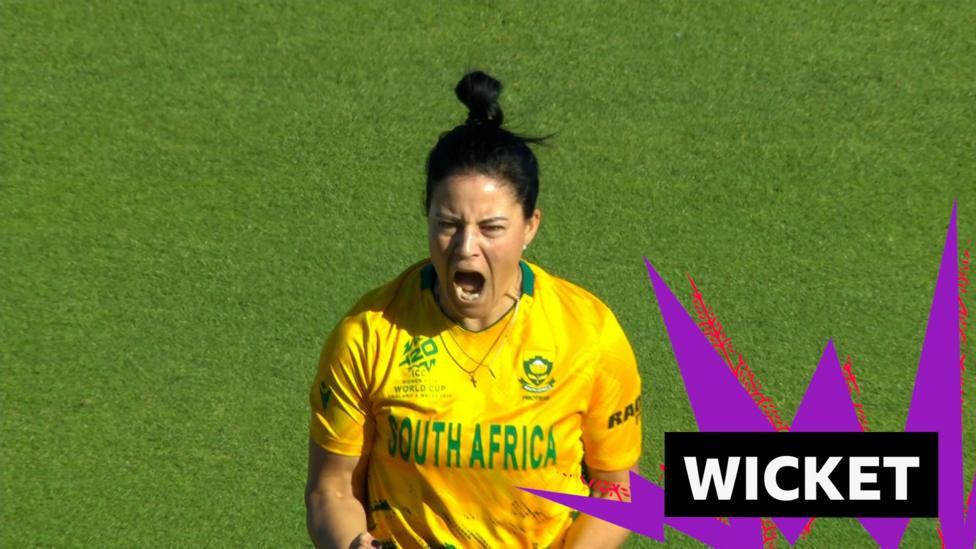
Marizanne Kapp removed Danni Wyatt-Hodge for 12 as South Africa ripped through England's top order in a dream start to their T20 World Cup semi-final.
title: "Superb Sciver-Brunt Leads From the Front as England Fight Back"
category: long-reads
badge: Feature
badgeType: category
author: Sarah Martinez
authorRole: Transfer Correspondent
authorInitials: SM
date: 2026-07-02
readTime: 7 min read
image: https://ichef.bbci.co.uk/ace/standard/976/cpsprodpb/2254/live/ad7e2a60-763f-11f1-9510-1546718f668b.jpg
imageAlt: Marizanne Kapp celebrating a wicket during the ICC Women's T20 World Cup semi-final against England
tags: ICC Women's T20 World Cup, Women's Cricket, T20 International, South Africa Women, England Women
excerpt: "Marizanne Kapp struck early, but captain Nat Sciver-Brunt's brilliant 75 powered England to a total of 170 in their T20 World Cup semi-final."
The Delivery That Silenced a Nation's Hopes
There is a particular cruelty to a ball that clips the stumps in a knockout match. No umpire's finger to debate. No edge to review. Just timber flying and a batter frozen in disbelief.
That is exactly what Marizanne Kapp delivered to Danni Wyatt-Hodge in the opening exchanges of the ICC Women's T20 World Cup semi-final, and the reverberations from that single ball may define this entire contest.
Wyatt-Hodge, England's most destructive white-ball opener, was gone for 12. England were 20-2. And Kapp, the 34-year-old seamer who has been doing this for over a decade, stood with the calm of someone who has seen every scenario this game can throw at her.
"That's huge!" was the call from the commentary box, and for once the exclamation felt entirely justified.
Why Wyatt-Hodge's Wicket Matters More Than Most
Wyatt-Hodge is not just another name on the England team sheet. She is the fuse. The player whose role is to detonate the powerplay, to set a tempo that forces the opposition onto the back foot before they have settled into their lines.
Her career T20I strike rate tells the story of a batter built for exactly this kind of occasion. When Wyatt-Hodge fires, England's middle order walks to the crease with a platform and freedom. When she falls early, the entire innings recalibration becomes a collective headache.
At 20-2, that headache had already become a migraine.
England's top three in T20 cricket carry an enormous share of the scoring burden. Losing two wickets inside the powerplay with barely 20 runs on the board strips the innings of its planned architecture. Suddenly the batters in the middle order are not playing their natural game. They are managing damage.
Kapp: The Most Complete Bowler in Women's T20 Cricket
Strip away the emotion, the crowd noise, and the occasion, and what you have left is a simple truth: Marizanne Kapp is one of the finest seam bowlers the women's game has ever produced.
Her numbers across T20 Internationals are staggering. But the statistics alone do not capture what makes Kapp so devastating in moments like these. It is the ability to produce a match-defining delivery when the stakes are at their highest.
Kapp operates with a seam position that would make textbook coaches weep with joy. Her stock delivery angles in, asking the batter to play at it. Her wobble seam moves just enough to find the edge. And then there is the one that comes back with the arm, the one that rearranges the stumps.
That is the delivery Wyatt-Hodge received. A ball that demanded a shot, shaped just enough to beat the bat, and crashed into the stumps with surgical precision.
The Kapp Effect by the Numbers
- Over 100 T20I wickets across her international career
- Consistent economy rate under 6 runs per over in powerplay overs across recent World Cup campaigns
- Among the top wicket-takers in women's T20 World Cup history
- Strike rate under 18 with the ball in tournament knockouts
That final number is the one that should terrify opposing batting lineups. In knockout cricket, Kapp does not just bowl well. She bowls at a level that tilts entire matches.
South Africa's Dream Start and What It Unlocks
The phrase "dream start" gets overused in sports journalism, but this was not hyperbole. 20-2 inside the powerplay in a World Cup semi-final against one of the tournament favourites is exactly that.
South Africa's women have been on a remarkable trajectory. After heartbreak in previous World Cup campaigns, this squad has developed a spine of experience around players like Kapp, who have lived through the disappointment and emerged tougher for it.
The Proteas' bowling attack in this tournament is built around pressure. Not flashy variations or mystery spin. Relentless, disciplined pace bowling that asks the batter to take risks. Kapp's opening spell is the spearhead of that philosophy, and when she strikes early, the rest of the attack feeds off it.
With England reeling at 20-2, South Africa's spin options suddenly become exponentially more dangerous. Batters who are forced to rebuild against pace must then contend with slower bowlers operating on surfaces that offer turn. The squeeze tightens. The required rate climbs. And the pressure compounds with every dot ball.
England's Dilemma: Rebuild or Counterattack?
This is the defining tactical question for England now, and neither answer is comfortable.
The conservative approach says: absorb the pressure, rebuild the innings, and aim for a competitive total around 130-140. The problem with that strategy is that South Africa's bowling attack is precisely designed to strangle low-risk batters. Dot balls breed pressure, pressure breeds mistakes, and mistakes breed collapses.
The aggressive approach says: counterattack immediately, take the game to South Africa's bowlers, and refuse to let the scoreboard stagnate. The problem there is obvious. At 20-2, taking risks means potentially sliding to 40-5 or worse, at which point the match is effectively over.
England's middle order, led by captain Nat Sciver-Brunt, chose the latter path. They needed to find a way to thread this needle. Rotate strike, punish the bad ball, and survive the good one. Simple in theory. Excruciating in practice when the bowler at the other end is Marizanne Kapp on a mission.
Behind the Delivery: Kapp's Powerplay Mastery
There is a tactical layer to Kapp's opening spell that goes beyond raw skill. Her powerplay strategy is a masterclass in reading conditions and exploiting them.
Kapp typically opens from around the wicket to right-handers, angling the ball across and asking the question: play or leave? For a player like Wyatt-Hodge, whose instinct is to attack anything in her hitting arc, that question becomes a trap. The natural scoring zones are covered, the stumps are always in play, and the margin for error is razor-thin.
What Kapp does better than almost anyone in the women's game is adjust her length based on the surface. On pitches with bounce, she hits a hard length and lets the ball do the rest. On slower surfaces, she pushes it fuller, trusting the movement off the seam to compensate for the reduced carry.
In this semi-final, she got the balance exactly right. Full enough to threaten the stumps, but with just enough nip to beat the outside edge. Wyatt-Hodge's stumps paid the price.
The Captain's Response and Knight's Steadying Influence
Where Kapp's early strike created a crisis, Nat Sciver-Brunt produced the innings to resolve it. The England captain counterattacked brilliantly, compiling a vital 75 off 47 balls to rescue her side from that precarious position and rebuild the innings with a combination of power and precision.
Her knock was the anchor around which England's recovery was built. Crucially, she was partnered by the experienced Heather Knight, who used all her class to contribute a vital 53 off 47 balls. Together, they guided England from a perilous 23-3 to a much more secure 169-5, a partnership that demonstrated the depth of talent and nerve in the England lineup.
The Bigger Picture: What This Moment Represents
For South Africa, Kapp's early breakthrough was a statement of intent: this squad is here to rewrite their World Cup story of near-misses. However, they now face a stiff challenge to chase down 170.
For England, the challenge was equally significant. A World Cup semi-final is not the place to recover from a poor start, but this is a squad with enough experience and talent. Led by their captain and supported by Knight, they summoned a magnificent recovery under pressure, setting a target that demands a significant response from the Proteas.
What Comes Next
The contest has been transformed. South Africa's dream start has been met with a captain's innings of the highest order and a masterful supporting knock from a seasoned campaigner. England, despite the early damage, have posted a commanding total of 170.
The pressure now shifts entirely to South Africa's batting lineup. Can they match the brilliance of Sciver-Brunt and Knight and chase down this total, or will England's fightback prove decisive?
One ball. Three stumps. A World Cup semi-final tilted on its axis, first by Marizanne Kapp, and then decisively by England's experienced duo. That is the power of individual brilliance in knockout cricket.
Updated: 2026-07-02 — Added Heather Knight's crucial 53 to detail England's recovery from 23-3 to 169-5.
Editorial Integrity
This is an original SportPulse article written by our editorial team. All content is independently researched, written, and reviewed by our writers and editors before publication. We do not publish copied, aggregated, or syndicated content.
SportPulse is committed to original sports journalism. Read our editorial policy or contact us with any questions.
More Like This
All long-reads
Wales Reinforce Coaching Ranks With Salvin Capture From Exeter
Wales land Exeter's Steve Salvin as full-time forwards coach ahead of WXV campaign.

Smith's First WBC Defence: Puello Looms on October 24
Dalton Smith faces Alberto Puello on October 24, testing his unbeaten record and new WBC title against a dangerous southpaw.

Cycling Royalty: Naming Every Tour de France Winner Since WW2
The 113th Tour de France departs Barcelona on July 4. Before the peloton rolls out, test your grit against the daunting pantheon of post-war Tour winners.