The Lob That Changed Everything: Marcus Willis Returns to Wimbledon on His Own Terms
Ten years after facing Federer on Centre Court, Marcus Willis is back at Wimbledon refusing to be a one-moment wonder.
A Decade of Distance From Centre Court
The lob floated into the late-afternoon London sky, hung there for what felt like an eternity, and dropped cleanly over the outstretched racquet of Roger Federer. The crowd on Centre Court gasped, then roared. Marcus Willis, ranked 772nd in the world, had just produced a moment of audacious brilliance against the greatest grass-court player in history during their 2016 Wimbledon first-round encounter.
He lost that match 6-0, 6-3, 6-4. The scoreline was brutally one-sided. Yet Willis walked off the court as the story of the entire Championships, a dental nurse's boyfriend from Warwickshire who had battled through pre-qualifying, qualifying, and a first-round win over Ricardas Berankis just to earn the right to share Centre Court with Federer. For a few sun-drenched days in June, he was the most talked-about player in tennis.
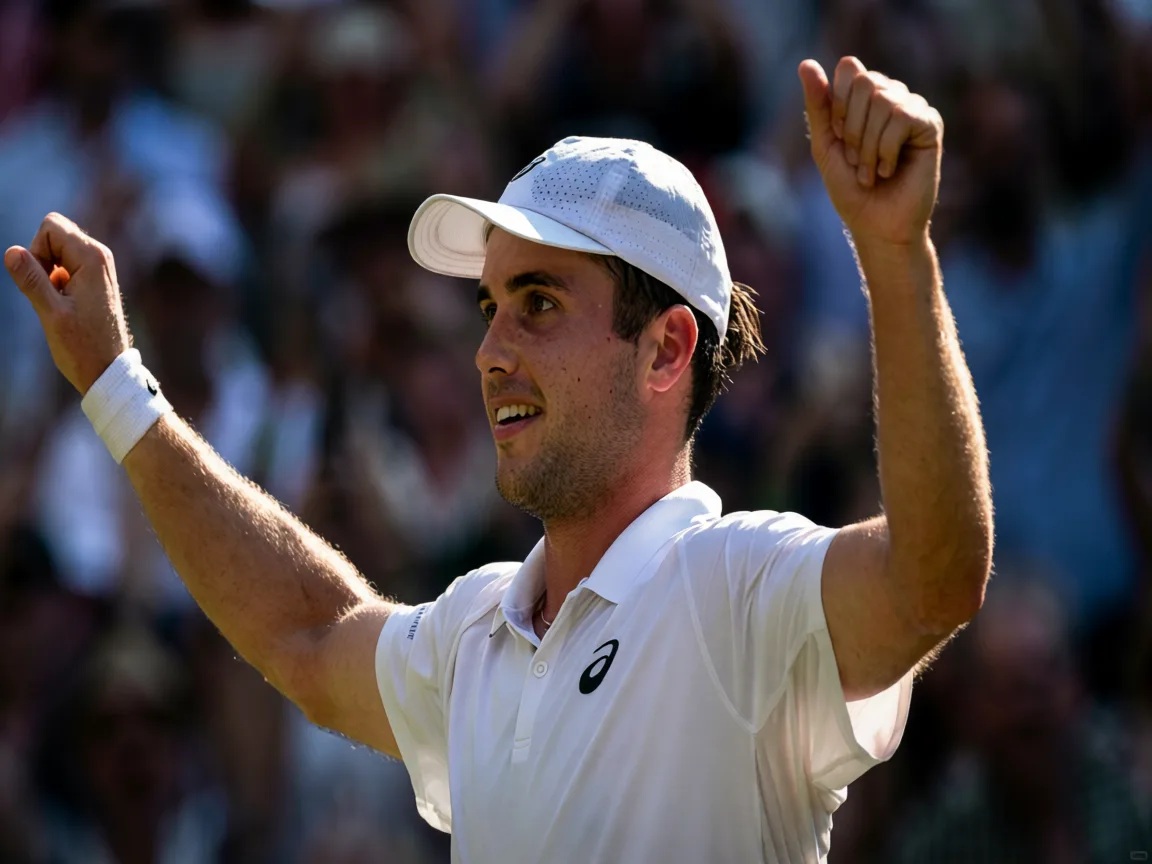
Now, ten years on, Willis is back at the All England Club. And the most striking thing about his return is how deliberately he is pushing back against the narrative that has both elevated and confined him ever since that afternoon.
"I'm not defined by that match. It was an incredible experience, but I've played thousands of points since then. I'm not just one lob." — Marcus Willis
The Making of a Cult Hero
To understand why Willis became a phenomenon in 2016, you need to understand the state of British tennis at the time. Andy Murray was shouldering the weight of an entire nation's expectations. Below him, the cupboard was largely bare. The Lawn Tennis Association had spent millions developing talent with modest returns, and here was a man who had been playing ITF Futures events in places like Sharm El Sheikh and Hammamet, scraping by on prize money that barely covered his travel expenses.
Willis had actually considered quitting the sport entirely before that Wimbledon run. His ranking had dipped below 800, and the financial reality of professional tennis at the lower tiers is unforgiving. A player ranked 772nd does not receive wild cards to major events. They do not attract sponsors. They wash their own kit in hotel sinks and share rooms to split costs.
The qualifying run changed everything, at least temporarily. His first-round victory over Berankis, a player ranked roughly 700 places above him, was the real sporting achievement. The Federer match was theatre. But the British public, starved of accessible sporting heroes, latched onto Willis with a ferocity that surprised everyone, including Willis himself.
He received sponsorship offers. He appeared on television chat shows. His phone rang constantly. For a player who had spent years toiling in obscurity, the sudden spotlight was both intoxicating and disorienting.
The Weight of One Moment
Here is the uncomfortable truth about sporting cult hero status: it can be a cage disguised as a crown. Willis has spent a decade navigating the space between being "the bloke who lobbed Federer" and being a professional tennis player trying to build a legitimate career.
In the years following 2016, his ranking fluctuated. He never broke into the top 200, never won a main-draw match at another Grand Slam. The gap between his public profile and his competitive reality created a tension that many athletes in similar positions have described as deeply isolating. Fans expected the fairy tale to continue. The sport's meritocracy did not care about fairy tales.
Willis continued competing on the lower circuits, grinding through Challenger events and the occasional ATP qualifying draw. He dealt with injuries. He adapted his game, recognising that the all-court flair that produced that famous lob needed to be supplemented with greater tactical discipline if he wanted to compete consistently at a higher level.
His story is not unique in tennis. Marcus Willis shares DNA with players like Dustin Brown, whose electrifying victory over Rafael Nadal at Wimbledon in 2015 made him a global name but never translated into a sustained top-50 career. The sport is littered with players who produced singular moments of genius on the grandest stages but could not replicate that magic across the relentless, week-in-week-out grind of the professional tour.
What distinguishes Willis is his refusal to let that moment be the final chapter.
The Return
Willis's return to Wimbledon is not a nostalgic wildcard handed out for sentimental reasons. He earned his place through results, which matters. The Wimbledon qualifying system, for all its imperfections, does not bend for reputation. You win your matches or you go home.
His presence at the 2026 Championships tells a story about persistence, about a player who refused to accept that his best tennis was behind him simply because the public had already written his highlight reel. In an era when young players with explosive power are rewriting the physical demands of the sport, Willis has survived through craft, court intelligence, and an understanding of grass-court tennis that many more highly-ranked players lack.
Grass remains the great equaliser. The surface rewards touch, variety, and the ability to improvise under pressure, qualities that Willis has always possessed in abundance. His game, built around slice, volleying instincts, and an ability to change the pace of rallies, is tailor-made for the conditions at SW19 in a way that more muscular baseliners often struggle to replicate.
What the Numbers Tell Us
- Willis's career-high ATP ranking peaked at 496 in the years following his 2016 run
- He has won multiple ITF titles across a career spanning over a decade
- His grass-court win percentage has historically been his strongest across all surfaces
- The 2016 Federer match lasted just 81 minutes, but generated more global media coverage than most Challenger events produce in an entire season
Redefining the Narrative
The most interesting element of Willis's return is his psychological clarity. He has spoken openly about the years of being asked about that lob, about being introduced at events as "the guy who played Federer" rather than as a professional athlete with his own ambitions and trajectory.
That identity struggle resonates far beyond tennis. Athletes across every discipline grapple with the tension between public perception and private reality. A footballer who scores one spectacular goal in a cup upset carries that moment for years, regardless of everything else they achieve. The public decides your story. Reclaiming the pen requires a particular kind of mental resilience.
Willis appears to have found that resilience. His return to Wimbledon is framed not as a farewell tour but as a continuation. He is not here for the cameras or the nostalgia. He is here to compete.
"People still bring up the Federer match. That's fine. But I want to be known as someone who kept fighting, who didn't stop just because one moment went viral." — Marcus Willis
What Comes Next
The draw will determine Willis's path, and the early rounds at Wimbledon are a graveyard for unseeded players who catch a top-30 opponent on a good day. But grass-court tennis remains inherently volatile, and a player with Willis's feel for the surface cannot be dismissed.
The broader question is whether his story can shift the conversation around lower-ranked professional players. The tennis pyramid is brutally steep. For every Carlos Alcaraz or Jannik Sinner rising through the junior ranks with elite infrastructure behind them, there are hundreds of players ranked between 400 and 1,000 who sacrifice everything for a sport that barely acknowledges their existence.
Willis's return to Wimbledon is a reminder that careers do not follow scripts. That one afternoon on Centre Court against Federer did not define him. But it gave him a platform, and a decade later, he is using it on his own terms.
The lob is part of history. The story, it turns out, is far from over.
Editorial Integrity
This is an original SportPulse article written by our editorial team. All content is independently researched, written, and reviewed by our writers and editors before publication. We do not publish copied, aggregated, or syndicated content.
SportPulse is committed to original sports journalism. Read our editorial policy or contact us with any questions.
More Like This
All tennis
Sinner Conquers Wimbledon and His Own Ghosts
From Roland Garros collapse to Wimbledon glory, Jannik Sinner's second title proves resilience outranks talent.
The Wildcard Who Cracked the Code: Fery's Wimbledon Fairytale
Arthur Fery's wildcard rampage past Flavio Cobolli has Wimbledon breathless, one match from an unthinkable final.

Wimbledon's Most Terrifying Shot: The Overhead Smash
The overhead smash looks simple but terrifies tennis elites, exposing even Novak Djokovic's legendary complete game on grass.