Mbappé vs a Senator: When Racism Upstages Football
A Paraguayan senator's racist tirade against Mbappé after France's 1-0 win forces a conversation far beyond the pitch.
A Win Overshadowed
Kylian Mbappé's penalty in Philadelphia on Saturday was supposed to be the story. France ground out a tense 1-0 victory over Paraguay to advance to the World Cup quarter-finals, a hard-earned result in an ill-tempered match that tested both France's defensive discipline and their attacking patience.
Instead, the post-match narrative has been hijacked by a disgraceful display of political provocation from the losing side's own government.
Celeste Amarilla, a sitting Paraguayan senator, posted a lengthy racist tirade on social media platform X almost immediately after the final whistle. In one of the most vitriolic attacks ever launched by an elected official against an international footballer mid-tournament, Amarilla branded Mbappé a "colonised Cameroonian, desperately trying to pass himself off as French."
She didn't stop at racial denigration. Amarilla dismissed Mbappé as a "brute who had not learned to write" and openly suggested that Paraguay's players should have physically assaulted the French captain with slaps after the match.
The response from Mbappé was swift and unflinching. Breaking the usual protocol of post-match silence, he condemned Amarilla directly.
"A despicable woman. That is all I have to say."
The brevity was lethal, and the quiet fury in his refusal to engage further with the substance of her attacks spoke volumes.
Escalation Beyond the Touchline
The French Football Federation (FFF) did not hesitate. Within hours, they confirmed their intention to file formal criminal charges, transforming an ugly social media outburst into a matter for international legal scrutiny.
This rapid legal response represents a significant shift in how governing bodies handle racial abuse directed at players. Historically, federations have issued sternly worded statements and waited for tournament organizers to act. The FFF's decision to pursue criminal charges immediately—before FIFA or CONMEBOL have even completed their reviews—establishes a new, aggressive template for protecting national team athletes.
Key elements of the escalating confrontation:
- The Match: France 1-0 winners, advancing to the quarter-finals via Mbappé's penalty.
- The Provocation: Racist and xenophobic language from a sitting member of a national legislature.
- The Response: Mbappé's direct personal condemnation and the active pursuit of criminal charges by the FFF.
The Anatomy of the Attack
Amarilla's rhetoric is not merely offensive; it is structurally racist. By deploying the phrase "colonised Camerounian," she reduces Mbappé's identity to a crude weapon, actively denying his French nationality. Never mind that this tournament is the World Cup, a competition where nationality is the sole prerequisite for participation.
Furthermore, the paternalistic dismissal of Mbappé as an uneducated brute plays into the worst historical colonial stereotypes. It describes one of the world's most visible and marketable Black athletes as sub-intellectual and inherently foreign, regardless of his birthplace or national representation.
This is not fan behavior emanating from the anonymous terraces. This is a sitting politician leveraging a global platform to dehumanize a rival nation's star player.
France's Quarter-Final Calculus
Stripped of the political noise, the footballing reality remains that France advanced because they found a way to win ugly.
Didier Deschamps set his team up to absorb pressure and strike on the break, a tactic that proved effective despite Paraguay's aggressive, physical approach. Mbappé tonight was a streak of isolated brilliance rather than a flowing creative force. He operated as a solitary threat, isolated against a deep, physical backline for long stretches.
Yet, when the decisive moment arrived, he delivered. The penalty was struck with a cold precision that completely juxtaposed the chaotic, ill-tempered nature of the match.
Deschamps now faces a critical preparation period ahead of the quarter-final. The brunt of Paraguay's physical approach took its toll, and navigating the emotional fallout of Amarilla's attack is an entirely new challenge.
The French medical and coaching staff can manage the physical recovery, but managing the collective mental state of a squad subjected to high-level racial abuse during a major tournament is completely uncharted territory.
The Verdict: France's victory was hard-fought, but the toll of navigating both Paraguay's fouls and a political sideshow may cost them heavily in the next round.
Football's Reckoning with State-Sanctioned Vitriol
The Amarilla incident exposes a glaring accountability vacuum in football governance. What happens when the abuse doesn't come from an anonymous troll, but a state official?
FIFA's anti-discrimination protocols are robust when dealing with fan behavior inside stadiums. But the governing body's jurisdiction effectively ends at the turnstiles. When an elected senator targets a player, FIFA's regulatory framework suddenly looks toothless. They can appeal to CONMEBOL or the Paraguayan Football Association, but truly formal mechanisms to discipline a sitting government official for a social media post are non-existent.
This crisis demands a structural, punitive response.
- Immediate Censure: CONMEBOL and FIFA must issue joint, unconditional condemnation of Amarilla's statements.
- Federation Accountability: The Paraguayan Football Association (APF) must distance itself from the narrative, or risk severe institutional consequences including potential bans or fines for the men's national team.
- Precedent Enforcement: The FFF's criminal charges must be pursued to their fullest extent, establishing a legal deterrent against future political attacks on athletes.
The Bottom Line
Kylian Mbappé has spent his career facing brute physicality on the pitch. Tackling institutional prejudice in the political arena is a different, more insidious challenge.
1-0 on the scoreboard. 1-0 on the basic decency scale. France advance, but the sport itself is diminished when elected officials feel emboldened to pedle racism on a global stage.
The real test now belongs to FIFA. Sanctions against a sitting politician are legally fraught, but silence—failing to defend the players who generate the billions that fund the sport's governing body—is simply unacceptable.
Mbappé answered the senator with four words and a match-winning penalty. The footballing establishment must match that directness with action, because the alternative is a sport where the politics of hate are allowed to compete alongside the athletes themselves.
Editorial Integrity
This is an original SportPulse article written by our editorial team. All content is independently researched, written, and reviewed by our writers and editors before publication. We do not publish copied, aggregated, or syndicated content.
SportPulse is committed to original sports journalism. Read our editorial policy or contact us with any questions.
More Like This
All football
Croke Park Braces for Hurling Semi-Final Weekend of Reckoning
The All-Ireland SHC semi-finals descend on Croke Park this weekend with provincial glory proving a deceptive predictor of September success.

Where Britain Watched the World Cup: A Regional Breakdown
BBC iPlayer data reveals which UK areas watched the World Cup most. The geographical split tells a deeper story about football fandom.
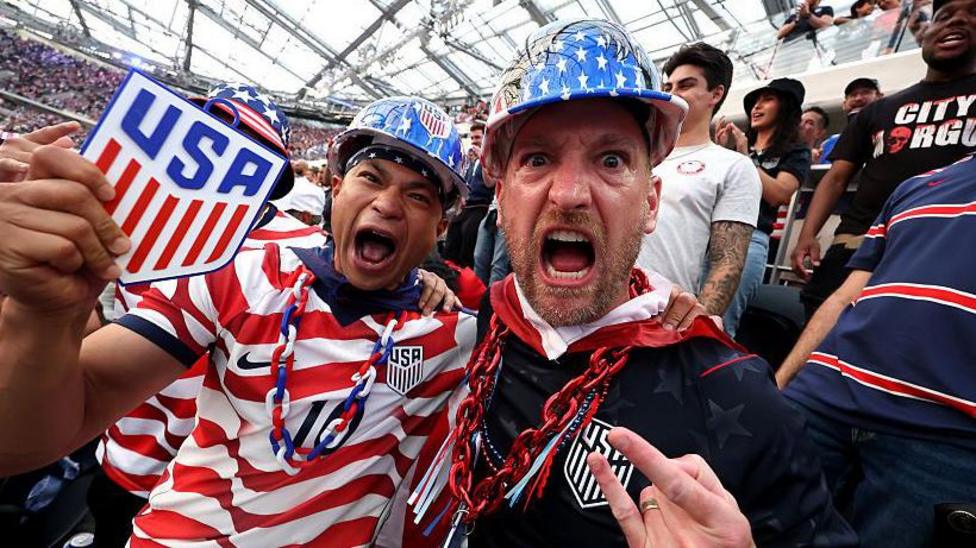
Is Football Finally Breaking America? The World Cup Says Yes
Three weeks into the World Cup, something is shifting in American sports culture — and this time it might stick.