Mercedes Losves Star Scout to Red Bull: What It Means for Both Teams
Red Bull poaches Mercedes' driver discovery architect behind Kimi Antonelli, reshaping the talent pipeline battle.
The Hidden Engineering of Driver Development
When we talk about aerodynamic packages and suspension geometry in Formula 1, we obsess over hundredths of a second. But the most sophisticated system on any F1 car is the one you cannot see on the telemetry: the talent identification pipeline that converts karting prodigies into Grand Prix winners. Mercedes has just lost a critical component in that system.
The Mercedes driver scout responsible for identifying Kimi Antonelli as a future Formula 1 talent is departing Brackley for Milton Keynes. This is not a routine HR transaction. In modern F1, where power unit regulations converge and aero regulations flatten the competitive spread, the human capital pipeline determines whether a team dominates a regulation era or merely survives it.
Think of driver development like engine mapping. The software does not just tell the injectors when to fire; it manages the entire thermal and mechanical stress profile across thousands of micro-decisions per lap. Similarly, a driver scout does not merely spot a fast teenager. They calibrate a development trajectory, mapping psychological load tolerance against physical development windows and technical feedback maturity. Remove the architect of that calibration system, and the entire development map needs to be reauthored.
Who Is Leaving and What They Built
The departing scout, Lagrue, operated as Mercedes' talent radar in the junior formulae ecosystem. His signature discovery, Kimi Antonelli, represents the archetype of what modern F1 driver identification demands. Antonelli was not simply fast in karts. He demonstrated a feedback precision that engineers associate with drivers capable of extracting performance from understeer-limited setups without destroying the front tires over a race distance.
Antonelli's trajectory through the junior categories mirrors what Red Bull's system achieved with drivers like Max Verstappen and more recently Liam Lawson. The formula is consistent: identify raw pace early, accelerate the learning curve through simulator exposure and private testing programs, and maintain a competitive development budget that ensures the driver encounters race scenarios that stress their decision-making under fatigue.
What Mercedes built under Lagrue's guidance was a structured alternative to Red Bull's historically dominant pipeline. Red Bull's junior program has functioned like their front wing concept: aggressive, proven, and continuously evolving. Mercedes needed their own architecture, and Antonelli was the proof that the system could identify elite potential.
What Red Bull Gains
Red Bull acquiring Lagrue presents the team with several competitive advantages that extend well beyond simply adding another experienced evaluator to their roster.
First, pattern recognition transfer. Having scouted for Mercedes, Lagrue understands exactly what the Brackley team looks for in a driver. He knows their evaluation protocols, their simulator benchmarking metrics, and crucially, the psychological markers they prioritise. That intelligence does not vanish because he changes employer.
Second, pipeline redundancy. Red Bull's junior system has produced extraordinary talent, but it has also experienced bottlenecks. When multiple junior drivers require seats simultaneously, the program faces pressure to place them quickly or lose them. An additional senior scout with Mercedes-calibre evaluation skills expands Red Bull's capacity to manage and develop a larger talent pool without diluting quality.
Third, institutional disruption to a rival. Mercedes must now rebuild the scouting framework that identifies their next Antonelli. In a sport where development timelines span three to five years, any disruption to talent identification creates a gap that compounds over seasons.
The Technical Parallel: Talent as a Measurable System
Modern driver evaluation relies on metrics that would have been unimaginable a decade ago. Scouts now track data points that read like engineering specifications.
Engineering Insight: The Modern Driver Evaluation Matrix
The contemporary driver identification process functions as a multi-layered filtering system, not unlike how an engineering team optimises a car through computational fluid dynamics iterations.
- Adaptive tire management index: How quickly a driver learns to modulate inputs based on real-time tire degradation curves rather than reactive corrections after the grip has already been lost.
- Feedback granularity under thermal stress: The ability to articulate specific handling characteristics while operating at sustained heart rates above 170 bpm for over an hour. Engineers measure not just what the driver reports but the technical vocabulary density of their feedback.
- Setup-sensitive performance deviation: A driver who performs well only in one setup window is less valuable than one who extracts performance across a wider operating envelope. This is the human equivalent of an aerodynamic platform that generates downforce predictably across different ride heights.
- Degradation curve learning rate: The lap-by-lap improvement in how a junior driver manages tire life across a stint, measured against a theoretical optimal degradation trajectory generated by the team's tire model.
What Lagrue brought to Mercedes was expertise in calibrating this matrix. He understood which metrics predicted success in a Mercedes-powered car specifically, with its particular power delivery characteristics and aero platform philosophy.
Why This Move Happened Now
The timing reflects broader structural shifts in both organisations. Mercedes enters 2025 facing a genuine transition in their driver lineup and technical philosophy. With Lewis Hamilton's departure to Ferrari, Mercedes needs its junior pipeline to produce the next generation more urgently, not less. Losing the scout who identified your most promising junior talent at exactly this moment creates unique pressure.
Red Bull, meanwhile, faces a different challenge. Their pipeline remains productive, but the cost cap era has compressed the financial margin for error in driver development. Every junior driver placement consumes budget that could fund wind tunnel hours or simulator upgrades. An additional elite scout helps ensure those development resources are spent on drivers with the highest probability of returning value.
The reality of modern Formula 1 is that the car and the driver form a single integrated system. You cannot develop the A-spec car without understanding exactly what feedback architecture your development provides you with.
What Mercedes Must Rebuild
Mercedes now faces a knowledge transfer gap that extends beyond simply hiring a replacement. The institutional memory of how Antonelli was identified represents years of accumulated evaluation methodology. A new scout will bring their own framework, which may prove equally effective, but the transition itself costs time.
In driver development, time translates directly into competitive opportunity. A junior driver identified at age 14 rather than age 16 receives two additional years of structured development before reaching the critical junior formulae years. Those two years encompass hundreds of hours of simulator time, ** coaching sessions**, and technical feedback training that cannot be compressed later.
Mercedes will likely respond by promoting internally and restructuring the evaluation hierarchy. Toto Wolff has demonstrated repeatedly that he treats organisational resilience as a core engineering challenge. The team that won eight consecutive constructors' titles did not achieve that continuity by leaving structural gaps unaddressed.
Looking Ahead: The 2025 Development War
The next phase of this battle will be invisible to the broadcast feed. It will play out in karting circuits across Europe, in private test days at circuits like Varano and Magione, and in the data rooms where junior driver performances are dissected with the same rigour applied to aero correlation data.
Red Bull has strengthened their talent identification system at precisely the moment when the 2026 regulation reset demands every team make long-term bets on the driver who will lead them into the new power unit era. Mercedes must now reconstruct their evaluation architecture without the individual who designed its most successful recent application.
The irony is sharp. In a sport defined by downforce and thermal efficiency, the most consequential performance variable may be which team more accurately identifies the twenty-four-year-old who will exploit those systems better than anyone else. Red Bull just secured a significant upgrade to their human sensing architecture. Mercedes faces the engineering challenge of rebuilding theirs.
Editorial Integrity
This is an original SportPulse article written by our editorial team. All content is independently researched, written, and reviewed by our writers and editors before publication. We do not publish copied, aggregated, or syndicated content.
SportPulse is committed to original sports journalism. Read our editorial policy or contact us with any questions.
More Like This
All f1
Verstappen Laughs at Silverstone Simulation: 'It's Just Constantly Flat'
The four-time champion warns the new engine formula could strip Silverstone of its soul this Sunday.
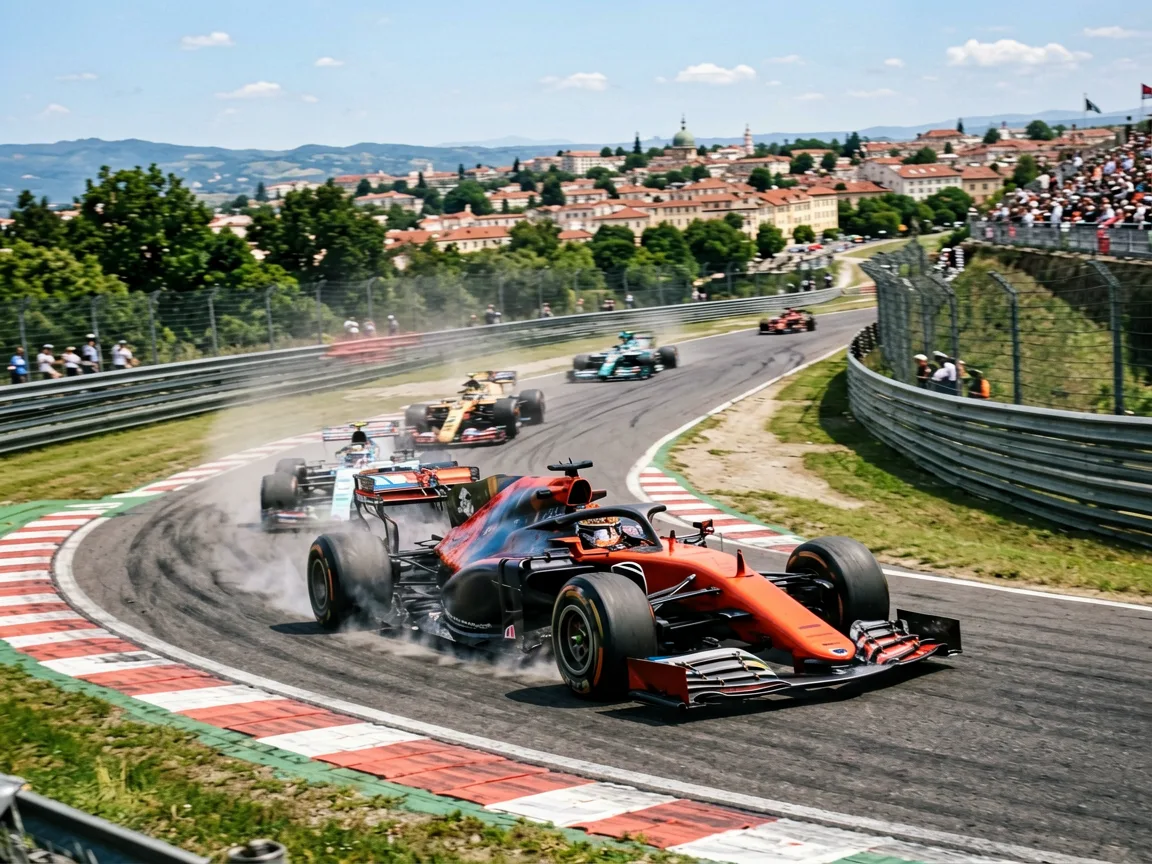
Hungarian GP 2026: Budapest Heat and the Tyre Strategy That Decides It
The Hungaroring returns with its tight layout and brutal summer temperatures, placing tyre management and qualifying position above raw straight-line speed.
Mercedes Locks Out Barcelona Front Row — The Engineering Behind the Resurgence
Hamilton and Russell at the front signals a genuine Mercedes aerodynamic reset, not just a one-off qualifying anomaly.