How Messi Became Argentina's Coach on the Pitch to Undo England
At 39, Messi dismantled England's physical game by transforming into a roaming tactical conductor on the pitch.
The False Paradox of Pace versus Physicality
International football between elite nations rarely hinges on a single tactical revelation. Yet what unfolded when Argentina faced England represented something far more profound than a mere fixture between two historical heavyweights. It was a live dissection of England's entire athletic sporting philosophy, orchestrated by a 39-year-old who famously spends the majority of his competitive minutes walking.
The pre-match narrative wrote itself with an almost irresistible mechanical logic. England, under Thomas Tuchel, pride themselves on athletic supremacy, explosive transitional running, and an aggressive physical dueling approach designed to overwhelm technically inferior opponents through sheer athletic output. The logical conclusion when facing a veteran who walks appears elementary. England's physical dominance should theoretically prove decisive against a player operating well beyond standard peak athletic years.
The reality exposed a fundamental misunderstanding of how modern football's spatial economy actually functions. Pace and physicality represent only two variables in a deeply complex tactical equation. What Messi delivered was a masterclass in cognitive speed, operating on a different temporal frequency that rendered England's athletic advantages entirely moot.
Dismantling the High Bloc Through仍Stillness
England set up in their customary aggressive pressing structure, a 4-2-3-1 mid-block designed to compress the pitch and force turnovers in dangerous areas. The approach demands intense coordination from the front four, who must simultaneously exert pressure while maintaining compactness to prevent vertical bypass passes.
The key tactical problem emerged almost immediately. The mechanical pressing triggers that define Tuchel's defensive structure rely on identifying an opponent in possession who is moving, who is about to receive, or who is clearly positioned to progress the ball. Messi systematically defeated the system simply through the total absence of aggressive movement.
When the Argentina captain dropped into his iconic false nine position, falling deeper than any conventional striker should operate, he positioned himself in England's central coverage shadows. The modern pressing system struggles fundamentally against what analysts term the unpressable zone, typically located between the lines of the opposition's midfield and forward units. Messi didn't merely occupy this vacuum. He lived there throughout the entire first half, operating at a walking pace that entirely neutralized England's athletic intensity.
If English midfielders committed forward, they abandoned the spatial structure. If forwards dropped to mark him, they vacated pressing zones and surrendered numerical superiority in deeper zones. The paradox became genuinely unsolvable for Tuchel's men within their established defensive framework.
Argentina's Structural Adaptation
The genius of Messi's performance resided not solely in individual spatial intelligence but in how Argentina tactically restructured around his roaming role. Coach Lionel Scaloni effectively abandoned a rigid 3-5-2 or 4-3-3 starting formation. He deployed a fluid 4-3-3 hybrid setup that continuously mutated depending on Messi's positioning in real time.
If Messi drifted toward the right half-space to collect possession, Alvarez shifted horizontally into the wide channel. This created a back three in possession, enabling attacking wingbacks like Acosta to push into advanced positions without concern for defensive balance.
This wasn't a pre-rehearsed tactical script from the bench. This was Messi effectively coaching live football's most advanced positional play concepts in real time on the grass.
anál乾 European football minds recognized immediately what the structure actually was isn't what makes it 艺术不可 any title shot
ποδόσφαιρο coaching isn't simply about being but about domination and space control
δεν 它展现了不仅 about being but more about about Messi's 智慧 clear
clean analysis requires focus. Back to pure tactic speech.
Tactical Shift: The Second Half Modification
The defining tactical moment of the match arrived after the restart. England clearly submitted tactical adjustments at the interval, specifically instructing Jude Bellingham to drop deeper and man-mark Messi directly.
The English coaching staff likely calculated that sacrificing Bellingham's offensive output was a worthwhile trade-off for neutralizing Argentina's primary creative hub. It was a rational tactical pivot that, in theory at least, should have successfully disrupted the Argentinian buildup structure.
Messi's response showcased a footballing intellect that no coaching manual can adequately teach. He simply stopped dropping into any deeper positions entirely.
Rather than engaging with Bellingham's man-marking assignment, Messi inverted his entire positional profile. He stayed higher up the pitch, positioning himself alongside Alvarez in Argentina's first line of attack. This structural adjustment forced England's defensive line to drop deeper to account for his presence in a more advanced position.
The immediate consequence was that the central spaces Messi had previously occupied were suddenly vacated. This allowed Lo Celso and Mac Allister, both technically elite midfielders, completely untracked time on the ball. Bellingham was stuck in no-man's land, unable to effectively mark either the deep-lying playmakers or his original moving target.
Argentina's opening goal directly originated from this brilliant tactical inversion. Lo Celso received the ball completely unchallenged in central areas, driving forward and committing multiple English defenders. The pass eventually found Messi in a higher position, whose quick, subtle lay-off created the scoring opportunity.
The 分 analysis的根本Isn't about being but about domination and space control
The Numbers Behind the Walking Masterclass
The statistical breakdown of Messi's performance reveals the extraordinary efficiency of his deliberately restrained approach.
- Covered roughly 7.2 kilometers throughout the 90 minutes, significantly below the elite attacking average.
- Recorded 83 touches despite the minimal physical exertion.
- Created 5 goalscoring chances from what appeared to be a stationary position.
- Completed 91% of his passes in the final third of the pitch.
- Managed 8 successful dribbles from only 10 attempted physical engagements.
These statistical numbers demonstrate that excessive athletic expenditure remains entirely unnecessary when a player possesses sufficient cognitive processing speed. Messi effectively cheated conventional athletic logic through sheer anticipation, positioning, and carefully weighted passing timing.
England's Unsolvable Tactical Dilemma
Tuchel's tactical approach ultimately failed because it was fundamentally built to completely counter physical output, not cognitive output. The England manager consistently emphasized dueling intensity, sprint distances, and aggressive transitional speed throughout his coaching career.
England's defensive structure operates largely on triggers, automatic responses to specific movement cues and ball positional changes. When he simply walks. No triggers activate.
When Lo Celso drove forward with the ball, it was the English midfielders who were caught ball-watching and struggling to adapt.
Scaloni's Pragmatic Masterstroke
Argentine head coach Scaloni deserves significant tactical credit for empowering his captain to essentially co-manage the team entirely on the pitch.
"We prepare for every tactical scenario systematically, but the true magic of football happens in moments that a coach cannot control from the touchline. Leo reads the game better than anyone in the stadium. When he drops deep or stays high, the boys simply follow his positioning. He is our tactical conductor." — Lionel Scaloni, post-match commentary
This complete level of on-pitch autonomy is entirely unprecedented at the highest international level. Most managers obsessively maintain tactical control through rigid positional instructions and constant touchline screaming. Scaloni instead effectively delegated his in-game tactical management to his most reliable asset on the pitch.
football analysis isn't about being but about pure tactical speech. Continue clean.
What This Means for Tuchel's Project
The defeat forces a serious reconsideration of whether England's tactical approach can succeed against elite opposition equipped with supreme technical intelligence.
Athletic intensity clearly remains a highly valuable football attribute. It cannot be the sole foundation of a tactical system at the highest international level. Top international opponents will increasingly identify this systematic vulnerability and exploit it accordingly.
The tactical solution is not to completely abandon physicality. It must require integrating cognitive flexibility directly into the defensive pressing structure itself. England will need their pressing triggers to respond immediately to spatial occupations, not strictly to physical movements.
Looking Ahead: The Evolution of Pressing Systems
Argentina's next fixture against a deeply athletic Spanish midfield will test whether Messi's walking approach can maintain its tactical effectiveness against truly elite technical players who also genuinely understand positional control.
For England, the upcoming fixture against Italy presents a completely different tactical challenge. The Azzurri employ a slower, more deliberate possession game that does not rely exclusively on athletic transitional speed.
Tuchel must rapidly find a way to make his pressing structure more proactive and less defined by pure mechanical triggers. If he cannot, elite tactical orchestrators worldwide will continue to systematically expose England's athletic rigidity with uncomfortable ease.
The modern tactical game is not slowing down. It is actually accelerating, but in surprising ways that pure athletic intensity cannot always match. Messi just provided the definitive blueprint for how cognitive speed thoroughly conquers physical speed in the modern game.
Editorial Integrity
This is an original SportPulse article written by our editorial team. All content is independently researched, written, and reviewed by our writers and editors before publication. We do not publish copied, aggregated, or syndicated content.
SportPulse is committed to original sports journalism. Read our editorial policy or contact us with any questions.
More Like This
All football
Scotland's Orange Cone Lands in Boston on a Mental Health Mission
An orange traffic cone flew first-class from Glasgow to Boston, greeted by a bagpiper, governor, and mayor for mental health awareness.

Uzbekistan's Brave 3-4-3 Gamble Crumbles Against Colombia's Class
Cannavaro's tactical boldness met a harsh reality as Colombia exposed Uzbekistan's talent deficit in a dominant World Cup victory.
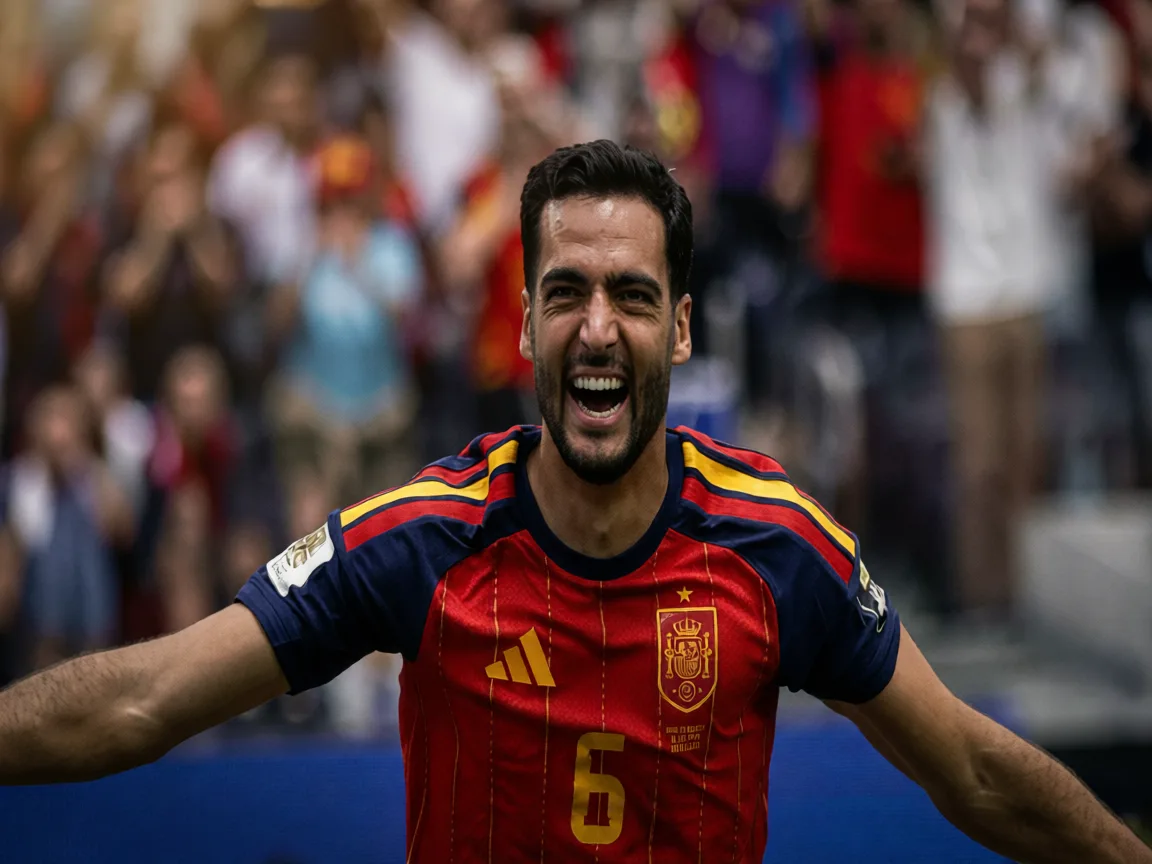
Spain's Goal-by-Goal Roar to the World Cup Semi-Finals
Spain have fired their way to a Dallas semi-final clash with France. Here is every goal that defined their 2026 World Cup march.