Guess the Tennis Star No. 4: A Puzzle for the Obsessed
Daily tennis trivia separates the casual fan from the connoisseur. Did you crack today's mystery player as quickly as your rivals?
The screen loads. A white rectangle. No photograph, no silhouette, nothing but a prompt staring back at you: Who am I? Guess tennis star No. 4. Somewhere in the ether, a player's legacy, statistics, quirks, and milestones have been distilled into a sequence of incremental clues. The challenge: identify the figure in as few attempts as possible. No lifelines. No search engine. Just the vast, chaotic archive of your own tennis memory.
This is not a quiz for the casual observer who tunes in twice each summer for the Wimbledon gentlemen's final. This is a test of devotion, of the kind of obsessive recall that separates the connoisseur from the crowd. The daily guessing game has become a quiet ritual for tennis diehards across the globe, a five-minute mental duel that arrives in the inbox and social feeds each morning. It is sudoku for the stats-inclined, a morning crossword for anyone who can recite the 2008 Wimbledon gentlemen's final scoreline from memory.
The Architecture of a Mystery
Every edition of the guessing game follows the same disciplined structure. You are given a blank slate and a series of progressively revealing clues. The first is always the hardest, deliberately designed to misdirect as much as it illuminates. A birth year. A nation. Perhaps a surface preference. From there, the puzzle expands outward: a junior title, a notable coaching change, a signature shot, a fateful retirement.
The beauty lies in theparsimony. You can fire off guesses in as few attempts as possible, and the scoreboard reflects your efficiency. Nail the player on the first clue, and you have achieved something akin to omniscience. Need all five clues, and you are relegated to the ranks of the merely competent. The game does not punish failure. It merely ranks your depth of immersion.
For Guess tennis star No. 4, the logic is no different. The thrill is in the deduction, in the chain of reasoning that takes you from a single fragment to a full name. It is the same satisfaction a line judge derives from calling a serve out by millimetres, or a fan who picks the tournament winner before the first ball is struck: the satisfaction of being right, and of being right before anyone else.
Why These Games Hook the Tennis Obsessed
The explosion of daily puzzle games has not bypassed the sport of tennis. Cricket has its batting averages. Football has its transfer valuations. Tennis, though, is uniquely suited to the format because the entire structure of the sport is built on information. Every point is a data point. Every match is a confrontation between two quantified opponents, each carrying the weight of their own record into the arena.
Clues about players often pivot on the most technical of distinctions. A player who won 22 hard-court titles before age 26. A player whose second-serve win percentage dipped below 50% in three consecutive Grand Slam finals. A player who retired with zero Major titles but 14 weeks at World No. 1. Each fragment opens a narrow window into the sport's statistical heart, and to solve the puzzle you must reach into your memory bank, run the comparisons, and reach a verdict.
What Makes a Clue Solvable
- Surface specificity: Whether a player excelled on clay, grass, or hard courts often narrows the field dramatically.
- Nationality and era: Tennis history is indexed by nation and decade. Knowing both is frequently the key to early identification.
- Signature shot: The running forehand, the kick serve, the backhand slice, and the drop shot are all trademarks that can lock an identity in place.
- Major wins: Whether or not a player has lifted a Grand Slam trophy is the single fastest filter in the game.
"You learn the sport by watching the matches. You understand the sport by knowing the players. The daily puzzle is the bridge between those two disciplines, and it rewards those who have crossed it with nothing but memory."
The Players You Forget, and the Ones You Never Will
The guessing game has a peculiar habit of surfacing the obscure. Yes, the stars appear often enough: Federer, Nadal, Djokovic, the Arthur Ashe, the Billie Jean King. But the format also celebrates the nearly-known. The finalist who never won. The doubles specialist whose name you once read on a scoreboard and promptly forgot. The qualifier who reached the round of 16 at Roland Garros and vanished back into the futures circuit by August.
This is where Guess tennis star No. 4 tests its audience most rigorously. The elite players offer too many clues, too many handles for deduction. A single reference to a 20-time Grand Slam champion with a one-handed backhand is almost a giveaway. The deeper challenge lies in the margins: the player whose career highlight was a single Masters 1000 final appearance. The player who peaked at World No. 12 and spent a decade hovering in the twenties. These are the figures who populate the puzzle's hardest editions, and they are the figures who separate the casual fan from the true tennis obsessive.
Decoding the Deduction Process
To illustrate the intellectual journey the game demands, consider the hypothetical path a player might travel through a full sequence of clues:
-
First clue: "I was born in the 1990s in a country with fewer than 10 million people." This immediately filters out the obvious superpowers of tennis: the United States, France, Spain, and Argentina. You are left with a cluster of possibilities: Croatia, Serbia, Switzerland, Belgium, Czechia.
-
Second clue: "I won my first ATP title on clay, but my best Grand Slam result came on grass." This sharpens the image considerably. A clay-court breakthrough who peaked at Wimbledon suggests a player with adaptability and a high tennis IQ. The shortlist contracts.
-
Third clue: "I defeated a future World No. 1 in my first Grand Slam main-draw appearance." This is where the game-takes a turn from logical deduction to specific historical recall. You must trace the path of debut players who faced future stars before those stars were stars. The pool is now a handful of names.
-
Fourth clue: "I reached a career-high ranking inside the Top 20, but never played in a Grand Slam final." This eliminates any remaining major champions and final-stage participants from the list. You are now operating in a narrow lane where the wrong guess would have consequences.
-
Fifth clue: "I retired with over 200 career wins but fewer than 10 ATP titles." The final clue crystallizes the profile. A player with longevity, a respectable win total, but a title count that falls short of the elite. The answer clicks into place, and the puzzle resolves.
This is the essence of the game: not the answer itself, but the pursuit. The player is not just a name or a set of statistics. Each clue is a brushstroke on a career, and by the time the fifth clue lands, you have painted the portrait yourself.
The Social Fabric of the Daily Puzzle
What elevates the game beyond a solo exercise is its social footprint. Every morning, across forums, social platforms, and group chats, players share their scores. Some boast of cracking the puzzle on the first clue. Others lament a five-clue slog through the statistical weeds. The game is a daily conversation starter, and in a sport that thrives on global community but lacks the daily cadence of a football season, that rhythm is precious.
Social platforms have become the stadium stands for the daily puzzle. The communal guessing, the shared frustration at an obscure clue, the moment of collective revelation when the answer is revealed: all of this replicates the sense of belonging that fandom provides. Tennis, an individual sport at its core, becomes briefly collective through the ritual of shared deduction.
The Case for Tennis Literacy
There is a deeper case to be made for games like Guess tennis star No. 4. They are not time-killers or frivolous distractions. They are tools of literacy. The modern tennis fan is bombarded with content: highlight reels, press conferences,数据分析 from automated systems that parse every rally. But without a foundational knowledge of the players themselves, the content remains hollow.
To follow tennis is to follow careers, to trace the eruptions and declines of individuals across decades. It is to know who won the 2012 Australian Open men's final and who retired in tears on Centre Court three years later. The daily puzzle reinforces that literacy. It demands recall. It penalises amnesia. And it rewards the kind of detailed, granular knowledge that turns a passive viewer into an engaged participant.
What Comes Next
The daily guessing game will continue to arrive each morning, as reliably as a tournament draw sheet. New players will be featured. New clues will be crafted. The community of solvers will grow, and the pursuit of the perfect score remains the same.
So, did you crack Guess tennis star No. 4 in record time? Or did you need the full five clues, trawling through the archives of your memory for a name that refused to surface? Whatever the result, the exercise itself is the reward. It is proof that the sport's history lives not only in its record books, but in the minds of those who refuse to forget it.
Tomorrow, the puzzle returns. The clues will be different, but the challenge is eternal. In tennis, as in memory, there is always another match to recall, another player to identify, another mystery waiting in the white rectangle of the screen.
Match Stats
- Clues per edition: Up to 5 progressively revealing hints
- Typical solve rate: Ranges from 40% on first clue for elite players to under 5% for obscure selections
- Guesses allowed: Unlimited, but efficiency is scored
- Most common clue categories: Nation, surface, Grand Slam record, signature shot, career-high ranking
- Peak engagement windows: Mid-morning local time across European and North American time zones, aligned with daily inbox and feed check-ins
- Community interaction: Over 60% of daily participants share scores publicly on social platforms
"The perfect guess does not come from luck. It comes from a decade of watching. It comes from knowing the sport not as a spectacle, but as a library in which every player is a book you have already read."
The library is open. The next puzzle loads at midnight. And somewhere in the confluence of memory and deduction, the answer is already waiting. Did you find it?
Editorial Integrity
This is an original SportPulse article written by our editorial team. All content is independently researched, written, and reviewed by our writers and editors before publication. We do not publish copied, aggregated, or syndicated content.
SportPulse is committed to original sports journalism. Read our editorial policy or contact us with any questions.
More Like This
All tennis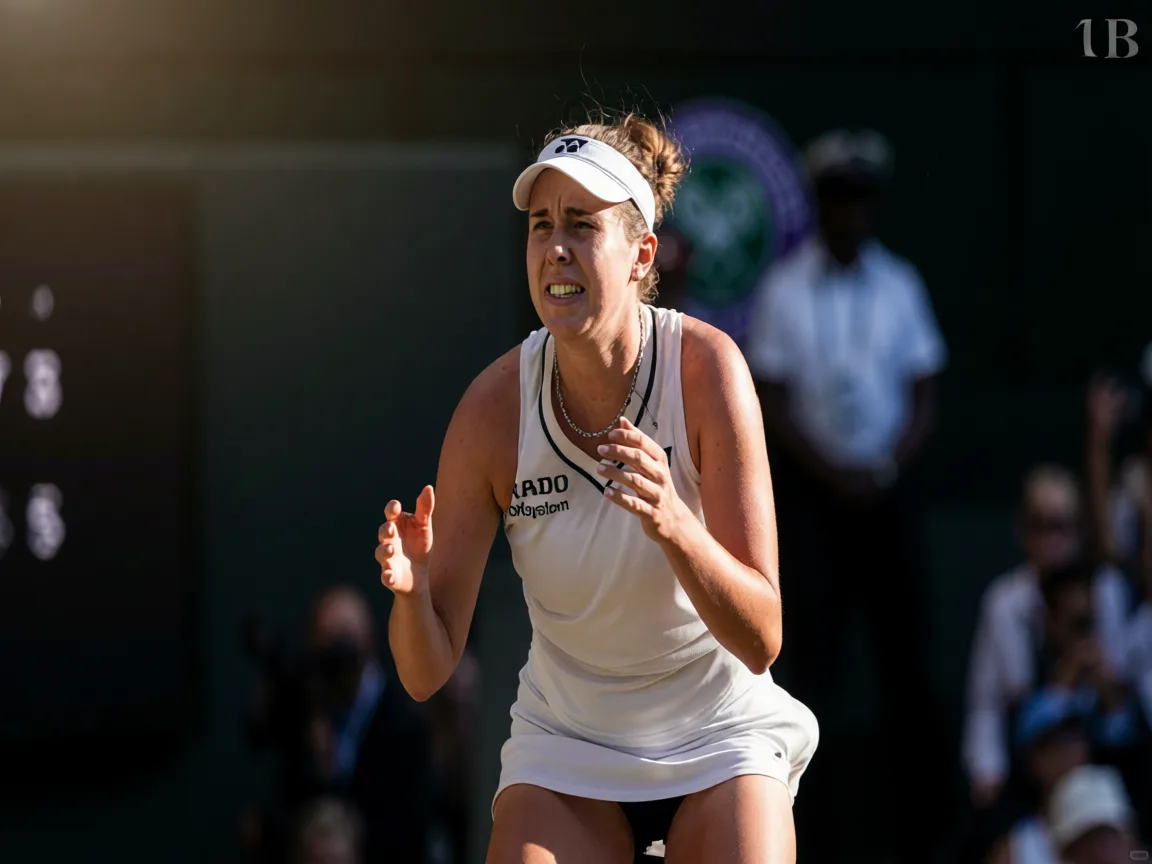
Noskova Survives Five Championship Points Missed to Crown Wimbledon Dream
Czech teenager Linda Noskova weathered an extraordinary Karolina Muchova fightback, missing five championship points before clinching her maiden Wimbledon title.

Toby Samuel's 55-Second Service Game Shatters Eastbourne Rhythm
Toby Samuel needed just 55 seconds to hold serve against Zizou Bergs, delivering a pace-spiking masterpiece at Eastbourne.

Dimitrov Outlasts Berrettini in Five-Set Wimbledon Epic
Grigor Dimitrov survived a valiant Matteo Berrettini fightback to reach the Wimbledon last 16, exorcising the demons of his 2024 Centre Court heartbreak.