Page Falls in Wimbledon Quarter-Finals But Welsh Star Chart Growth
Welsh teenager Oliver Page exits Wimbledon boys' quarter-finals inspired by Arthur Fery's path from junior Grand Slam runs to professional tennis.
A Welsh Dream on Court 18
The ball toss was clean, the contact crisp, and for a flickering moment on Wimbledon's Court 18, the Welsh dragon roared once more. Oliver Page, all 18 years and raw ambition, cracked a forehand winner that drew a roar from the modest but knowledgeable crowd. It was the kind of shot a teenager dreams about during countless hours on the wet indoor courts of Cardiff, the kind that makes the trip from the Welsh capital to SW19 feel impossibly, rewardingly short.
But Grand Slam tennis is rarely a fairy tale. It is a grind, and for Page, the boys' singles quarter-final proved to be a mountain too steep. The Welsh teenager's Wimbledon journey came to a halt on a day where the gap between promise and progression was measured in breakpoints and unforced errors. Page lost 6-4, 6-3, a scoreline that tells only a fraction of the story.
The first set was tight. The Welsh teen, ranked outside the junior top 50, had already exceeded expectations by reaching the last eight. He held his first three service games with a calm that suggested he could handle the occasion. But at 4-5, 30-30, a double fault—the kind that haunts a player's dinner—gave the opponent a look. Two points later, the set was gone.
A Quarter-Final to Remember
The second set deteriorated. Page, perhaps feeling the physical and mental toll of a deep Grand Slam junior run, lost his serve early. He fought, clawing back to 30-30 on the opponent's serve, but the moment the opportunity presented itself, it vanished.
2 break points came and went in the second set. Page could not convert either. On grass, those moments are fleeting. The surface rewards aggression and punishes hesitation. By the time the match ended, Page had won just 49% of his first-serve points, a stat that will frustrate him and his team as they review the match tape.
Yet, there was no shame in the defeat. Page had reached the quarter-finals of the most prestigious junior event in the world. He had beaten three players ranked above him. He had represented Wales on tennis's grandest stage and had done so with a maturity that belied his age.
Match Stats: Page's Wimbledon Quarter-Final
- First-serve points won: 49% (well below the elite threshold of 65%)
- Break points saved: 3 of 5 (60%)
- Break points converted: 0 of 2 (0%)
- Double faults: 4, including a costly one at 4-5 in the first set
- Total points won: 58 to his opponent's 67
- Winners: 12 (his opponent hit 19)
The Fery Blueprint: A Path Forward
As Page packed his rackets and looked ahead, his mind turned to Arthur Fery. The British No. 4, now 23 years old, once walked the same path. Fery was a junior star, reaching a career-high junior ranking of No. 3 in the world. He reached the boys' singles semi-finals at the US Open in 2019 and made the quarter-finals at both the Australian Open and Roland Garros in the same year. More importantly, Fery made the leap from junior promise to professional main draw.
Fery received a wildcard into the Wimbledon main draw in 2023 and played doubles at the All England Club. He has earned his place on the Challenger circuit and has tasted qualification for ATP events. For Page, Fery is living proof that the transition from junior Grand Slam quarters to professional tennis is possible, however daunting the path.
"I want to follow what Arthur has done," Page said after his quarter-final exit. "He's shown that coming through the British junior system can lead to playing on the main tour. That's the goal now. You see him at Challengers, at qualifying for slams. That's where I want to be."
The comparison is apt but comes with caveats. Fery grew up in Esher, Surrey, with access to some of Britain's best facilities and coaching. He spent time at the renowned JTennis Academy. He also moved to the United States to play college tennis at Stanford, where he was a two-time All-American. That blend of British junior development and American college experience shaped a player who could compete at the professional level.
Page's path is different. He is Welsh, which means he has often had to travel further for elite competition. The tennis infrastructure in Wales, while improving, does not match the resources available to players in London or Surrey. The Welsh national tennis centre in Cardiff has produced some good players, but the jump to the professional game remains a significant challenge.
What the Numbers Say About Junior Success
The data on junior Grand Slam quarter-finalists is mixed. A study by the International Tennis Federation (ITF) found that approximately 30% of junior Grand Slam quarter-finalists eventually reach the ATP top 200. Only about 15% break into the top 100. The attrition rate is high, and the reasons are manifold: financial pressures, the difficulty of transitioning to the men's professional game, and the sheer physical demands of the sport.
For British players, however, the numbers are slightly more encouraging. Thanks to LTA support and the wildcard system, British juniors often get more opportunities to test themselves at the professional level. Fery himself received several wildcards before breaking through.
The British Junior-to-Pro Pipeline: Recent Successes
- Arthur Fery: Junior world No. 3, now ATP-ranked inside the top 200 with main draw appearances at Wimbledon
- Jack Draper: Reached the boys' singles final at Wimbledon in 2018, now ranked inside the ATP top 40
- Henry Searle: Won the boys' singles title at Wimbledon in 2023, now transitioning to the professional game with an ATP ranking
- Oliver Crawford: A former junior standout who switched allegiance to the United States but remains a cautionary tale about the complexities of the British system
The Welsh Challenge: Unique Hurdles
Page's situation is unique within the British context. Wales does not have the depth of talent or the volume of high-level training partners found in England. The Lawn Tennis Association has made efforts to support Welsh tennis, but the reality is that promising Welsh juniors often need to travel across the border to find the level of competition required to grow.
For Page, the solution may mirror Fery's route. College tennis in the United States offers a blend of high-level competition, education, and time to develop physically and mentally. The ITF junior circuit will also continue to be a testing ground.
What's Next for Oliver Page
The immediate future for Page involves a return to the ITF junior circuit, with potential appearances at the US Open juniors in late August. He will also likely begin to dip his toes into the professional game, perhaps at ITF Future events in Britain or Europe. The transition is rarely smooth, and Page will need to adjust to the power and consistency of older, more experienced players.
The LTA will certainly keep a close eye on his progress. Pro Player Pathway funding is available, and Page's Wimbledon performance strengthens his case for support. But the real work begins now, away from the pristine lawns of the All England Club, on the hard courts of Challenger qualifiers and ITF Futures events.
For Welsh tennis, Page's run is a beacon. It is a reminder that talent can come from anywhere in Britain, not just the traditional hubs. It is also a signal to young players in Wales that a path to professional tennis exists, however narrow.
"I've had an amazing experience here," Page reflected. "It's been the best two weeks of my life. But I want to come back. I want to come back and play on the main courts. That's the dream. I've seen what it takes. Now I need to go and do the work."
That work will be done in the shadows, far from the cameras and the Wimbledon crowds. It will be done in gymnasiums and on unglamorous courts. But if Arthur Fery's journey is any guide, the foundation is there. The question now is whether Oliver Page can build on it. Wimbledon has given him a glimpse of what is possible. The rest is up to him.
As the summer hard-court season heats up and the US Open junior draws are finalised, all eyes will be on whether the Welsh teenager can build on his SW19 success. The next chapter will be written not on grass, but on concrete. And that, in many ways, is where careers are truly defined.
Editorial Integrity
This is an original SportPulse article written by our editorial team. All content is independently researched, written, and reviewed by our writers and editors before publication. We do not publish copied, aggregated, or syndicated content.
SportPulse is committed to original sports journalism. Read our editorial policy or contact us with any questions.
More Like This
All tennis
Ten Out of Ten Losers: Britain's Chastening Wimbledon Meltdown
All ten British players who finished their matches lost on a historically bleak opening day at SW19.

The Lob That Changed Everything: Marcus Willis Returns to Wimbledon on His Own Terms
Ten years after facing Federer on Centre Court, Marcus Willis is back at Wimbledon refusing to be a one-moment wonder.
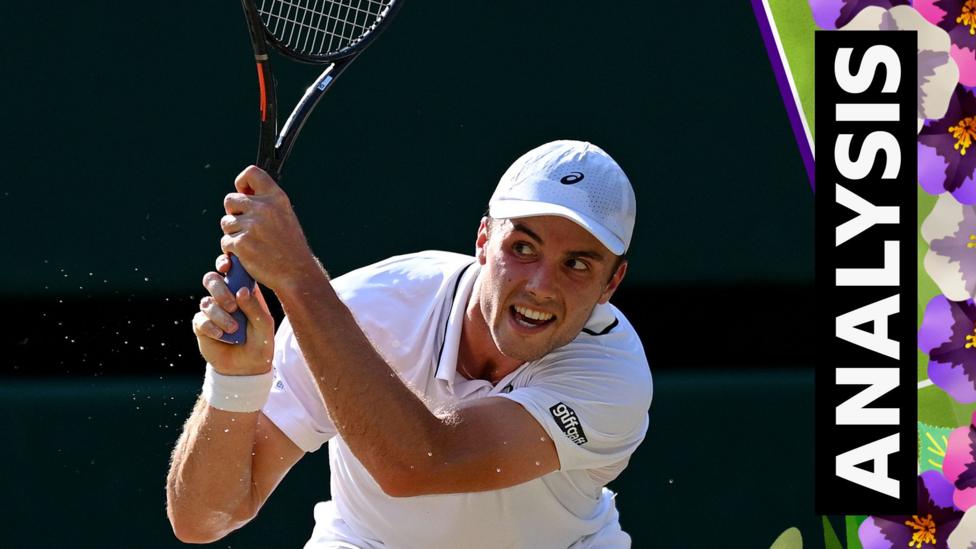
Arthur Fery's Wimbledon Run Rewrites the British Wildcard Playbook
A British wildcard is terrorizing Wimbledon's elite with an old-school net game that modern players simply cannot decode.