Osaka Rediscovers Her Grand Slam Soul on Centre Court
Naomi Osaka dismantled top seed Aryna Sabalenka 6-2, 7-6 to reach Wimbledon quarter-finals, exposing cracks in the world's best.
The Stillness at the Centre of the Storm
There is a particular kind of silence that swallows Centre Court when a great player remembers who they are. It is not the hush of deference, nor the awkward quiet of a crowd robbed of a contest. It is something closer to collective breath-holding, an involuntary recognition of a sporting polyphony resolving into a single, clarion note.
On a sun-drenched Sunday at the All England Club, that note rang out with startling clarity. Naomi Osaka, a four-time hard-court major champion whose relationship with grass has long resembled a civil negotiation rather than a love affair, produced a performance of such controlled aggression that it left the women's top seed questioning not merely her tactics but her entire Wimbledon existence. The 6-2, 7-6 (2) scoreline does not fully capture the psychological demolition job Osaka orchestrated over the course of an hour and change.
A 32-Minute Masterclass in Disarmament
The expectation before the match was thunder. Eight Grand Slam titles sat in the players' respective trophy cabinets, and the billing promised a collision of two of the cleanest ball-strikers the women's game has produced in the last decade. What it delivered instead was a masterclass in one-directional traffic.
The opening set lasted a mere 32 minutes, a timeframe more commonly associated with a changeover and a bathroom break than a complete set of tennis at this level. Osaka did not so much win it as strip it of all Sabalenka's inherent menace. The Belarusian's power game, the very engine that has carried her to the summit of the women's rankings, misfired so spectacularly that she was left screaming into the London sky, a gladiator stripped of her sword and shouting at the architecture.
Osaka's returning was exquisite, a precise dismantling of the Sabalenka serve. She stood deep, took the ball on the rise, and redirected pace with the kind of geometric efficiency that turns raw power into self-defeating energy. Every Sabalenka missile came back heavier, shorter, and more uncomfortable. The top seed was not beaten by a counter-puncher with a trick; she was out-hit by a player with superior timing and a clearer mind.
The Architecture of an Upset
Grass as a Canvas for Reinvention
The irony of Osaka's finest Wimbledon performance is that it arrived on a surface that has, for most of her career, seemed philosophically opposed to her gifts. Her four Grand Slam titles all came on hard courts across Australia and New York, where the predictable bounce and true bounce reward her penetrating, flatter groundstrokes. Grass, with its low skids and capricious bounces, has historically asked her questions her footwork could not answer.
But grass also rewards intent. It shortens points, privileges the first strike, and forgives defensive frailty if the offense is sufficiently overwhelming. On Sunday, Osaka played grass-court tennis not as a concession to the surface but as an extension of her best hard-court instincts. She hit 32 clean winners, moved forward with purpose, and served with a percentage that suffocated any attempt by Sabalenka to build rhythm.
TheServe numbers tell a story of quiet dominance. Osaka won 82% of her first-serve points, a figure that effectively removed the pressure environment from her own delivery games and transferred it wholesale onto the Sabalenka serve. When the top seed looked up at the scoreboard and saw herself two breaks down in 20 minutes, the psychological architecture of the match had already been poured and set.
The Tiebreak as Microcosm
If the first set was a rout, the second set evolved into a study in competitive tension. Sabalenka, to her immense credit, stopped screaming and started competing. The jarring errors of the opening set diminished. The serve found its courtyard. She traded blows with Osaka and, crucially, forced a tiebreak that briefly promised the kind of dramatic narrative elevation Wimbledon devours.
But tiebreaks are pressure-cookers, and on Sunday the pressure only cooked one of the two combatants. Osaka seized the initiative immediately, racing to a lead and closing the match with the ruthless efficiency of a player who has stood on the biggest stages in the sport and refused to blink. The 7-2 tiebreak was not a collapse by Sabalenka as much as it was an assertion by Osaka, a reminder that clutch performance is not a statistical phenomenon but a state of mind.
I just want to get drunk and forget this Wimbledon.
The rawness of Sabalenka's admission is a testament to the desolation Osaka left in her wake.
The Anatomy of a Frustrated Champion
When Power Meets a Wall
Sabalenka's post-match gesture, blasting a ball clean out of Centre Court, will draw the headlines and the fine, but it deserves a more sympathetic reading. It was not the tantrum of a brat but the involuntary physical expression of a player who had run into a wall she could not hit through. Her career has been built on the conviction that, if she swings hard enough and cleanly enough, no one can survive the exchange.
On Sunday, Osaka survived and thrived. She absorbed Sabalenka's pace, used it against her, and denied her the baseline rhythm that makes the world number one so formidable. Sabalenka hit 28 unforced errors in the match, a number that reflects not carelessness but the desperation of a player who felt the clock running and tried to manufacture winners from positions that did not contain them.
This is the particular cruelty of Osaka at her best. She does not grind you down. She removes your capacity to play well.
Wider Reverberations
The Draw Opens Up
Osaka's march to the quarter-finals reconfigures the women's draw in ways that extend beyond her own candidacy. With the top seed departed, the bottom half of the draw suddenly looks radically more accessible. Nobody anticipated a return to deep Wimbledon runs from Osaka this fortnight, but the combination of renewed confidence and a draw that has shed its most imposing presence creates a genuinely open landscape.
She has arrived at the quarter-finals not as a dark horse but as a proven champion rediscovering her native habitat. The pressure, for the first time in years, sits comfortably on her shoulders.
A Legacy Reclaimed
The deeper resonance of this match lies not in the result but in what it suggests about Osaka's relationship with the sport. Her struggles with mental health, her sabbaticals from the tour, and her candid admissions about the toll of professional tennis have made her a complicated and sometimes distant figure in recent seasons. There were moments when the prospect of another Grand Slam run felt less like a probability and more like a memory.
But great champions carry within them the architecture of their own comeback. Osaka has not merely returned; she has returned with a game plan, with clarity, with the kind of tennis that suggests she has spent her time away not healing alone but analyzing, recalibrating, and remembering why she picked up a racquet in the first place. The serve is still a weapon. The backhand is still among the best in the game. The mind, so often her most formidable opponent, looks quiet and fierce at once.
What Comes Next
The quarter-final awaits, and with it a new set of tactical questions. Grass demands consistency as much as brilliance. Osaka will need to prove this performance was a reawakening rather than an isolated flash of former glory.
But Sunday on Centre Court was not merely about one match. It was about a player repossessing her identity on the grandest stage. Sabalenka wanted to get drunk and forget Wimbledon. Osaka, by contrast, has just remembered it. The rest of the tournament should take note, because a re-armed Osaka with belief in her bones is the kind of proposition that reshapes entire draws and entire seasons.
The silence of Centre Court has given way to something far more resonant.
Editorial Integrity
This is an original SportPulse article written by our editorial team. All content is independently researched, written, and reviewed by our writers and editors before publication. We do not publish copied, aggregated, or syndicated content.
SportPulse is committed to original sports journalism. Read our editorial policy or contact us with any questions.
More Like This
All tennis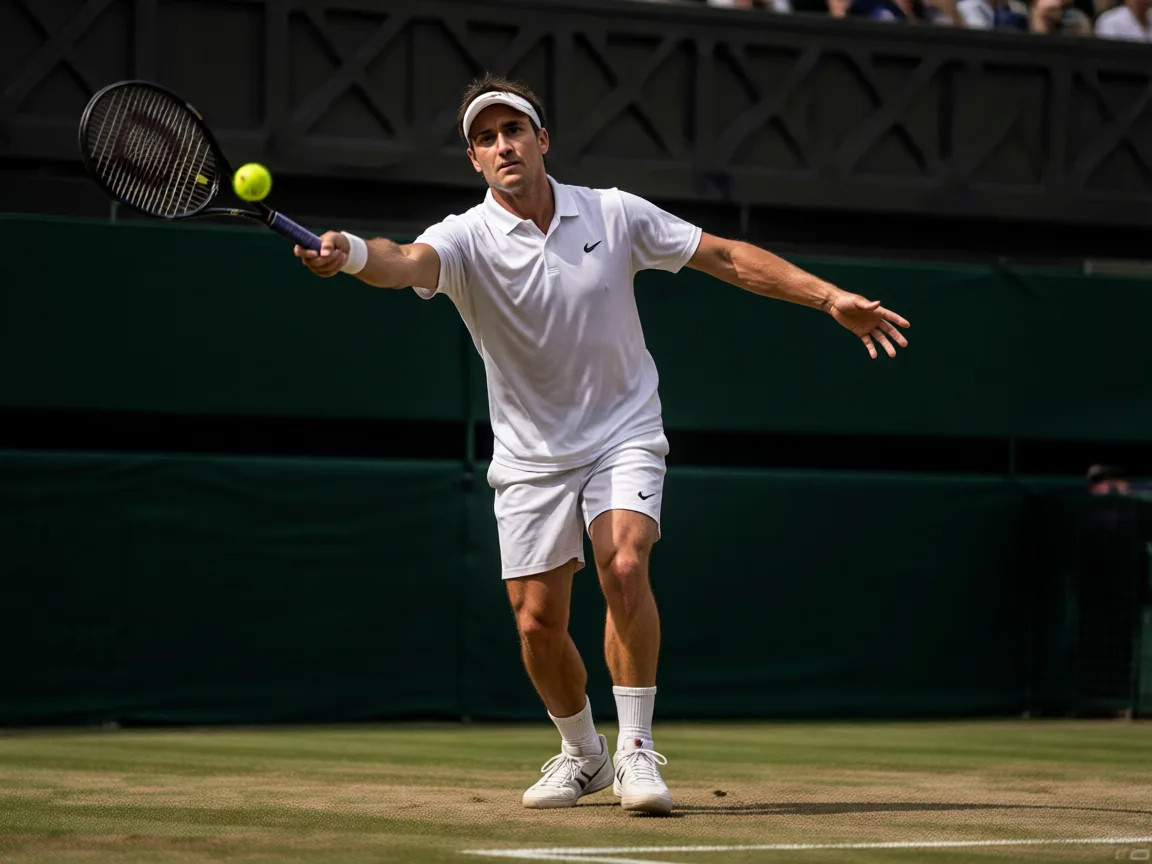
Arthur Fery and the Myth of the Diminutive Tennis Player
A Guardian letter exposing Wimbledon's height bias raises a deeper question: why does tennis still equate greatness with size?
Fritz Channels Sampras Ghost to Storm Wimbledon Quarterfinals
Taylor Fritz served 23 aces in a surgical demolition of Alexander Bublik, reviving American hopes at Wimbledon after 26 years.

Castle Walks Away: BBC's Voice of Wimbledon Ends Four-Decade Run
Andrew Castle quits BBC after lead commentator demotion, closing the curtain on a defining Wimbledon broadcasting era.