Porro's Brilliance Puts Spain Within Reach of World Cup Final
Pedro Porro's exquisite one-two with Olmo doubled Spain's lead over France in the 2026 World Cup semi-final.
Pedro Porro has never been the obvious protagonist in Spain's golden generation 2.0. For large swaths of his career, the Tottenham Hotspur right-back has been viewed as a tactically fascinating but defensively suspect wing-back, brilliant going forward yet occasionally a liability in transition. But on the grandest stage of all, in a 2026 World Cup semi-final against France, the 28-year-old produced a moment that permanently alters his reputation and potentially decides the tournament's narrative.
Playing a devastatingly sharp one-two with Dani Olmo, Porro found the space in a congested French penalty area and slotted home to double Spain's lead. The goal was not merely a statistical footnote. It was the product of an intricate tactical setup, a triumph of positional play over raw physical dominance, and a statement that this Spanish side possesses the cold-blooded efficiency their predecessors often lacked.
The Anatomy of a Tournament-Defining Goal
The move that led to Spain's second goal was textbook La Roja, executed with a ruthlessness France could not answer. The sequence began deep in the Spanish half, with the midfield triumvirate probing for angles and drawing the French press into a committed but ultimately fruitless chase. As the ball shifted to the right flank, Porro positioned himself in the half-space, the zone between the winger and the touchline that modern tactics have turned into the most valuable real estate on the pitch.
The exchange with Dani Olmo was surgical. A quick, weighted pass into Olmo's feet. A darting run behind the French defensive line. A perfectly timed return ball. And a composed finish past one of the best goalkeepers in the world.
Breaking Down the French Collapse
France's defensive structure, so often their bedrock in tournament football, was caught in a rare moment of disarray.
- The French left-sided press was bypassed with three quick passes, collapsing their midfield block.
- Dayot Upamecano and the French center-backs were forced to step out, creating the lane for Porro's run.
- The fullback cover was absent, swallowed by Spain's overloading of the left side mere seconds earlier.
This was not luck. It was repetition and choreography meeting execution under immense pressure.
Porro's Evolution: From Premier League Curiosity to World Cup Hero
To understand the significance of this moment, one must trace Porro's trajectory over the past few seasons. During his time at Manchester City and later at Tottenham, his ceiling as a top-tier attacking full-back was visible but never fully realized. His crossing was elite, his link-up play sharp, but questions persisted about his positioning in transition.
By the time the 2026 World Cup arrived, Porro had refined his game with the precision of a jeweler. His positioning in the attacking third no longer resembled a winger playing out of position. It looked like a midfielder with the license to gamble.
The Numbers Behind the Goal
Spain's possession in the build-up to the second goal was staggering.
- They completed 14 consecutive passes before Porro's strike.
- The move spanned 22 seconds, starting from the back and ending in the net.
- Porro himself made a 28-meter sprint to get on the end of Olmo's return pass.
- Spain's expected goals (xG) for that phase of play jumped from 0.04 to 0.41 in a single touch.
These are not the statistics of a lucky breakthrough. They are the fingerprints of a system that has been drilled to perfection and a player who has finally found his role within it.
France's Tactical Blind Spot
For all of France's attacking weaponry, they have always carried a vulnerability to teams that combine patience with vertical thrust. Their midfield, while physically imposing, can be bypassed if the opposition refuses to engage in aerial duels and instead plays through the lines on the ground.
Spain did exactly that. They did not try to out-muscle France in the central areas. They used the wings, dragged the French block wide, and then punched through the middle with those quick, intricate combinations like the one between Porro and Olmo.
Historical Echoes
This goal places Porro in an exclusive club of unlikely Spanish heroes in World Cup semi-finals. The nation's tournament history is filled with moments where the unexpected figure delivered to the marquee narrative. From the defensive midfielders of 2010 to the attacking full-backs of this new era, Spain has continually evolved their definition of a match-winner.
That victory in South Africa was built on a foundation of suffocating possession and a single moment of individual genius from a defender. This team, trailing those ghosts by a decade and a half, is writing a new chapter with similar ingredients but a distinctly modern flavor.
The Tactical Battle
France's approach to this semi-final was always going to be defined by how they handled Spain's midfield. Didier Deschamps, the French manager, is a pragmatist who builds from defensive solidity and trusts his collection of superstars to produce moments in the final third.
But that pragmatism requires a defensive line that does not get pulled apart by runners from deep. When Porro made his run, there was a gap in the French backline that a freight train could have passed through.
Where France Went Wrong
- The midfield press was disconnected from the defensive line, creating a 15-meter gap that Olmo exploited.
- The wide areas were left vulnerable as France's wingers failed to track back.
- The center-backs were forced into individual duels rather than maintaining a cohesive block.
This was a collective failure, but it was also a testament to Spain's ability to stretch and manipulate a defense that has been one of the most resilient in international football.
Suffocating Control Measured in Passes
What makes this Spanish side so dangerous is not just their ability to score goals like Porro's. It is the suffocating control that precedes them. For long stretches of this semi-final, France could not get near the ball. Their world-class attackers were reduced to spectators, watching Spain weave patterns around them.
The Bottom Line
Pedro Porro's goal against France is more than a moment of individual brilliance. It is the culmination of years of tactical evolution, the refinement of a player's game from a defensive question mark to a World Cup semi-final match-winner. It puts Spain on the verge of a final and forces France to confront the tactical limitations that even their galaxy of stars could not mask.
For Spain, this is the moment. Not just the goal itself, but the cold certainty with which it was scored. This team does not panic. It calculates. And with Porro's strike, they may have just calculated their way to a World Cup final.
The Road Ahead
A World Cup final awaits the winner. For Spain, the prospect of adding another star to their crest is tantalizingly close. For France, the challenge is stark. They must find a way to break Spain's rhythm, to disrupt the passing lanes, and to rediscover the attacking fluency that was so noticeably absent.
Spain's victory, built on a foundation of tactical discipline and moments of individual quality, sends a clear message to whatever opponent awaits in the final. This is not a team that relies on emotion or运气. It is a machine, fine-tuned and relentless, with players like Pedro Porro stepping into the spotlight at the precise moment they are needed.
The semi-final goal will be replayed for years. Not just because it was beautiful or because it was important. Because it was the moment when the plan worked perfectly, when years of preparation met the chaos of a World Cup semi-final and emerged victorious.
Verdict
Spain's 2-0 lead, anchored by Porro's moment of genius, is not just a scoreline. It is a tactical manifesto. La Roja has proven that they can dismantle even the most physically imposing teams with precision and patience. The final awaits, and Spain has every reason to believe they can finish the job.
Editorial Integrity
This is an original SportPulse article written by our editorial team. All content is independently researched, written, and reviewed by our writers and editors before publication. We do not publish copied, aggregated, or syndicated content.
SportPulse is committed to original sports journalism. Read our editorial policy or contact us with any questions.
More Like This
All football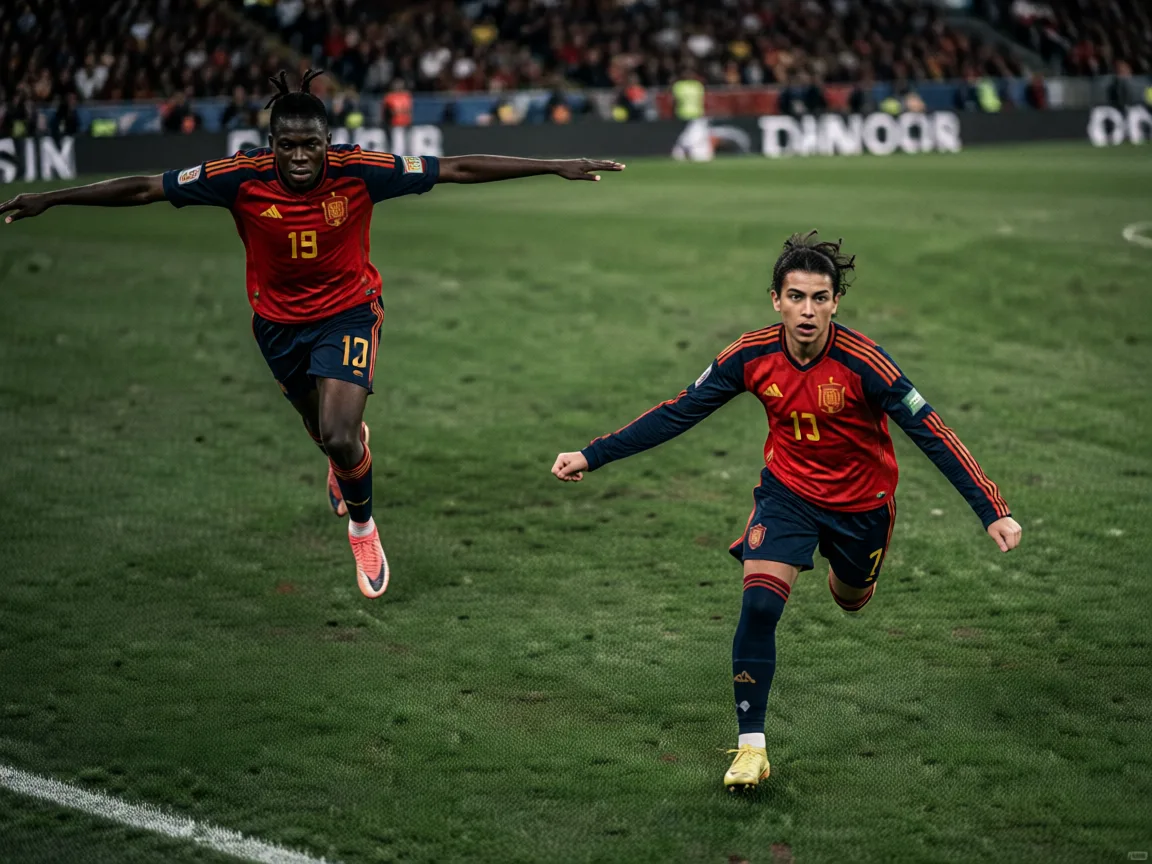
How Williams and Torres Won Spain the World Cup From the Bench
Two substitutes didn't rescue Spain's final, they refined what was already working, and that distinction won them the trophy.

Knockout Football Arrives: The Biggest Sporting Weekend of 2026
World Cup elimination drama, F1 in Spielberg, and T20 knockout cricket collide in a stacked weekend.
The Brands FIFA Tried to Silence Became the Loudest Story at the World Cup
FIFA's crackdown on unofficial sponsors keeps backfiring spectacularly — and the Streisand Effect is eating their commercial model alive.