Russell Eyes Hamilton and Ferrari as Championship Dark Horse in 2025
Mercedes driver George Russell names Lewis Hamilton's Ferrari switch as the biggest title threat heading into the new season.
The Quote That Signals a Shift in the Grid's Power Dynamics
George Russell does not hand out compliments like pit lane lollipops. The Mercedes driver is calculating, measured, and brutally honest when the microphone is on. So when he labels Lewis Hamilton and Ferrari "a huge threat" for the 2025 World Championship, the paddock listens. This is not diplomatic fluff. This is a statement born from thousands of kilometers of shared data, intimate knowledge of Hamilton's racecraft, and a clear-eyed assessment of where the competitive order stands heading into the new season.
Russell spent three years alongside Hamilton at Mercedes. He knows the seven-time champion's tendencies, his ability to extract performance from a car that is not quite there, and his almost supernatural capacity to peak when titles are on the line. The fact that Russell is now framing Hamilton in Ferrari red as his primary concern rather than the reigning dominance of Red Bull tells you everything about how dramatically the landscape has shifted.
Why Ferrari Suddenly Looks Like the Real Deal
The Scuderia's trajectory over the past eighteen months has been nothing short of remarkable. After the regulatory chaos and strategic blunders that plagued their 2022 title challenge, Ferrari rebuilt methodically. Charles Leclerc's three victories in the second half of the 2024 season demonstrated that the SF-24 was not just fast on Saturdays but genuinely competitive on Sundays. The team's operational execution improved dramatically, with pit stop times consistently under 2.3 seconds and strategy calls that no longer became memes.
The addition of Hamilton changes the equation entirely. This is not simply swapping one fast driver for Carlos Sainz. This is plugging a generational talent into a team that has already proven it can build a championship-caliber car. Hamilton's 104 career victories and unmatched experience in title fights bring a dimension Ferrari has lacked since the Michael Schumacher era. His ability to manage tires over long stints, his mastery of tire blanket strategies, and his understanding of how to extract the absolute maximum from Pirelli's compounds at critical moments are precisely the qualities that separate contenders from pretenders.
The Technical Foundation
Ferrari's 2025 power unit development has been aggressive. The Maranello outfit has focused on addressing the energy recovery deployment weaknesses that cost them top speed at circuits like Monza and Jeddah in previous seasons. Reports from pre-season testing in Bahrain suggested significant gains in the hybrid system's efficiency, with Hamilton posting competitive speed trap numbers that rivaled the Red Bull.
The aerodynamic philosophy has also evolved. Ferrari moved away from the aggressive low-drag concept that made them vulnerable in high-downforce configurations and adopted a more balanced approach. The result is a car that should perform consistently across the full calendar, from the tight streets of Monaco to the sweeping curves of Silverstone.
Russell's Calculated Admission
Russell's comment deserves scrutiny beyond its surface meaning. When a current driver publicly identifies a rival as a championship threat, several dynamics are at play.
First, there is the psychological warfare element. By elevating Hamilton and Ferrari, Russell is subtly shifting pressure onto their shoulders. If the partnership fails to deliver early results, the narrative of expectation versus reality becomes a distraction. Every qualifying session where Hamilton is not on the front row, every race where Ferrari strategy falters, will be magnified because the bar has been set so high.
Second, Russell is managing expectations at Mercedes. The Brackley team has endured a turbulent period since the ground-effect regulation changes of 2022. Their W15 showed flashes of competitiveness, and Russell's two victories last season proved the car was not a lost cause. But by identifying Ferrari as the primary threat rather than positioning Mercedes as the favorites, Russell gives his own team breathing room. It is a smart media play from a driver who has matured considerably in the public eye.
Third, and perhaps most importantly, Russell genuinely believes it. The data supports the claim.
The Red Bull Factor
Conspicuously absent from Russell's public assessment is any sustained focus on Red Bull. Max Verstappen enters 2025 as the defending champion, and the Milton Keynes operation remains formidable. However, the Adrian Newey departure has cast a shadow over the team's technical direction. The RB21 showed inconsistent characteristics during testing, with reports of unpredictable rear-end behavior that even Verstappen struggled to manage in certain conditions.
Red Bull's advantage in the ground-effect era has been their mastery of the underbody aerodynamics. Without Newey's guiding hand, the question is whether Pierre Waché and the remaining technical staff can maintain that edge. The early indications suggest Red Bull will still be fast, but the gap that once seemed insurmountable has narrowed considerably.
The McLaren Wild Card
Any championship prediction that ignores McLaren is incomplete. The Woking team's resurgence under Andrea Stella has been one of the great stories of the modern era. Lando Norris and Oscar Piastri delivered six race victories in 2024, and the MCL38 was arguably the fastest car across the full season. Their technical partnership with Mercedes provides a reliable power unit, and the team's operational execution has improved to elite levels.
McLaren enters 2025 with the confidence of a team that has tasted victory and wants more. Norris, in particular, will be desperate to convert his raw pace into a championship challenge after several near-misses. The three-way battle between Ferrari, McLaren, and Red Bull promises to produce one of the most competitive seasons in recent memory.
What This Means for the Championship Picture
Russell's acknowledgment of the Hamilton-Ferrari threat reflects a broader consensus forming in the paddock. The 2025 season is shaping up as a genuine multi-team fight, the kind that Formula 1 has been desperate to deliver since the hybrid era began.
The key variables that will determine the championship are:
-
Tire management across different compounds: Pirelli's 2025 range introduces a revised construction that rewards teams with better mechanical grip. Ferrari and Hamilton's combined expertise in this area could prove decisive.
-
Sprint race performance: With six sprint weekends on the calendar, consistency across shorter formats becomes increasingly important. Hamilton's adaptability in unfamiliar car setups will be tested.
-
Development race through the season: The budget cap era means teams cannot simply throw money at upgrades. Ferrari's ability to bring efficient upgrades to the track, guided by Hamilton's feedback, could be the difference between a title challenge and a solid but ultimately unsuccessful campaign.
-
Reliability: Ferrari's engine reliability improved significantly in 2024, but the new power unit will need to prove its durability over 24 races. Any mechanical failure in the early rounds could be catastrophic in such a tight championship fight.
The Hamilton Factor Cannot Be Understated
There is a reason Russell, who knows Hamilton better than almost anyone on the current grid, is sounding the alarm. Hamilton at Ferrari is not just a driver change. It is a cultural shift, a statement of intent, and potentially the final chapter of one of the greatest careers in motorsport history.
Hamilton has nothing left to prove in Formula 1. He holds the joint record for most championships, the record for most race victories, and the record for most pole positions. Yet the hunger remains. Those who have worked with him describe a driver who is reinvigorated by the challenge of mastering a new car, a new team, and a new set of rivals.
The question is not whether Hamilton will be fast at Ferrari. The question is whether the combination of his talent, the team's engineering, and the SF-25's potential can translate into consistent championship-level performance from the first race in Melbourne to the finale in Abu Dhabi.
Russell thinks it can. And when George Russell speaks with that level of conviction, history suggests he is rarely wrong.
Championship Implications and the Road Ahead
The 2025 season launches in earnest with the Australian Grand Prix in mid-March, and the early rounds will provide the first concrete evidence of whether Russell's assessment holds weight. Ferrari's performance at high-speed circuits like Jeddah and Suzuka will be particularly revealing, as these venues expose any aerodynamic deficiencies with brutal efficiency.
For Mercedes, the challenge is clear. Russell must extract every fraction of performance from the W16 to remain in the championship conversation. The team cannot afford another season of incremental progress while their former driver potentially lifts the title in different colors.
The stakes have never been higher. The grid has never been more competitive. And if George Russell is right about Hamilton and Ferrari, we could be witnessing the beginning of something extraordinary in Maranello.
Editorial Integrity
This is an original SportPulse article written by our editorial team. All content is independently researched, written, and reviewed by our writers and editors before publication. We do not publish copied, aggregated, or syndicated content.
SportPulse is committed to original sports journalism. Read our editorial policy or contact us with any questions.
More Like This
All f1
Home Turf Glory: Which F1 Drivers Actually Deliver Under Home Pressure?
The data reveals a stark divide: some drivers thrive on home soil, others crack under the weight of expectation.
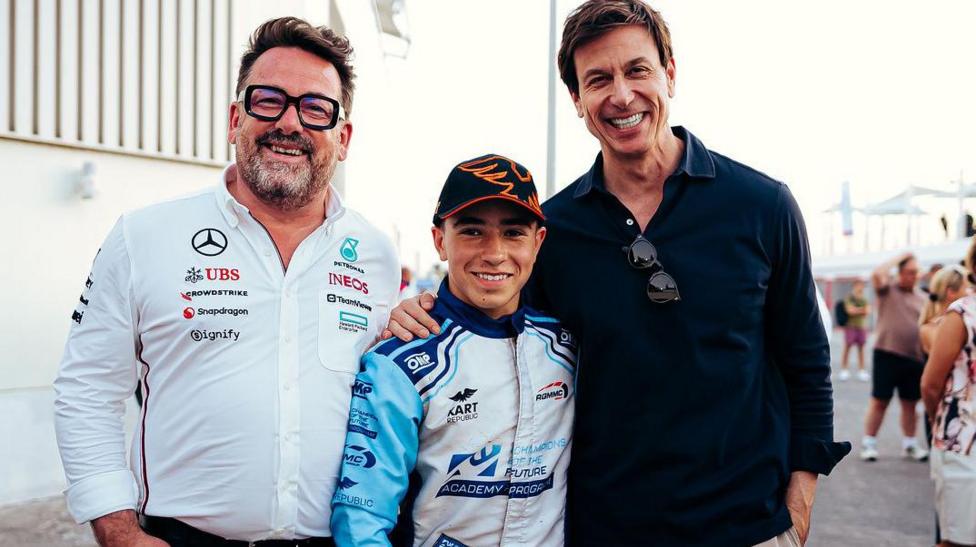
Mercedes Losves Star Scout to Red Bull: What It Means for Both Teams
Red Bull poaches Mercedes' driver discovery architect behind Kimi Antonelli, reshaping the talent pipeline battle.
New Names on the Timing Screens: FP1 Rookies Descend on Spielberg
Fresh faces take over FP1 at the Austrian Grand Prix as teams strategically deploy their young driver obligations.