Serena's SW19 Revival: Legends and Contenders Collide at Wimbledon 2026
Serena Williams graces the Wimbledon lawns once more as Swiatek, Zverev, and Sabalenka navigate a chaotic Day Two.
The grass stains on the baseline were not yet dry when the roar erupted. Not the polite, Pimm's-fueled murmur that usually accompanies the opening exchanges of a Wimbledon fortnight, but a guttural, collective recognition of something bordering on mythic. Serena Williams, 34 years after her SW19 debut, was walking back onto the Wimbledon lawn. It is a scene that rewrites the accepted boundaries of athletic longevity, blurring the line between past and present on tennis's most sacred turf.
Day two of Wimbledon 2026 was never going to survive on ordinariness, not with the promise of this returning queen. But the agenda offered far more than a single nostalgia trip. It was a faintly daunting, thoroughly thrilling banquet of tennis. Iga Swiatek, Alexander Zverev, and Katie Boulter were all slated for combat, each carrying their own distinct gravitational pull. Yet the morning belonged irrevocably to the woman who turned the All England Club into her personal playground for two decades.
There is no modern blueprint for what Williams is attempting. Because no one has done this. The conversation was supposed to have closed. The farewell at the 2022 US Open was meant to be the final, trembling note of a transcendent opera. But competitors of her ilk do not walk away easily; they leave a piece of their soul on every baseline they have ever owned, and eventually, the silence becomes deafening. Her return is not a victory lap. It is a resurrection.
The Mind Behind the Comeback
To understand why Serena would subject her body to the unique, joint-punishing violence of grass-court tennis at this stage, you must understand the engine that drove her to 23 Grand Slam singles titles. It is an engine fueled not by the accumulation of records, though she has plenty, but by an obsession with the contest itself.
The training philosophy shifted long ago. Gone are the endless, grinding baseline rallies that defined her early dominance. In their place: surgical, high-octane practice blocks designed to preserve the chassis while sharpening the weaponry. The serve remains the greatest single shot in the history of the sport, and on grass, a serve like that buys you a minimum of two free points per game. That math keeps comeback dreams alive.
"People ask me why I'm back. They don't get it. I'm not here to add to the resume. I'm here because the energy of Centre Court on a Tuesday is still the only thing that makes my heart beat this way. I still have something to give."
That something is aura. Opponents do not merely play Serena Williams; they wrestle the ghost of her dominance before a ball is struck. The psychological chess match begins in the locker room.
The Contenders Navigate the Chaos
While the return of Williams dominated the early headlines, the business of actually winning the 2026 Championships pressed forward with brutal efficiency. Grass is a поверхности that refuses to respect reputations. It demands instant adaptation, rewarding those who embrace its chaos and punishing those who carry hard-court habits onto the lawn.
Aryna Sabalenka learned that lesson the hard way earlier in the day. The world number one suffered a characteristic wobble, a sudden disintegration of rhythm and focus that threatened to turn a routine victory into a crisis. Against Teodora Kostovic, Sabalenka saw a commanding lead evaporate into a second-set spiral of double faults and wayward returns.
Sabalenka's Survival Instinct
It is easy to forget, given her recent dominance, that Sabalenka's career was once defined by these psychological collapses. The yips on serve were not merely a technical flaw; they were a primal scream of a mind at war with itself. Today's wobble was a reminder that the Belarusian's ascension to the top of the game has not erased those demons. It has merely given her the tools to cage them.
She recovered. She always recovers now. Kostovic fought valiantly, but surviving a Sabalenka comeback requires more than just talent; it requires a ruthlessness that few possess. The victory, however uncomfortable, underscores a crucial tactical reality: Sabalenka does not need to be flawless to win majors. She only needs to be resilient enough to survive her own mistakes.
Elsewhere, the tournament's other heavy hitters waited in the wings. Iga Swiatek, the undisputed queen of clay, continues her perpetual quest to translate her Parisian dictatorship into SW19 supremacy. The Pole owns four French Open titles but has historically found the erratic bounces and low skids of grass to be a linguistic barrier. Her opening match was a test of how far her footwork recalibration has come.
Alexander Zverev, meanwhile, carries the burden of unfinished business. The German has spent the last two seasons hovering dangerously close to the summit, pushing Novak Djokovic and Carlos Alcaraz to the brink without delivering the final, decisive blow. Wimbledon remains the missing artifact in his career museum, the one major where his massive serve and oppressive baseline game should theoretically thrive, yet never quite has.
The British Hope
Then there is the matter of Katie Boulter. The British number one represents a different kind of pressure entirely. Swiatek and Zverev play with the weight of global expectation; Boulter carries the desperate, parochial hope of a nation starved of a homegrown singles champion since Virginia Wade in 1977. Every swing of her racket is monitored by a crowd desperate for a miracle, an energy that can elevate a player to the extraordinary or crush them under its sheer weight.
Career by Numbers: Serena Williams
- 23 Grand Slam singles titles, the most in the Open Era
- 7 Wimbledon singles championships, won consecutively from 2002 to 2008
- 186 weeks as the world number one, spread across three separate decades
- 73 consecutive weeks at world number one from 2013 to 2016
- 13 years between her first and last major title
- 3 Olympic gold medals in doubles
The Grass-Court Paradox
This is the peculiar magic of Wimbledon. It is a tournament that simultaneously venerates its history while demanding the most forward-thinking, adaptive tennis on the planet. The grass is a living, breathing antagonist. It changes over the fortnight, shifting from a slick, serve-dominated highway in week one to a worn, dusty battlefield in week two. Winning here requires solving two entirely different puzzles in 14 days.
For the returning legend, the equation is both simpler and more complex. Williams does not need to solve the entire fortnight right now. She only needs to solve the next two hours. Every match won is an act of defiance against the calendar, a refusal to accept that primes and peaks belong only to the young.
The psychological toll of navigating a major draw is immense. For the top seeds like Sabalenka, Swiatek, and Zverev, the challenge is occupying the mind during the mundane moments, the quiet, empty afternoons in the locker room when doubt creeps in. For Williams, the challenge is entirely physical. Can her tendons and ligaments withstand the explosive, braking forces demanded by grass-court movement? Can she recover in 48 hours to do it all over again?
The Legacy Equation
This is where the story of Wimbledon 2026 diverges from mere reporting and enters the realm of sporting mythology. What we are witnessing with Serena's return is not an athlete chasing a statistical ghost. She already owns the Open Era record. Margaret Court's 24 is a number debated in bars and barrooms, but it has never defined the essence of what Williams built.
Her legacy is not a tally. It is a standard. The standard of power, of relentless aggression, of a champion who made opponents feel beaten before they walked onto the court. When she steps onto the grass at the All England Club this fortnight, she is not adding to that tally. She is simply reminding the tennis world that the standard still exists.
The 2026 Championships will eventually crown a winner. The smart money still resides with Sabalenka, Alcaraz, or Swiatek, players in the prime of their athletic lives who have already proven they can navigate the grueling marathon of a Grand Slam. But for however long Serena Williams remains in this draw, the tournament belongs to her.
The grass will eventually swallow the footprints. The records will eventually be surpassed. But the aura of Serena on Centre Court is a phantom that will haunt Wimbledon long after she finally, irrevocably, walks away.
Editorial Integrity
This is an original SportPulse article written by our editorial team. All content is independently researched, written, and reviewed by our writers and editors before publication. We do not publish copied, aggregated, or syndicated content.
SportPulse is committed to original sports journalism. Read our editorial policy or contact us with any questions.
More Like This
All tennis
Swan and Fery Carry British Hopes Into the Wimbledon Spotlight
Katie Swan and Arthur Fery gave home crowds reasons to roar on a thrilling day four at Wimbledon 2026.
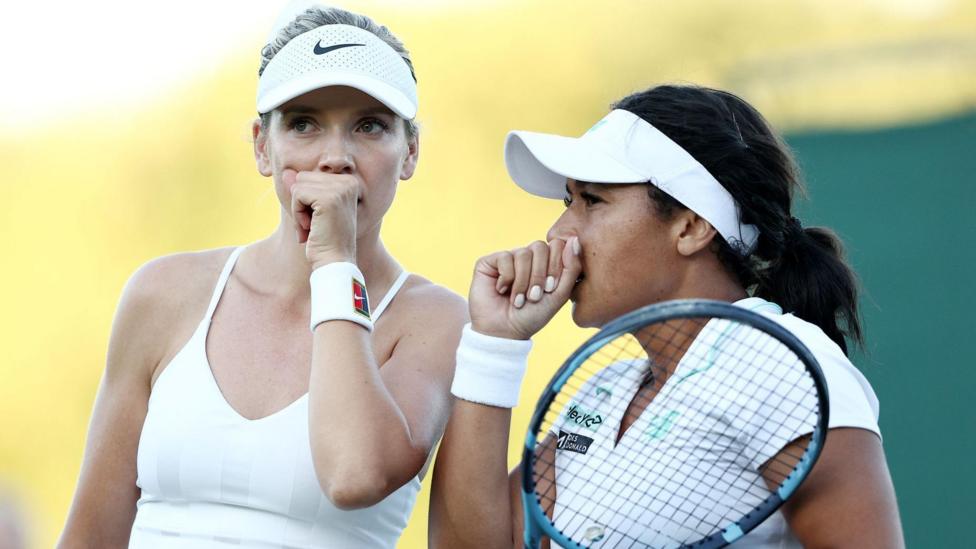
British Hopes Fade as Boulter and Watson Fall in Wimbledon Doubles Opener
Katie Boulter and Heather Watson bow out in the first round, exposing Britain's doubles depth problem on home grass.

Castle Walks Away: BBC's Voice of Wimbledon Ends Four-Decade Run
Andrew Castle quits BBC after lead commentator demotion, closing the curtain on a defining Wimbledon broadcasting era.