Stroll's Rear Suspension Fails on New Aston Martin at Hungarian Practice
A rear suspension failure halted Lance Stroll's running and raised questions about Aston Martin's latest upgrade package.
Stroll’s AMR24 Suspension Failure Halts Hungarian GP Practice
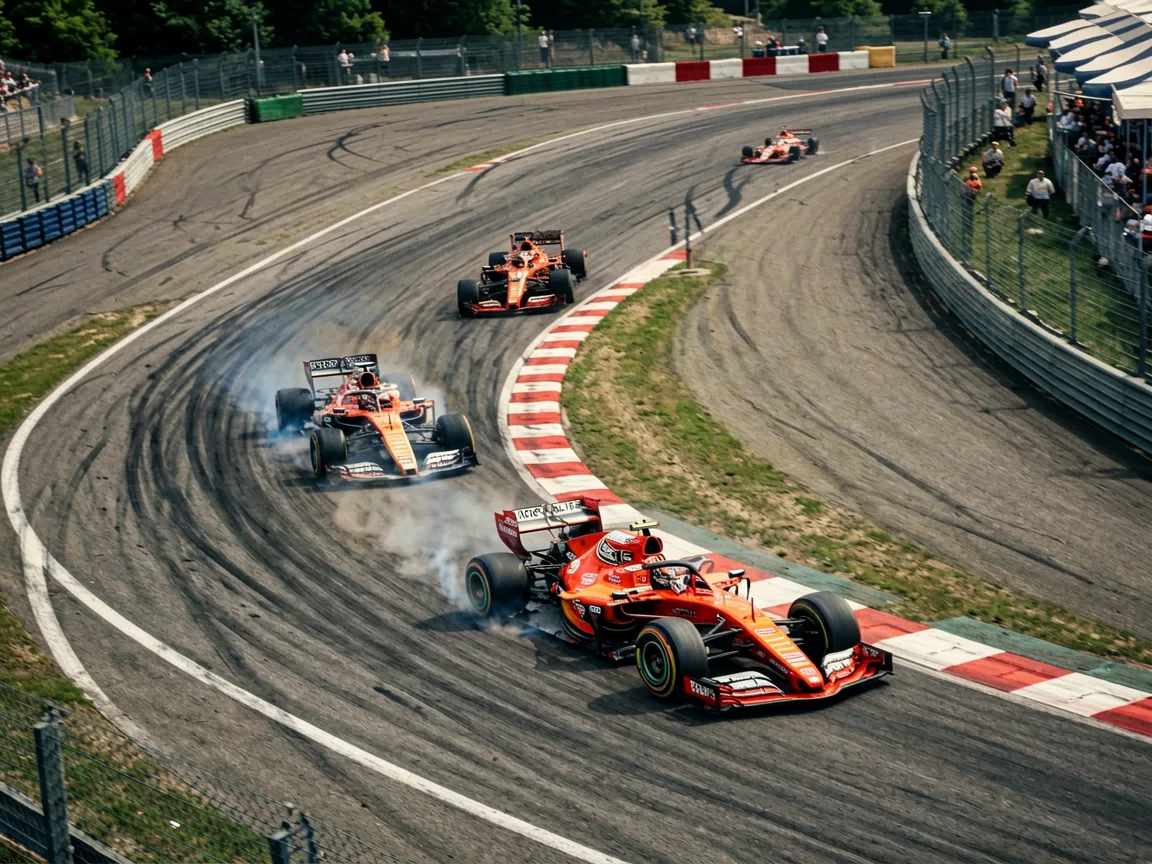
Lance Stroll’s first evaluation of Aston Martin’s new-spec AMR24 upgrade package ended prematurely at the Hungarian Grand Prix. The Canadian driver spun out during practice after the rear suspension failed, bringing out red flags and ending his session early. The timing is critical: the Hungaroring is one of the most aerodynamically and mechanically demanding circuits on the calendar, and lost track time directly reduces setup data availability.
Charles Leclerc topped the session for Ferrari. For Aston Martin, the immediate priority is determining whether this failure reveals a structural weakness in the revised car or was an isolated component break.
Circuit Demands Expose Suspension Limits
The Hungaroring’s narrow, twisty layout places heavy loads on the rear axle through sequences of low- and medium-speed corners. Turn 4 and the chicane at Turns 6 and 7 generate sustained lateral G-forces that push rear suspension geometry to its limits. Bumps at the apex of Turn 5 load the rear structure in compression precisely when the car requires maximum lateral grip. If a new suspension package has not been fully validated against these specific inputs, failure is likely.
Aston Martin introduced the updated specification in Budapest despite the circuit’s risks. Teams typically prefer wide run-off areas and forgiving kerbs—such as those in Barcelona and Bahrain—for initial testing of major upgrades. The Hungaroring offers neither. Concrete walls sit close to the racing line, and aggressive kerbs in the final sector introduce sudden, high-frequency load spikes into the suspension.
Manufacturing Defect vs. Load-Path Miscalculation
The failure raises a key engineering question: was this a manufacturing defect in a specific component, or does it point to a load-path miscalculation in the new suspension geometry?
If it is a one-off production fault, the fix is straightforward: inspect the batch, swap the component, and resume testing. If the new geometry introduces a resonant frequency or unanticipated load case under the car’s revised aerodynamic platform, the problem is systemic. The entire upgrade package may then require re-evaluation.
Aston Martin’s engineering team will analyze telemetry data from Stroll’s car. Modern F1 cars carry hundreds of sensors on the suspension alone, measuring displacement, load, temperature, and vibration in real time. Engineers will examine the milliseconds before the failure to determine if loads exceeded the design envelope or if a fatigue crack propagated from a pre-existing flaw.
Impact on Setup and Qualifying
Stroll missed significant seat time needed for mechanical grip development. The Hungaroring rewards a car balanced on turn-in with strong traction out of slow corners. Achieving this balance requires track time, not just simulator data.
His teammate, running the older-spec car or a different configuration, generated the team’s only meaningful setup data for the remainder of the session. This asymmetry puts Stroll at a disadvantage heading into qualifying, where track position and confidence in the car’s behavior through the final sector's flowing sequence are decisive.
Ferrari Leads as Rivals Assess Pace
Leclerc’s pace at the top of the timing sheets signals strength for Ferrari at a circuit that historically suits their car. The SF-24 has shown strong low-speed mechanical grip this season, aligning with the Hungaroring’s layout. However, practice times remain contextual. Fuel loads, engine modes, and tyre compounds skew results, and the session disruption limited clean long-run data for all teams.
Red Bull and McLaren serve as benchmarks for qualifying. Max Verstappen’s RB20 has demonstrated dominant traction characteristics all season, an advantage that compounds in the Hungaroring’s slow corners. Lando Norris’s MCL38 has been the strongest in medium-speed balance, potentially decisive through Turns 11 to 14.
Rear Upright Criticality
The rear upright is a primary stress concentrator in modern F1 rear suspensions. It connects wishbones, trackrod, and pushrod/pullrod linkages to the wheel assembly and brake duct. It must transmit all longitudinal and lateral forces from the tyre into the chassis while housing the wheel bearing and accommodating the brake caliper mounting.
Uprights are machined from aerospace-grade aluminium-lithium alloys or increasingly, titanium and carbon-fibre composites. The geometry is complex: each mounting point for a suspension leg must be positioned within fractions of a millimetre to maintain designed camber, toe, and instant-centre geometry across full suspension travel. A datum shift of even 0.2mm under load shifts the tyre’s contact patch, changing grip distribution and potentially overloading adjacent components.
When teams introduce new rear suspension packages, they often redesign the upright to accommodate revised aero load targets. New floors or diffusers alter downforce distributions, changing vertical load on the rear tyres and forces flowing through every suspension member. The upright sits at the nexus of these variables and typically reveals first whether the system’s load assumptions were correct.
Stroll’s failure may have originated in the upright, wishbone pick-up points, or a fatigue failure of a pushrod. Forensic analysis will determine the cause, dictating whether Aston Martin runs the new package or reverts to the known-good specification.
Spa-Francorchamps Presents Different Challenges
The next round at Spa-Francorchamps presents a distinct challenge. Where the Hungaroring punishes suspension at low speed with aggressive kerbs, Spa loads it at high speed through Eau Rouge and Blanchimont. Cars hit compression forces at over 300 km/h. The rear suspension must manage lateral loads alongside massive aerodynamic downforce that changes rapidly as the car crests and dips through the Ardennes valley.
If Aston Martin’s new package has an unresolved load-path issue, Spa will expose it quickly, but at much higher speeds and with greater consequences. The team now faces component inspection, data review, and damage limitation. The upgrade was intended as a step forward; in Hungary, it resulted in a loss of track time.
Editorial Integrity
This is an original SportPulse article written by our editorial team. All content is independently researched, written, and reviewed by our writers and editors before publication. We do not publish copied, aggregated, or syndicated content.
SportPulse is committed to original sports journalism. Read our editorial policy or contact us with any questions.
More Like This
All f1
Williams Reveal Upgrade Timeline as Vowles Admits Rivals Have Impressed
James Vowles lays out Williams' development roadmap while acknowledging the midfield pack has raised its game.
Silverstone's High-Speed Tyranny Demands a Flawless Compound Chess Match
Pirelli's three-way compound selection at Silverstone forces teams to navigate brutal thermal loads and high-speed lateral shear.
Spa and Hungaroring Demand Opposite Engineering Philosophies
Formula 1's 2026 double header tests aerodynamic efficiency against mechanical grip across two radically different circuits.