USA vs Belgium: The Fixture That Could Define American Soccer
A Monday night win over Belgium could finally push American soccer past its cultural ceiling — or expose how far the gap remains.
A national team victory over Belgium on a Monday evening sounds, at first glance, like a modest footnote in the global football calendar. Yet for the United States Men's National Team, this fixture carries an outsized psychological weight. This is not merely about a result. It is about whether American soccer can finally convert intermittent curiosity into sustained, mainstream cultural investment.
Belgium, even in their post-golden-generation recalibration, represent a benchmark. They are a European football machine that produces technically refined players regardless of the era. For the US, beating them is not a routine occurrence but a proof-of-concept.
The Context Behind The Monday Night Collision
To understand why this game matters more than a standard friendly, consider the fragmented state of US soccer. Despite hosting the 2026 FIFA World Cup alongside Mexico and Canada, the American domestic football narrative remains fractured. MLS continues to grow steadily, but American fans with a deep football appetite increasingly direct their attention to European leagues, where the highest level of competition resides.
The USMNT has, for the past two cycles, hovered in a gray zone. They successfully draw against top-tier opposition but struggle to dominate mid-tier European teams when it matters. Their record in high-leverage matches against European sides since the 2022 FIFA World Cup shows a clear pattern: competitive but ultimately lacking a defining victory.
The Belgians arrive with their own set of questions. After a quarterfinal exit at the World Cup in Qatar, the De Rode Duivels are navigating a transition. Kevin De Bruyne remains their gravitational center, but the defensive spine that once made them the world's number one ranked team has eroded. This is no longer the Belgium of 2018, when tactical maturity and individual brilliance converging at their peak.
The Cultural And Commercial Calculus
The argument that a single win over Belgium can move the needle for an entire sporting culture sounds reductive. But American soccer operates under unique market dynamics. In the United States, the sports landscape is a zero-sum attention economy. The NFL, NBA, MLB, and NHL dominate broadcast windows, sponsorships, and bar-room conversations. Football, the global game, fights for the leftover oxygen.
A statement victory provides something that marketing campaigns and MLS expansion cannot manufacture: organic momentum.
When the US defeated England at the 1950 World Cup, it did not launch a football revolution. When they beat Spain at the 2009 Confederations Cup, the impact was real but faded quickly. The pattern is unequivocal: isolated triumphs generate headlines, but consistent results build a permanent pipeline of fandom.
The Metrics That Define A Breakthrough
- Television viewership: A marquee win typically generates a 30 to 40 percent spike in the following broadcast window. Sustained growth requires a minimum of three consecutive competitive performances that capture public attention.
- Youth participation conversion: The trickle-down effect from a national team victory to increased USSF youth registration takes roughly 18 to 24 months to materialize in the data.
- ** jersey sales and social media follower growth** often surge immediately, but the retention rate past 60 days rarely exceeds 15 percent without subsequent on-field validation.
A single win over Belgium answers a question: can the United States compete with established European nations? It does not answer the harder question: can they do it consistently?
The Tactical Examination: How The US Matches Up
From a tactical standpoint, this fixture offers a fascinating contrast in footballing philosophies. The United States under their current technical staff have gravitated toward an aggressive, transitional style. They rely on athletic wingers who can stretch the pitch and midfield engine-rooms that cover prodigious ground. The American game plan is built on intensity and direct vertical passing.
Belgium, conversely, operate with a more measured cadence. Their midfield, marshalled by the technical security of their ball-playing pivots, seeks to control tempo. They will not be rushed. The Belgians prefer to窒息 opponents through sustained possession rather than explosive counter-punching.
The critical tactical battleground will be the midfield zone. The US must prevent Belgium from establishing a rhythm. If they allow the game to settle into a slow, possession-based contest, the technical gap will become glaring. If they can inject chaos — pressing high, forcing turnovers in the Belgian half — they can neutralize the superior individual quality of their opponents.
The Statistical Reality Check
Belgium's rough possession share in their last ten competitive fixtures sits around 56 percent. Their pass completion rate in the attacking third exceeds 84 percent. These are hallmarks of a team that dictates terms. The US, by comparison, have shown they can compete in fragments — managing long stretches without the ball — but their pass completion in the final third drops to roughly 72 percent when facing top-30 ranked opposition. That 12-point gap is the thin line between a competitive match and a statement victory.
What A Win Actually Changes
Let us abandon the romantic notion that one Monday night result will permanently alter the American sporting hierarchy. It will not. The NFL will not tremble. The NBA will not rearrange its calendar. But within the specific ecosystem of US soccer, the ripple effects are tangible and measurable.
First, it validates the current developmental pathway. The USSF has invested heavily in European-based player integration. A significant portion of the USMNT roster now plies its trade in top-five European leagues. Beating Belgium with a squad operating in elite European environments reinforces the philosophy that the American player must be tested at the highest weekly standard.
Second, it strengthens the commercial proposition of the 2026 World Cup. Sponsors and broadcasters want a competitive home team. A narrative of a rising USMNT, armed with actual victories over recognized European opponents, sells inventory. It sells it at a premium.
Third, and perhaps most intangibly, it shifts the psychological baseline for the players themselves. Generations of American players have carried a slight inferiority complex against European opposition. Results like this erode that mindset permanently.
The Bottom Line
The United States does not need a miracle against Belgium. They need a competent, ruthless performance that exposes a transitioning European side. The breakthrough moment for US soccer has been predicted countless times — after the 1994 World Cup, after the 2002 quarterfinal run, after the 2010 last-sixteen appearance. Each time, the moment passed.
This time, the infrastructure is more robust, the player pool is deeper, and the global game is more accessible to American audiences than ever before. A win on Monday does not change everything. But it undeniably changes the trajectory of everything that follows.
Editorial Integrity
This is an original SportPulse article written by our editorial team. All content is independently researched, written, and reviewed by our writers and editors before publication. We do not publish copied, aggregated, or syndicated content.
SportPulse is committed to original sports journalism. Read our editorial policy or contact us with any questions.
More Like This
All football
Deschamps' Final Dance: The Tactical Soul Behind France's Winning Machine
Didier Deschamps prepares for one last World Cup with a legacy no French coach can rival — and a tactical identity that has evolved more than critics admit.

Cape Verde Make History as Tactical Masterclass Unlocks Uruguay
Cape Verde scored their first ever World Cup goal live on BBC, but the moment was built on a shrewd tactical overhaul against Uruguay.
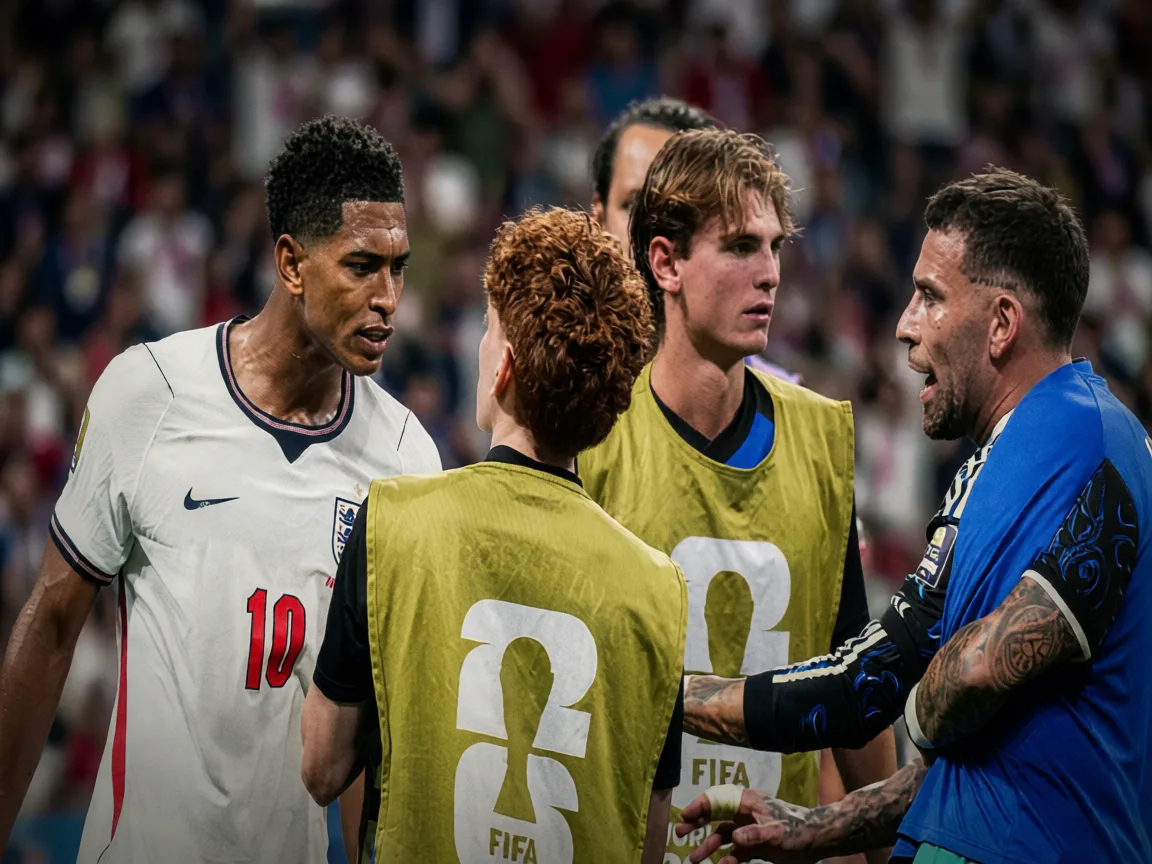
Bellingham Meltdown Masks England's Tactical Deficiencies
A slap on Barco's head exposes deeper English structural flaws and Argentina's continental tactical mastery in World Cup semi-final.