Wimbledon's Second Week: Where Grass Court Dreams Intensify
As Wimbledon enters its second week, the All England Club transforms from grand spectacle into pressure-cooker theatre.
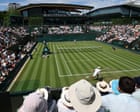
The afternoon light slants across Centre Court at a particular angle during the second week of Wimbledon, catching the ivy on the old walls and turning it to a colour that exists only here, only now. The crowd settles into its seats with the quiet intention of people who have paid handsomely and waited patiently. A ball kid tosses a fuzzy yellow sphere to the server. The silence before the first point of a second-week match is unlike anything else in tennis. It does not merely ask for quiet. It demands reverence.
This is the tournament's pivot point. The first week of Wimbledon is a sprawling festival, a carnival of upsets and five-set marathons played on outside courts where every match feels like a separate little novel. The second week is something altogether different. The draws have been whittled down. The pretenders have been separated from the contenders. The players still standing are the ones who have survived the unique chaos of grass, where a bad bounce or a slipped knee can end a fortnight's dream in a heartbeat.
The Theatre Narrows
By the time the championships enter their second Monday, the All England Club undergoes a transformation. The outside courts, once packed with curious wanderers seeking a glimpse of anyone with a racket, begin to empty. The crowds migrate inward, drawn toward Centre Court and Court No. 1 as if pulled by gravity. The matches still happening on Court 12 or Court 14 may be fiercely contested, but there is a growing awareness among spectators that the story they need to witness is unfolding under the roofs.
photographer Sarah Lee's visual diary for The Guardian captures this shift with an intimacy that the broadcast cameras often miss. The photographs from the second week are not about the players alone. They are about the spaces between points. The old gentleman in the Royal Box adjusting his spectacles. The line judge's hand trembling slightly as she signals a ball out on a breakpoint that could change a career. The grounds crew member standing at the edge of a court, watching with the professional eye of someone who cut this exact grass at dawn.
Wimbledon's second week is not merely a continuation of the first. It is an escalation. The quality of tennis rises because the stakes do. Every service game carries the weight of a potential quarterfinal. Every breakpoint saved becomes a paragraph in the story of a champion. The players feel it in their bodies, that tightening of the shoulders and sharpening of the focus that comes when the divide between glory and disappointment narrows to a few points.
Grass Court Tennis at Its Purest
The grass itself becomes a character in the second week. By Day Seven or Eight, the famous baselines at the All England Club show the wear of thousands of footplants. The brown patches where players have shuffled and slid grow wider with each match, a visual record of rallies won and lost. The ball behaves differently on the worn patches, bouncing lower and skipping faster, rewarding the player who has the quicker reactions and the lower centre of gravity.
This is where grass court tennis separates itself from the hard courts of Melbourne and New York or the clay of Paris. On grass, the bounce is unpredictable. The ball skids. The player who can adapt in real time, who can read the surface and adjust racket face and footwork within a fraction of a second, is the player who survives. The second week of Wimbledon is where this truth is tested most ruthlessly.
Consider the numbers that typically define success on grass during the second week of a major championship. The players who advance tend to win over 70% of their first serve points. They convert break opportunities at a rate above 35%, though chances are scarce on this surface. They approach the net with purpose, finishing points at the front of the court with a volley conversion rate that separates the tactically astute from the baseline-bound.
The Metrics That Matter on Grass
- First serve percentage: typically above 65% for players reaching the second week
- Return games won: often below 25% given the serving advantage on grass
- Net points won: the best grass-court players convert over 68% of their forays forward
- Break points saved: elite physical performance under pressure, usually above 60%
The Crowd Becomes a Participant
The Wimbledon audience is unlike any other in tennis. It is knowledgeable in a way that borders on the scholarly. These are people who understand the difference between a good return and a great return, who can identify a tactical shift before the commentator mentions it, who will applaud a well-constructed point regardless of which player benefits. In the second week, this knowledge transforms into something more intense.
Lee's photographs capture the crowd as participants rather than observers. The woman pressing her hand to her mouth during a tiebreak. The group of friends in matching straw hats leaning forward in unison as a server begins the motion. The child on a parent's shoulders, too young to understand the stakes but old enough to realise something important is happening. These are not passive consumers of entertainment. They are witnesses to a sporting ritual that has been performed on this ground since the 19th century.
The second week of Wimbledon has its own atmosphere. It is not a frenzy like a football crowd. It is a collective held breath, a shared understanding that what they are watching matters in a way that transcends sport.
That atmosphere affects the players. The best competitors learn to use it, to channel the energy of fifteen thousand quiet, intent people into their racket arm. A great Wimbledon match in the second week is a conversation between the players and the crowd, each point a sentence in a shared language.
What the Second Week Demands
The physical and psychological demands of the second week are unlike anything else in a tennis season. Players who have spent six months grinding on clay and hard courts must now recalibrate everything for a surface that punishes hesitation and rewards aggression. The grass does not forgive a late swing. It does not offer a second chance to a player who misreads a bounce. Five sets on grass in the second week of Wimbledon is a form of athletic poetry that tests every facet of a player's game.
The tournament structure itself adds to the drama. The second Monday at Wimbledon traditionally carries the entire round of sixteen in the men's and women's singles draws, a scheduling quirk that concentrates all the narrative tension into a single extraordinary day. Every year, this day produces at least one match that will be discussed for years to come. Every year, a player announces themselves as a future champion with a commanding performance that seemed improbable just a week earlier.
Looking Ahead
As the second week unfolds, the questions that define this tournament begin to sharpen. Who will hold their nerve on Centre Court under a roof closed against the English summer? Which unseeded player will continue their improbable run through the draw? Which top seed will stumble at the threshold of a major that seemed destined to be theirs?
The beauty of Wimbledon's second week is that the answers arrive not through prediction but through performance. The grass does not lie. The ball does not bend to reputation. The player who wins is the player who earns it, point by point, game by game, in the golden light of an English summer afternoon that belongs to tennis and to nothing else.
The All England Club in its second week is a cathedral of sport. The rest of the tennis world fades to background noise. What remains is the ceremony of the serve, the geometry of the rally, and the slow, beautiful reveal of who deserves to lift the trophy on the final Sunday. That answer is still days away. The story is still being written on grass that has been cut and maintained and cussed at by centuries of groundskeepers. The second week has arrived. The real Wimbledon is about to begin.
Editorial Integrity
This is an original SportPulse article written by our editorial team. All content is independently researched, written, and reviewed by our writers and editors before publication. We do not publish copied, aggregated, or syndicated content.
SportPulse is committed to original sports journalism. Read our editorial policy or contact us with any questions.
More Like This
All tennis
Arthur Fery's Wimbledon Miracle Built on Nose Surgery and The Godfather
A secret nose procedure and Coppola's epic turned a bleeding qualifier into a Wimbledon semi-finalist facing Alexander Zverev.

Fery's Fairy-Tale Queen's Run Ends at Cerundolo's Hands
British hope Arthur Fery falls agonisingly short in the Queen's quarter-finals, denied a career-defining milestone by Francisco Cerundolo.
The Microbiome Match: How Gut Science Conquered Wimbledon's Dining Room
Trout sushi and coffee kombucha for breakfast signal a seismic shift in how elite tennis players fuel their bodies at the All England Club.