Trump, Shakira, and Logistical Chaos Threaten World Cup Final
Security delays and a blockbuster halftime show risk turning the World Cup final into a geopolitical circus rather than a football celebration.
The biggest match in global football may be overshadowed by the biggest ego in global politics. As the World Cup final approaches, the beautiful game's showcase moment is colliding with a logistical nightmare that has nothing to do with tactics, formations, or player fitness.
The White House has confirmed that Donald Trump will attend the final, and the ripple effects are already visible. The closing ceremony, scheduled to begin 90 minutes before kickoff, has yet to start. Security protocols surrounding Trump's attendance have essentially frozen the pre-match buildup, leaving organizers scrambling to adjust the timeline without disrupting the actual sporting event.
This is not a new phenomenon. Trump's presence at sporting events has routinely produced delays, heightened security perimeters, and restricted access zones. But applying that disruption to the World Cup final, an event watched by an estimated 1.5 billion viewers globally, elevates the stakes considerably.
Halftime Entertainment: Innovation or Distraction?
FIFA's decision to stage the first-ever World Cup halftime show represents a calculated gamble. The organization has booked genuine global star power: Shakira, Madonna, and BTS are all slated to perform during the interval.
The concept borrows directly from the NFL's Super Bowl model, where the halftime spectacle often generates as much cultural conversation as the game itself. For FIFA, the appeal is obvious: extended broadcast windows, additional commercial inventory, and a chance to capture casual viewers who might tune in for the music rather than the football.
But the Super Bowl model works because American football's natural rhythm includes a 20-minute halftime that can be stretched to 30 minutes without fundamentally altering the athletic product. Football's conventional 15-minute interval is a core part of the sport's regulatory structure. Players use that window for tactical adjustments, hydration, and physical treatment. Stretching it to accommodate a multi-artist performance risks disrupting the competitive integrity of the match itself.
Consider the physiological implications: footballers at the World Cup final level operate at the absolute ceiling of human endurance. A standard halftime allows muscle temperature to decrease gradually, a process that medical teams manage carefully through active warm-up protocols before the second half begins. Extending the interval by even 10 to 15 minutes changes the cooling curve, potentially increasing injury risk and altering the physical demands of the final 45 minutes.
"The halftime period in modern football is a precision operation. Medical teams have protocols calibrated to the minute. You extend that window, and you are asking players to adapt to physiological conditions they have not trained for."
FIFA insists the halftime show will not compromise the match. Whether managers agree remains to be seen.
What the Numbers Say
- 1.5 billion estimated global viewership for the World Cup final
- 90 minutes is the standard pre-match window for closing ceremonies
- 15 minutes is the conventional halftime interval in football, compared to the NFL's 20-minute Super Bowl halftime
- 2 minutes and 30 seconds is the average additional stoppage time added to FIFA tournament knockout matches since 2022
The Security Calculus
Trump's attendance introduces a security apparatus that dwarfs anything football routinely handles. Even for a World Cup final, the standard security operation is already maximalist: armed perimeters, no-fly zones, credential verification, and coordinated multi-agency response teams. Adding a former U.S. president to that equation requires an entirely separate layer of protocol.
The delay to the closing ceremony is the most visible symptom so far. Stadium entrances are subject to additional screening. Media access has been curtailed. And kickoff itself remains in question, though organizers will undoubtedly do everything possible to maintain the scheduled start time given the global broadcast implications.
For context, the World Cup final broadcast window is negotiated years in advance and worth hundreds of millions of dollars to FIFA and its media partners. A delay of even 15 minutes triggers cascading consequences across global broadcast schedules, advertising inventory, and post-match programming.
The irony is sharp: FIFA has spent the tournament celebrating the purity of the sport, only to have its showpiece event potentially delayed by a political figure whose attendance is entirely unrelated to the football.
What This Means for the Match
None of this changes the reality that two teams will eventually take the pitch and play a football match that determines the most prestigious trophy in the sport. The tactical battle, the individual brilliance, the pressure management: all of the elements that actually make a World Cup final compelling will still be present.
But the surrounding chaos matters. Managers prepare their teams with meticulous attention to routine and timing. Pre-match warm-ups are calibrated to the kickoff time. Nutritional intake is timed to peak physical readiness. Mental preparation follows a structured arc. Every delay, every disruption, every shift in the schedule chips away at that preparation.
The team that adapts best to the disruptions may gain a marginal advantage. In a World Cup final, margins are everything.
A Precedent Worth Watching
FIFA's decision to incorporate a halftime show and accommodate high-profile political attendance simultaneously represents a convergence of interests that could define future tournaments. The organization wants the World Cup to be more than a sporting event; it wants a cultural moment that transcends football.
That ambition carries inherent risk. The Super Bowl works because it has spent decades refining the balance between spectacle and sport. FIFA is attempting a similar transformation in a single match, with a political wildcard layered on top.
The Bottom Line: the World Cup final has always been more than just a football match. But FIFA's challenge is ensuring it remains a football match at all. The halftime show concept, the political attendance, and the logistical delays are all manageable in isolation. Combined, they risk creating an event where the football is not the centerpiece but merely one act in a larger circus.
Organizers have roughly two hours to ensure that the most watched sporting event on the planet does not become a case study in overproduction. The closing ceremony will eventually start. The halftime show will eventually happen. The only question that matters is whether the football survives the spectacle intact.
For the players, the coaches, and the billions watching for the sport rather than the pageantry, that answer cannot come soon enough.
Update:
新文章提及特朗普、贝伯和夏奇拉等明星现身世界杯决赛,与已发布文章报道的特朗普中场秀和安保混乱为同一事件,无实质新增事实。
Editorial Integrity
This is an original SportPulse article written by our editorial team. All content is independently researched, written, and reviewed by our writers and editors before publication. We do not publish copied, aggregated, or syndicated content.
SportPulse is committed to original sports journalism. Read our editorial policy or contact us with any questions.
More Like This
All football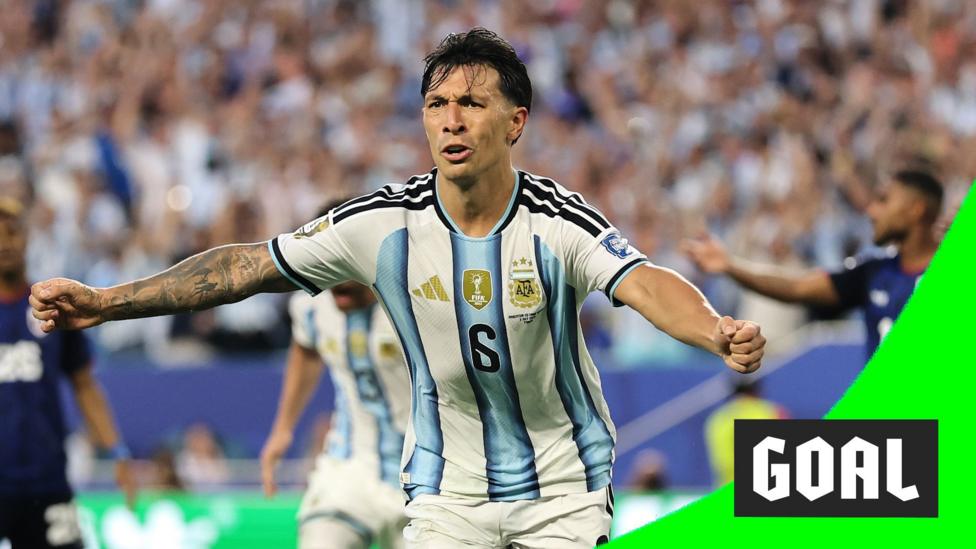
Martinez Breaks Cape Verde Hearts as Argentina Advance in World Cup Knockouts
Lisandro Martinez's decisive strike in the 2026 World Cup knockout stage sends Argentina past a resilient Cape Verde side and into the next round.
Inside the World Cup Machine: Rodrygo Reveals the Relentless Routine Behind Brazil's Campaign
Rodrygo pulls back the curtain on the grueling daily grind that powered Brazil's 2022 World Cup squad.
Argentina's 3-2 Comeback Against Egypt: A Tactical and VAR Deep Dive
Argentina's 3-2 comeback against Egypt exposes a tactical chess match overshadowed by a decisive and highly contentious VAR intervention.