Messi Ties Klose's World Cup Scoring Record With Hat-Trick on 200th Cap
Lionel Messi's hat-trick against Algeria equalled Miroslav Klose's all-time World Cup record of 16 goals on a night of pure footballing history.
A Mileve of Milestones Converges at Once
There are nights in football that feel almost scripted, where narrative symmetry and sporting excellence collide so precisely that the result reads like a filmmaker's treatment rather than a match report. Argentina's Group Stage clash against Algeria on June 17, 2026, was precisely that kind of evening. Lionel Messi, wearing the captain's armband for the 200th time in an Argentina shirt, delivered a hat-trick that hauled him level with Miroslav Klose on 16 all-time World Cup goals, tying a record that many assumed would stand for a generation.
It was vintage Messi in the most literal sense. Three goals, each arriving through the kind of spatial intelligence and finishing precision that defined his peak years at Barcelona and that powered Argentina to their glorious 2022 World Cup triumph in Qatar. Yet this was not a farewell performance in the nostalgic sense. At 38 years old, Messi remains the tactical fulcrum of Lionel Scaloni's system, and the way Argentina are constructed around him speaks to a coaching philosophy that has matured significantly since its early, more chaotic iterations.
"It's just a statistic." — Lionel Messi, when asked post-match about equalling Klose's record.
The understatement is pure Messi. But the numbers are anything but.
The Klose Comparison: Context Behind the Tally
Miroslav Klose set his 16-goal record across four World Cups spanning from 2002 to 2014, a remarkable testament to longevity and aerial dominance. The German striker was a specialist of the tournament format, a player whose peak club career arguably undersold his international pedigree. He reached the landmark in 24 World Cup appearances.
Messi now sits on the same figure, but the trajectory has been markedly different. His World Cup journey began as a teenage substitute in 2006, blossomed into frustration during the 2010 and 2014 campaigns, reached a nadir with Argentina's 2018 group-stage struggles, and ultimately found its glorious resolution in Qatar. The 2022 tournament was the watershed: seven goals, including two in the final against France, delivering the one trophy that had eluded him throughout his extraordinary career.
Now, in what is almost certainly his final World Cup, Messi has added three more against Algeria to draw level. One more goal and he stands alone atop the all-time scoring chart. Given the way he is playing, and given the tactical architecture Scaloni has built to serve him, it would be far more surprising if the record does not fall in the matches ahead.
Scaloni's System: Building the Cathedral Around the Master
The most fascinating tactical dimension of Argentina's 2026 setup is how openly and deliberately it is designed to funnel play through Messi. This is not a secret, nor is it a weakness when executed correctly. It is a philosophy.
Under Scaloni, Argentina typically operate in a 4-3-3 or 4-2-3-1 shape that shifts fluidly depending on the phase of play. The key structural principle is the creation of a free role for Messi between the lines, drifting into half-spaces where he can receive on the turn and dictate tempo. The midfield trio behind him provides the defensive coverage and progressive passing angles that allow this freedom without sacrificing structural integrity.
What has evolved since 2022 is the supporting cast's understanding of the geometry. The wide forwards hold width to stretch opposition back lines, creating the central corridors Messi exploits. The full-backs offer overlapping runs that pin defenders and create hesitation. The central midfielders rotate possession patiently until the moment arrives to break the line with a vertical pass into Messi's feet.
Against Algeria, this machinery functioned with ruthless efficiency. The three goals were not accidents or moments of isolated genius. They were the product of a system that has been refined over four years under Scaloni's stewardship, one that understands its best player's preferences with the precision of a Swiss watch.
The Evolution of Messi's Positional Play
It is worth noting how Messi's role within this system has shifted over time. At Barcelona during his prime, he operated as a false nine who dropped deep, combined with midfielders, and accelerated into the final third with devastating speed. Under Scaloni at the 2022 World Cup, he functioned more as a number ten in a 4-3-3, conserving energy in defensive phases and exploding into life when Argentina had possession in advanced areas.
At 38, the demands on his physical output have been managed even more carefully. Scaloni has effectively created a system where Messi does not need to cover excessive ground. The pressing structure is built around collective triggers rather than individual high pressing, and Messi's defensive contribution is largely positional rather than based on sprints and recoveries. The trade-off is entirely justified by the creative and goalscoring output he continues to deliver.
The 200th Cap: A Number That Tells Its Own Story
Reaching 200 international caps is an extraordinary feat in any era of football. Only a handful of players in the history of the sport have achieved it. For Messi, the number carries particular weight given the turbulence of his early international career, the retirement he briefly considered in 2016, and the years of criticism from sections of the Argentine media who questioned his commitment to the national team.
That narrative feels almost absurd now. Messi has not merely persisted through those difficult years; he has transformed them into the defining chapter of his career. The 2022 World Cup was the emotional climax, but the 2026 campaign represents something different: a valedictory tour in which every touch, every goal, every moment of genius carries the weight of finality.
The 200th cap was marked not with ceremony but with a hat-trick. The symbolism was perfect.
What the Record Means in the Broader Picture
There is a tendency in football discourse to reduce debates about greatness to single metrics. Messi versus Cristiano Ronaldo. Goals versus assists. Club trophies versus international honors. The World Cup scoring record is one such metric, and tying it adds another line to a résumé that was already unmatched.
But the significance extends beyond the individual milestone. Argentina's group-stage performance against Algeria suggests a team that is clicking at the right moment, with its talisman delivering at peak efficiency. The 2026 World Cup represents the final opportunity for this generation, led by Messi but supported by players who grew up idolizing him, to add another chapter to Argentine football's golden era.
Klose's record was built on consistency across multiple tournaments, a model of reliability in knockout football. Messi's path has been more dramatic, punctuated by heartbreak and redemption. Both approaches deserve recognition, but only one man now has the chance to claim the record outright.
Looking Ahead: The Knockout Rounds Beckon
Argentina will not be judged on group-stage performances against Algeria. The true test of Scaloni's tactical framework, and of Messi's ability to deliver on the biggest stage one final time, will come in the knockout rounds.
The key tactical questions heading into the Round of 16 and beyond are straightforward but critical. Can Argentina's midfield maintain its compact shape against opponents who press with greater intensity and technical quality than Algeria? Can the wide forwards provide enough goal threat to prevent opponents from overloading central areas in an attempt to isolate Messi? And, perhaps most importantly, can Scaloni manage his captain's minutes effectively enough to ensure he is fresh for the decisive moments?
The answer to the last question may define Argentina's entire tournament. Messi has shown repeatedly that when the stakes are highest, his capacity for decisive action remains unparalleled. But the margins at this stage are razor-thin, and the physical demands of knockout football are unforgiving.
If the system continues to function as it did against Algeria, if the supporting cast continues to understand its role in the grand design, then the all-time World Cup scoring record will belong to Lionel Messi alone before this tournament concludes.
And knowing Messi, he will call it just a statistic.
Editorial Integrity
This is an original SportPulse article written by our editorial team. All content is independently researched, written, and reviewed by our writers and editors before publication. We do not publish copied, aggregated, or syndicated content.
SportPulse is committed to original sports journalism. Read our editorial policy or contact us with any questions.
More Like This
All football
England vs France: Third-Place Play-off Tactical Postmortem
The bronze medal match nobody wanted revealed uncomfortable truths about both England and France's tactical identities.

The Pants Rule: How Football's Weirdest Rituals Actually Work
Footballers endure bizarre pre-match routines from lucky pants to fixed seating charts, believing each ritual edges them closer to victory.
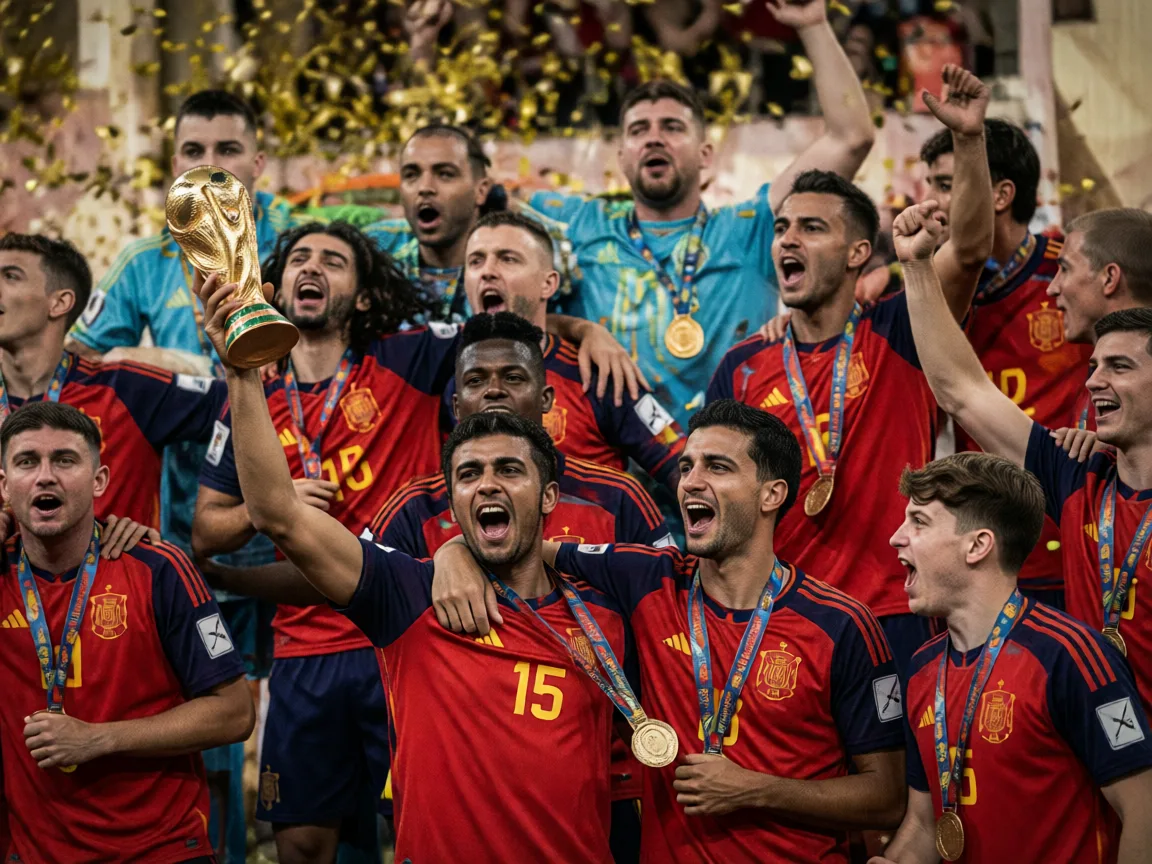
Spain Crowned 2026 World Cup Champions in Historic Second Triumph
Spain capture their second World Cup title, completing a generational rebuild with tactical brilliance and undeniable dominance on the global stage.