Philly Cashes In, Boston Pays: NBA Free Agency's Early Verdict
The first week of 2026 NBA free agency delivered blockbuster moves, with Philadelphia winning big and Boston left counting costs.
The board room at the Wells Fargo Center must have smelled like champagne and cigar smoke. Somewhere in the后台 of the Philadelphia 76ers' front office, Daryl Morey was surely leaning back in his chair, tapping the side of his nose, knowing he had just detonated the kind of earthquake that reshapes an entire conference overnight.
The first week of 2026 NBA free agency has come and gone, and if you blinked, you missed something seismic. Deals were struck. Franchises lurched. Stars rearranged the league's constellation. We are still weeks away from training camps, months away from a single meaningful dribble, but the preliminary verdicts are already writing themselves in permanent ink.
Premature? Absolutely. But that has never stopped anyone in this business before.
The Philadelphia Revolution
Start with the winners. Start where the loudest noise originated.
The Sixers did not merely participate in free agency. They conquered it. They walked into the marketplace with cap space burning a hole in their pocket and an aggressive mandate from ownership, and they walked out with the kind of haul that shifts the balance of power in the Eastern Conference. This was not a tweak or a patch job. This was a manifesto. Morey has been assembling this moment for over two years, maneuvering contracts, clearing space, waiting for the exact window when a max-level star would be available and the Sixers would be the only franchise with the oxygen to sign him outright.
That window opened. Morey jumped through it.
The beauty of what Philadelphia constructed is not just the headline acquisition. It is the depth around it. They supplemented their star catch with veterans who understand exactly what their roles will be. They added shooting on the margins. Theyaddressed defensive questions that haunted them in past spring collapses. And the balance of the roster now gives Nick Nurse a level of lineup flexibility that simply did not exist last season.
First-year projections suggest the Sixers have leapfrogged at least two rivals in the East's hierarchy. Whether that translates to a top-two seed is a matter of chemistry, durability, and luck. But on paper, and in July, paper is all that matters.
We don't wait for the perfect moment. We build the shape that creates the moment.
That has been the Morey philosophy throughout his career. This summer, it finally hit its apex in Philadelphia.
The Boston Calculus
And then there is Boston. The Celtics, long the class of the East, now face a different math.
The price of contention has finally come due. Years of trading first-round picks, stacking salaries, and operating well above the luxury tax apron have left the franchise in a bind that could take more than one offseason to undo. The final salary cap penalties for exceeding the second apron are no longer theoretical. They are here, and they hurt.
Boston did not have the flexibility to counter Philadelphia's move. They could not absorb the financial hit required to match what the Sixers assembled. The new collective bargaining agreement has teeth now, and the Celtics are one of its first prominent victims. Every dollar spent above the apron now carries the weight of trade restrictions, frozen draft picks, and an inability to use the taxpayer mid-level exception.
The Celtics are not crumbling. They still have a core that won a championship. They still have one of the best coaches in the league. But the margin for error has narrowed dramatically. A team that once reinforced its roster through oblique moves at the deadline now finds itself hemmed in by the very rules designed to punish sustained spending.
This is not a collapse. It is a correction. And corrections rarely feel good when they arrive.
LeBron's Endless Center of Gravity
Meanwhile, in Los Angeles, LeBron James once again reminded the league that free agency revolves around him, even when he is not technically a free agent in the traditional sense. The decisions surrounding his future, his player options, his willingness to adjust salary, and his influence on roster construction continue to function as a slow-moving weather system that shapes everything around it.
James is 40 years old and still functions as the gravitational center of an entire franchise's offseason strategy. The Lakers cannot move without considering his preferences. They cannot plan without factoring in his timeline. And yet, this summer, there was a subtle shift in the dynamic. James appeared more willing than ever to work with the front office on restructuring, to carve out space, to allow the franchise to pursue talent that may not align perfectly with his remaining window.
Whether that cooperation yields a better roster or merely delays an inevitable rebuild remains the central question of the Lakers' next two seasons.
The Middle Class Shrinks Again
Beyond the marquee names and the franchise-altering decisions, a quieter and more troubling story continues to unfold across the league.
The middle class of NBA rosters is vanishing. Role players who once commanded $8 to $12 million annually are now settling for veteran minimum deals or bi-annual exceptions. The new CBA has created a landscape where franchises are either paying superstars the absolute maximum or filling out rosters with minimum-salary talent. The area in between, the region that once allowed teams to retain quality depth and reward solid professionals, is becoming a wasteland.
This is not an accident. It is the intended consequence of a system designed to discourage teams from stacking the deck. But the collateral damage is real. Veterans who expected one more multi-year deal are finding a market that has no room for them. Agents are fielding calls that last thirty seconds. The speed of the market this July was not a sign of efficiency. It was a sign of scarcity.
Multiple rotation-quality players remain unsigned as of the end of week one. Some will find homes before training camp. Others will not.
What We Learned Before the Dust Settled
If Philadelphia is the headline and Boston is the cautionary tale, the broader lesson of this first week is that the NBA's new economic reality has arrived with full force. Teams that prepared for the apron era are cashing in. Teams that ignored the warnings are paying for it in ways that go beyond dollars.
The Sixers saw this moment coming and built toward it with patience that bordered on obsession. The Celtics maintained their excellence but did not anticipate the severity of the penalties. The Lakers continue to straddle the line between competing for the present and protecting the future, with a star who refuses to let either priority fully dominate.
And the rest of the league watches. Adjusts. Waits.
Because if this first week proved anything, it is that the dust never fully settles anymore. It simply moves to the next city, the next phone call, the next decision that changes everything.
Editorial Integrity
This is an original SportPulse article written by our editorial team. All content is independently researched, written, and reviewed by our writers and editors before publication. We do not publish copied, aggregated, or syndicated content.
SportPulse is committed to original sports journalism. Read our editorial policy or contact us with any questions.
More Like This
All basketball
Brooklyn's Flatbush Five: Who Carries the Heaviest Burden?
Five first-round picks, one franchise's future. As Summer League unfolds, the pressure on Brooklyn's rookie class intensifies.
The Spartan Vow Behind the Knicks' 53-Year Curse Breaker
James Dolan invoked ancient Sparta and demanded ten weeks of sacrifice. The Knicks actually delivered the title.
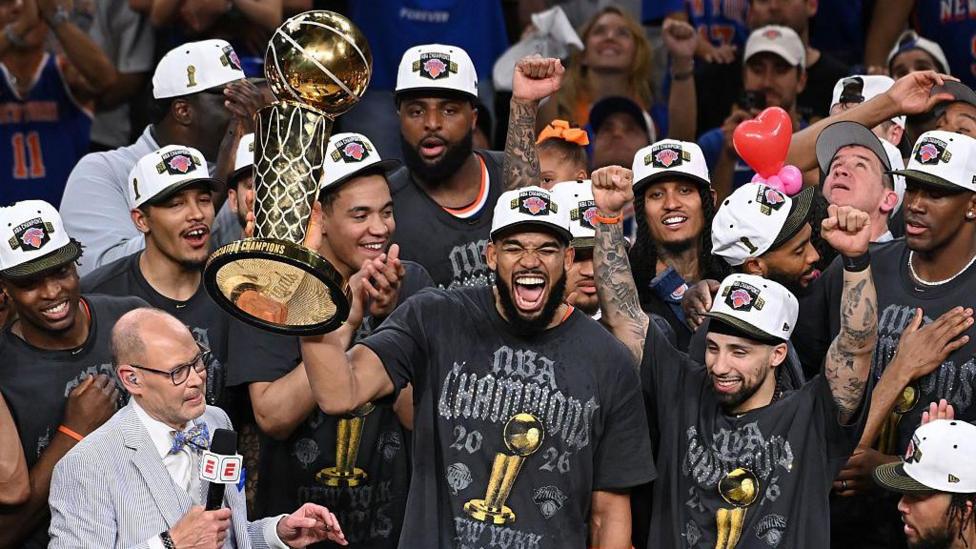
The Wait Is Over: Knicks Conquer 53-Year Championship Drought
After half a century of heartbreak, New York finally has its crown again — and the city will never be the same.