Spain's Secret Weapon Isn't Yamal — It's the System That Sets Him Free
Azpilicueta argues De la Fuente's tactical balance, not Yamal alone, is what makes Spain dangerous this summer.
The System Behind the Star
The narrative around Spain heading into Euro 2024 has been dangerously reductive. Strip away the breathless YouTube compilations and the social media hype cycles, and you are left with a singular public obsession: Lamine Yamal. The 16-year-old Barcelona winger has become a cultural phenomenon before he has even sat his GCSE equivalents, and understandably so. His talent is preternatural.
But former Spain captain Cesar Azpilicueta, a man who has worn the armband through multiple tournament cycles and understands the architecture of winning squads better than most, has issued a timely corrective. In his view, the real story of Luis de la Fuente's Spain is not Yamal's emergence. It is the tactical ecosystem that allows Yamal to thrive while ensuring the team does not collapse when he is contained.
At the heart of Azpilicueta's argument sits Mikel Oyarzabal — a player who rarely trends but who consistently embodies the kind of intelligent, positionally versatile forward play that De la Fuente demands.
De la Fuente's Collectivist Blueprint
To understand why Azpilicueta singles out Oyarzabal, you first need to understand what De la Fuente has built since replacing Luis Enrique after the 2022 World Cup. This is not a team that lives or dies on individual brilliance. It is a possession-based, positionally fluid system where every player is expected to occupy multiple zones across a match.
De la Fuente's preferred 4-3-3 is deceptively simple in its base shape but extraordinarily demanding in its execution. The double pivot — typically featuring Rodri alongside one of Fabian Ruiz or Pedri — is tasked with controlling the tempo and distributing into half-spaces. The wingers, Yamal on the right and Nico Williams on the left, are given licence to drive at defenders but are also expected to track back and maintain the defensive block out of possession.
It is in the centre-forward position where De la Fuente's philosophy becomes most interesting. He has resisted the temptation to simply deploy a traditional number nine and instead favours players who can drop into pockets, link play, and rotate with the attacking midfielders. Oyarzabal is the ideal embodiment of this role.
"Luis has built a squad where every player understands the collective idea. Mikel is the perfect example. He can play across the front line, he presses intelligently, and he always makes the right decision in the final third. That is what wins tournaments, not just individual talent." — Cesar Azpilicueta
Oyarzabal: The Anti-Star Who Drives Everything
Mikel Oyarzabal does not have Yamal's dribbling, nor does he possess Alvaro Morata's aerial presence. What he has is something far more valuable in tournament football: tactical literacy. Under Imanol Alguacil at Real Sociedad, Oyarzabal has spent years operating in a system that demands positional discipline, intelligent pressing triggers, and the ability to find space between the lines.
His numbers across the 2023-24 La Liga season reflect this profile. Oyarzabal registered 8 goals and 5 assists in league play, but the raw output tells only a fraction of the story. His expected assists per 90 minutes ranked among the top tier of La Liga forwards, and his pressing actions in the attacking third were consistently elite for a player nominally stationed as a centre-forward.
Critically, Oyarzabal offers De la Fuente something no other Spanish forward can: positional elasticity. He can drift left to create overloads with Nico Williams, drop into the number 10 space to link with Pedri, or hold the central channel to drag centre-backs apart and open corridors for Yamal's diagonal runs. This interchangability is what makes Spain so difficult to defend against.
Tactical Shift: Why De la Fuente's Depth Changes Everything
The most significant tactical evolution in this Spain squad compared to previous tournaments is the absence of a single point of failure. Under Luis Enrique, Spain were often accused of being too dependent on Pedri's creativity or Busquets' screening. If one player was neutralised, the entire structure suffered.
De la Fuente has addressed this by assembling a squad where every position has a like-for-like tactical replacement. Dani Olmo can step in for Pedri without altering the midfield structure. Oyarzabal can rotate with Morata or Joselu depending on whether the game demands pressing intensity or direct aerial threat. Even in defence, the transition from Robin Le Normand to Aymeric Laporte is seamless because both are comfortable carrying the ball into midfield, a non-negotiable requirement in De la Fuente's build-up.
This depth is not merely about having good players on the bench. It is about maintaining the integrity of the tactical shape regardless of personnel changes. When Yamal is substituted after 65 minutes, the system does not shift. The replacement — whether that is Mikel Oyarzabal wide right or Dani Olmo tucked inside — simply occupies the same zones and executes the same principles.
The Pressing Structure That Scares Europe
Perhaps the most underappreciated aspect of De la Fuente's Spain is the coordinated pressing mechanism. Spain under Luis Enrique pressed high but often in an uncoordinated, individualistic manner. De la Fuente has implemented a more structured counterpressing trigger system where the loss of possession in the attacking third immediately activates a gegenpressing sequence involving the front three and the nearest central midfielder.
Rodri is the lynchpin of this system. His ability to read pressing triggers and intercept opposition transitions before they develop is what allows Spain to maintain their territorial dominance. In qualifying, Spain conceded the fewest goals of any major European nation — a statistic that speaks to the collective defensive discipline as much as the individual quality of defenders like Dani Carvajal and Marc Cucurella.
The pressing numbers are staggering. Across qualifying, Spain averaged 12.4 high turnovers per match, the highest figure in the tournament's qualification cycle. This is not a team that waits for opponents to make mistakes. It is a team that forces mistakes through coordinated, systematic pressure.
What This Means for Euro 2024
Azpilicueta's intervention is not merely a defence of his former teammate. It is a tactical thesis. The former Chelsea captain understands that tournament football punishes one-dimensional teams. France learned this in 2021 when their over-reliance on Kylian Mbappe's pace was neutralised by Switzerland's deep block. England's dependence on Harry Kane as a sole creative hub was exposed repeatedly against better-organised defences.
Spain, on current evidence, do not have this vulnerability. Yamal is the headline act, but he is a headline act operating inside a system that does not require him to be the only act. If opponents double up on Yamal, space opens for Oyarzabal and Nico Williams. If they press Rodri aggressively, Pedri drops deep to receive and the fullbacks push high to stretch the defensive line horizontally.
The Road Ahead
Group B will provide an immediate test. Croatia, Italy, and Albania represent three distinct tactical challenges — Croatia's midfield diamond, Italy's low block under Luciano Spalletti, and Albania's aggressive counter-pressing approach. Each will ask different questions of De la Fuente's system.
The match against Italy looms largest. Spalletti's Italy are a team built on the same positional principles as De la Fuente's Spain, which means the margins will be razor-thin. The tactical duel between Rodri and Jorginho/Nicolo Barella for midfield supremacy could define the group.
But as Azpilicueta rightly identifies, this Spain squad is equipped for those chess matches precisely because it is not built around a single genius. It is built around a collective idea — one where Oyarzabal's quiet intelligence matters as much as Yamal's explosive brilliance.
That balance, more than any individual, is why Spain should be considered among the favourites this summer. The system is the star. Everyone else is a component.
Editorial Integrity
This is an original SportPulse article written by our editorial team. All content is independently researched, written, and reviewed by our writers and editors before publication. We do not publish copied, aggregated, or syndicated content.
SportPulse is committed to original sports journalism. Read our editorial policy or contact us with any questions.
More Like This
All football
Foden locks in City future until 2030 with Maresca era in sight
Phil Foden extends his Manchester City stay, betting on Enzo Maresca to continue the club's winning culture.
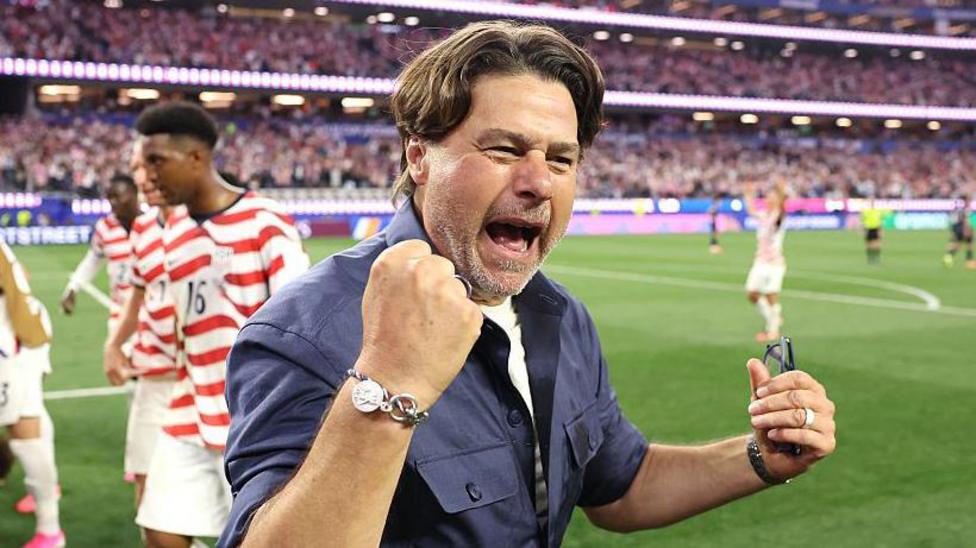
Pochettino Has US Believing World Cup Glory Is Possible
Mauricio Pochettino isn't just managing the USMNT—he's rewiring their psychology to genuinely believe they can lift the 2026 World Cup.
FIFA's Refereeing Reshuffle Is Turning Football Into Calvinball
Hasty law tweaks and barely tested protocols are creating World Cup qualifying chaos, mistaken identities, and officiating anarchy.