Wimbledon Day Four Delivers a Feast of Storylines Across SW19
From Shnaider's grass court redemption arc to Swiatek's relentless march, Day Four packs narrative at every corner.
When Every Court Tells a Story
There is a particular electricity to the fourth day of Wimbledon. The pretenders have been separated from the contenders. First-round nerves have dissolved into second-round conviction. And the draw, still wide enough to dream in, begins to reveal its true architecture. Day Four at the All England Club in 2026 did not disappoint.
The headline acts are always there, lurking on Centre Court and Court One like gravitational forces. Iga Swiatek and Alexander Zverev headline the bill, their names printed largest on every broadcast graphic. But the real texture of a Grand Slam Thursday lives in the outer courts, in the matches that never make primetime but shape the tournament just as decisively.
This year's Day Four delivered exactly that duality. Global superstars commanding the biggest stages while hungry names further down the draw fought for the kind of breakthrough that can redefine a career.
Shnaider's Quiet Revolution on Grass
Perhaps the most fascinating subplot of Thursday's action was Diana Shnaider stepping onto a grass court to face Liudmila Samsonova in an all-Russian affair. On paper, it reads as a routine second-round encounter. In context, it is anything but.
Shnaider arrived at SW19 carrying the emotional residue of a French Open final defeat just weeks ago. That kind of loss can either hollow a player out or harden them into something more dangerous. For a 22-year-old who has risen through the rankings with startling speed, the answer was never going to be simple.
What makes Shnaider's presence on grass so compelling is the surface mismatch. She is, at her core, a player built for clay's grinding rallies and hard court's blunt power. Grass demands different reflexes, different footwork, a willingness to improvise in the half-second after the bounce. That she has found enough form to navigate the early rounds suggests a tactical maturity that belies her age.
Samsonova, meanwhile, is no pushover on this surface. Her flat, driving groundstrokes cut through the low bounce of grass like a knife through paper. The matchup between two Russians with contrasting grass court pedigrees offered a genuine chess match buried in the schedule.
The Outer Courts: Where Wimbledon Breathes
Walk the grounds of the All England Club on a Thursday and you will find the soul of the tournament. Alex de Minaur against Adrian Mannarino on an outer court is the kind of match that rewards the devoted fan who skips the queue for Centre.
De Minaur, the Australian who plays every point as if it might be his last, is built for grass court tennis in a way that his Grand Slam results have not always reflected. His speed, his willingness to take the ball early, his refusal to concede a single inch of baseline real estate. Against Mannarino, a French veteran whose effortless-looking game masks a deeply intelligent tactical brain, the contrast in styles was stark.
Mannarino at 37 years old remains one of the most awkward opponents on grass in professional tennis. His flat backhand, played with almost no backswing, skids through the low bounce and forces opponents to generate their own power. De Minaur's challenge was to impose his own rhythm against a player who excels at disrupting exactly that.
Then there was Arthur Fery, the British hope, taking on Otto Virtanen. The Finnish qualifier who had already stunned Ben Shelton earlier in the tournament carried genuine momentum into this one. For Fery, playing on home soil with a partisan crowd tucked into every crevice of Court 12 or 18, the stakes were personal. British players at Wimbledon carry a weight that no other tournament imposes, and Fery's every forehand was freighted with expectation.
The Heavyweights Hold Court
Away from the outer-court drama, the tournament's marquee names continued their marches. Jannik Sinner, the defending champion, had already dispatched Nuno Borges in a match that tested his resolve more than the scoreboard might suggest. Borges, a Portuguese baseliner with nothing to lose, pushed the Italian into uncomfortable positions before Sinner's class told.
Sinner's title defense carries its own particular pressure. Defending a Wimbledon crown is unlike defending any other Grand Slam. The surface is unforgiving of any dip in focus. The grass rewards the bold and punishes the hesitant, and Sinner's ability to blend his metronomic baseline game with the instinctive net approaches that grass demands will define how far he goes.
Swiatek, meanwhile, continues to evolve on a surface that once seemed hostile to her strengths. The Pole's heavy topspin forehand, devastating on clay, has historically lost some of its venom on grass where the ball stays low and rewards flat hitting. But her 2025 Wimbledon run signaled a turning point, and by 2026 she approaches SW19 with genuine credentials rather than hopeful ambition.
Zverev's presence adds another layer. The German, still pursuing that elusive first Wimbledon title, has the game for grass even if his movement on the surface has sometimes lagged behind his shotmaking. His serve alone, clocking consistently above 130 mph, makes him a threat in every match at a tournament where holding serve is currency.
Career by Numbers: Diana Shnaider
- French Open finalist in 2026, her deepest Grand Slam run to date
- Rose from outside the top 100 to the top 20 in under two seasons
- Left-handed with a serve that generates natural angles most right-handers can only simulate
- Reached her first WTA final at 19 years old
- Known for an aggressive return stance, standing inside the baseline to take time away from servers
What Day Four Reveals About the Draw
The beauty of a Thursday at Wimbledon lies in its diagnostic power. By the time the second round is complete, you can begin to read the draw like a novel. Which seeds have been tested? Which dark horses have genuine momentum? Where are the quarterfinal collisions likely to form?
This year's Day Four suggested a tournament still wide open on both sides. The women's draw, in particular, offers a fascinating convergence of clay-court queens adapting to grass, natural surface players peaking at the right moment, and young disruptors like Shnaider who refuse to follow the expected script.
On the men's side, Sinner's steady progression through the early rounds looks ominous for the rest of the field. But Zverev's power game, de Minaur's relentless energy, and the ever-present threat of a grass-court specialist emerging from the lower ranks mean the champion's path is anything but guaranteed.
The Legacy Question
For every player who steps onto the lawns of SW19, there is an implicit conversation with history. Wimbledon is the tournament that defines legacies more than any other. Champions are remembered differently here. Finals become folklore. And even second-round victories on Court 14, witnessed by a few hundred sunburnt spectators, can become the foundation of a player's identity.
Shnaider's French Open heartbreak is still fresh, but Wimbledon offers something that Roland Garros never could: the chance to prove that her rise is not surface-specific, that she belongs in the conversation regardless of the ground beneath her feet. Every match on grass is an audition for permanence.
Sinner, chasing the rare distinction of back-to-back Wimbledon titles, knows that only a handful of men in the Open Era have achieved it. Each round brings him closer to a club that includes the very greatest names in tennis history.
Day Four at Wimbledon 2026 was not about one match or one moment. It was about the tapestry. The outer-court epics, the marquee showdowns, the careers being built and tested simultaneously across every blade of grass. That is the gift of the second Thursday at the All England Club. The tournament is no longer young. But it is far from finished.
The business end awaits. And based on what Day Four delivered, it is going to be spectacular.
Editorial Integrity
This is an original SportPulse article written by our editorial team. All content is independently researched, written, and reviewed by our writers and editors before publication. We do not publish copied, aggregated, or syndicated content.
SportPulse is committed to original sports journalism. Read our editorial policy or contact us with any questions.
More Like This
All tennis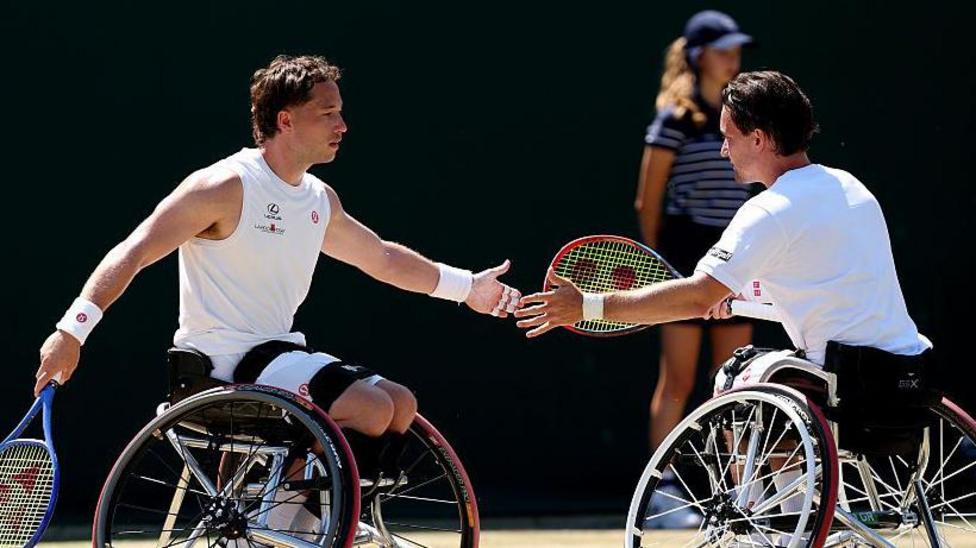
Alfie Hewett's Relentless Pursuit of Wimbledon Glory on Two Fronts
Britain's wheelchair maestro fights through a grueling Thursday double-header to keep his SW19 singles and doubles dreams alive.
The Last Slice: Dan Evans Says Goodbye on His Own Terms
Dan Evans walked off Wimbledon's grass one final time — a career of defiance, talent, and redemption complete.
The Invisible Army: Surviving Tennis' Forgotten Rung
Beyond the Grand Slam spotlight, thousands of tennis pros sleep in vans and split rent just to keep their careers alive.