Osaka's Wimbledon Awakening: Freedom, Fire, and a Mother's Touch
A coaching shake-up and maternal comfort fueled Naomi Osaka's stunning Wimbledon upset over Aryna Sabalenka.
There is a particular kind of silence that falls over Centre Court when the expected order of things collapses. It is not a hostile silence, nor a confused one. It is a reverent hush, the sound of a sporting cathedral recognizing a genuine practitioner of the craft. When Naomi Osaka cracked a final, blistering forehand past the outstretched frame of Aryna Sabalenka to secure a result that sent shockwaves through the Wimbledon draw, the silence that preceded the eruption was a confirmation of a resurrection. The pragmatic, mechanical brute force of tournament tennis had, for one golden afternoon on the lawns of the All England Club, been violently subverted by an artist who had finally remembered how to paint.
The Architecture of a Rebirth
To understand the sheer magnitude of what transpired, one must first appreciate the barren landscape from which Osaka climbed. The narrative surrounding the Japanese superstar over the past two years had been one of palpable struggle. Juggling the transformative demands of motherhood with the uncompromising rigors of a professional tennis tour was always going to be a brutal alchemy. Her return to the sport was met with sporadic bursts of brilliance, frequently interrupted by agonizing defeats, and a deep, visible existential questioning of her own place in the modern game.
Tennis is a sport of singular isolation, and Osaka has always been acutely sensitive to the emotional frequencies of her environment. When the environment turns toxic through pressure or simple shot-making misalignment, she retreats. When it sings with harmony, she becomes an unstoppable force. The defeat of Sabalenka, the current world No. 3 and a player whose entire brand is suffocating opposition, was a testament to a deliberate restructuring of that environment.
It required a surgical shift in her inner circle. The introduction of a new coaching voice into her camp was engineered to dismantle the rigid, outcome-driven tension that had paralyzed her game. The mandate was clear: liberate the mind, and the racquet will follow.
Dismantling the Sabalenka Wall
Aryna Sabalenka does not lose often on grass when she is allowed to dictate. Her game is a relentless symphony of first-strike tennis, built on overwhelming power from the baseline and a serve that, when untracked, resembles a meteorological event. To disrupt that rhythm, an opponent cannot merely match the Belarusian blow for blow. They must strategically pull her out of position, manipulate the angles, and force her to generate pace from awkward, defensive stances.
Osaka executed this tactical masterclass with a fluidity that recalled her very best hard-court tennis from the beginning of the last decade. The metrics told a story of controlled aggression. She won a remarkable 46% of her receiving points against one of the most feared servers in the women's game. More crucially, she constructed 18 break point opportunities across their two contested sets, a staggering volume of pressure that eventually fractured Sabalenka's typically impenetrable resolve.
But it was not merely the volume of her winners, though the 26 she struck off the ground were breathtaking. It was her placement. Osaka dragged Sabalenka wide on the deuce court with glamorous serving targets, neutralizing the threat of the return before neutralizing the threat of the Sabalenka groundstroke. She played tennis on a razor wire, entirely unburdened by the consequence of the fall.
The Secret Ingredient in the Suite
"I just thought, I have nothing to lose, so why am I playing tight?"
Professional athletes spend their careers cloistered in environments designed to eliminate distraction and maintain manic focus. They exist in hotels that look identical from Shanghai to Cincinnati, eating from meticulously calibrated nutritional plans. Yet, for Osaka, the path to rediscovering her elite form did not lead through a sterile laboratory of optimization. It led through the warmth of a kitchen.
The presence of her mother in London provided a grounding tether to reality that no coaching manual could ever replicate. There is an intimate, stabilizing power in a parent's cooking that effectively resets the nervous system. The harsh, quantifiable reality of Grand Slam tennis was softened by the comfort of familial normalcy. It is a profound psychological insight: for a mind as fluid and sensitive as Osaka's, peak performance is unlocked not by tightening the screws, but by loosening them entirely.
She spoke frequently of rediscovering the sheer, unadulterated fun of the sport. The word "fun" is a dangerous concept in the brutally clinical modern game, but for Osaka, it is the essential fuel. When she plays with the joy of a child hitting balls against a neighborhood wall, her devastating baseline game becomes a dangerous instrument of free expression. The tightness that had characterized her previous tournament exits evaporated. In its place was a player swinging with reckless, joyous intent.
The Grass Whisperer
There is a historical irony in Osaka finding her most profound rebirth on the surface that has, historically, been her least compatible. She is a four-time Grand Slam champion built on the hard courts of Melbourne and New York, surfaces that reward her flat, penetrating strike and her uncompromising knee bend. Grass, with its unpredictable bounces and capricious footing, has traditionally mocked her rhythm.
Yet, the lawns of SW19 have a peculiar habit of rewarding those who arrive stripped of expectation and burdened by nothing but desire. The surface demands movement, adaptability, and a willingness to embrace chaos. Osaka, unburdened by the suffocating pressure of being a tournament favorite, moved with a lightness that defied her history on the turf. She was willing to slide, willing to scramble, willing to hit slice backhands when the situation dictated a softening of the pace.
The tactical flexibility instilled by her new coach was evident in her willingness to abandon the baseline when the geometry demanded it. She approached the net a dozen times during the match, winning eight of those exchanges. She refused to be a mere stationary ball machine.
What the Horizon Holds
The implications of this victory extend far beyond a mere third-week progression at the Championships. For Osaka, this triumph represents a psychological bridgehead. Beating a top-three opponent in straight sets at a Grand Slam is the definitive proof that her post-maternity return is not a sentimental farewell tour. It is a legitimate second ascent. The mental barrier separating her from the summit has been structurally breached by the very act of dismantling Sabalenka.
For the rest of the Wimbledon draw, the landscape has violently shifted. The field, already reeling from scattered upsets, must now contend with a multi-Slam champion operating with absolutely zero pressure and an arsenal fully loaded. The WTA's upper echelon has been put on notice. A liberated, loose, and well-fed Naomi Osaka is tennis's most terrifying proposition.
As the tournament progresses deep into the second week, the challenge will be to maintain this exquisite equilibrium. The spotlight will inevitably grow harsher. The opponents will grow steeper. But the memory of this afternoon, the hush of Centre Court, and the fundamental joy of a well-struck ball will serve as her guiding compass. The rebirth is complete. The fun is back.
Editorial Integrity
This is an original SportPulse article written by our editorial team. All content is independently researched, written, and reviewed by our writers and editors before publication. We do not publish copied, aggregated, or syndicated content.
SportPulse is committed to original sports journalism. Read our editorial policy or contact us with any questions.
More Like This
All tennis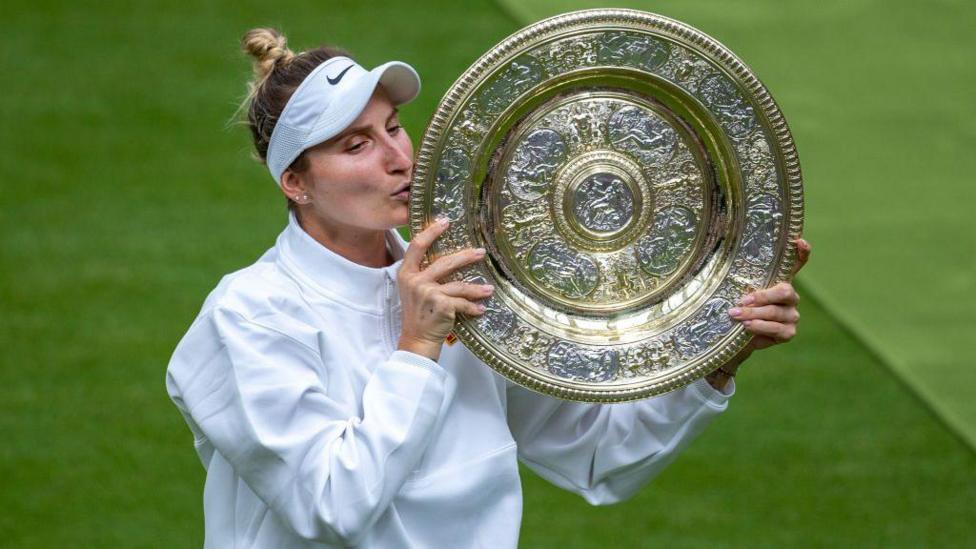
Vondrousova Slapped With Four-Year Ban Over Doping Refusal
Former Wimbledon champion Marketa Vondrousova receives a crushing four-year ban for refusing an anti-doping test.
Raducanu's Wimbledon Dream Shattered by Stress Fracture on Eve of Championships
Britain's brightest tennis hope withdraws from Wimbledon with a leg stress fracture, leaving Centre Court's roar waiting for another year.
The Queen's Blueprint: How Raducanu Rebuilt Her Game for Wimbledon
Emma Raducanu's Queen's final loss revealed a transformed player with a tactical blueprint ready for Wimbledon.